Paper I — Q4
(a) Draw a well-labelled diagram of adrenal gland and discuss the functions of its hormones. (20 marks) (b) Describe the general…
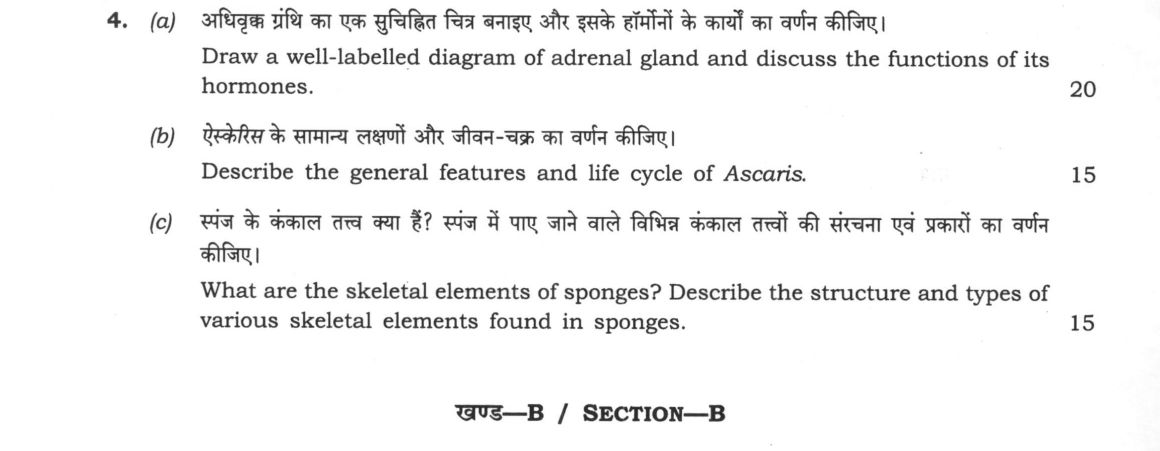
Draw a well-labelled diagram of adrenal gland and discuss the functions of its hormones. 20 marks
Describe the general features and life cycle of Ascaris. 15 marks
What are the skeletal elements of sponges? Describe the structure and types of various skeletal elements found in sponges. 15 marks
हिंदी में प्रश्न पढ़ें
अधिवृक्क ग्रंथि का एक सुचिहित चित्र बनाइए और इसके हार्मोनों के कार्यों का वर्णन कीजिए। (20 अंक)
ऐस्कैरिस के सामान्य लक्षणों और जीवन-चक्र का वर्णन कीजिए। (15 अंक)
स्पंज के कंकाल तत्व क्या हैं? स्पंज में पाए जाने वाले विभिन्न कंकाल तत्वों की संरचना एवं प्रकारों का वर्णन कीजिए। (15 अंक)
Model answer
Written by UPSC Answer Check against this question's marking rubric, to the expected length. UPSC does not publish answers for Mains — this is one way to score well, not an official key.
Structure and Endocrinology of Adrenal Gland
The paired adrenal (suprarenal) glands perched atop the kidneys comprise two distinct embryological and functional entities: the outer mesodermal cortex and the inner ectodermal medulla.
`` [DIAGRAM: Adrenal Gland Histology & Anatomy] Capsule ──> Outer connective tissue covering CORTEX: ├─ Zona Glomerulosa (15%) ──> Secretes Mineralocorticoids (Aldosterone) ├─ Zona Fasciculata (75%) ──> Secretes Glucocorticoids (Cortisol, Corticosterone) └─ Zona Reticularis (10%) ──> Secretes Androgens (DHEA, Androstenedione) MEDULLA (Chromaffin cells) ─> Secretes Catecholamines (Adrenaline 80%, Noradrenaline 20%) Blood Supply ───────────────> Central Adrenal Vein ``
The cortex is regulated by the hypothalamic-pituitary axis via ACTH and the renin-angiotensin-aldosterone system (RAAS). Zona glomerulosa produces aldosterone, which acts on renal distal convoluted tubules and collecting ducts to enhance sodium and water reabsorption and potassium excretion, maintaining blood pressure and electrolyte balance. Zona fasciculata secretes cortisol, which promotes gluconeogenesis, lipolysis, and proteolysis, while suppressing immune responses and inflammation. Zona reticularis produces weak androgens (dehydroepiandrosterone), contributing to secondary sexual characteristics. Dysfunction causes Addison’s disease (hyposecretion leading to hypotension and skin hyperpigmentation) or Cushing’s syndrome (hypercortisolemia characterized by central obesity and hyperglycemia).
The adrenal medulla, an extension of the sympathetic nervous system, possesses chromaffin cells that secrete adrenaline (epinephrine) and noradrenaline (norepinephrine). Acting through alpha and beta-adrenergic receptors, these catecholamines initiate the rapid "fight-or-flight" response by elevating heart rate, glycogenolysis, and blood pressure, shifting blood flow from the viscera to skeletal musculature.
General Features and Life Cycle of Ascaris
Ascaris lumbricoides is an endoparasitic nematode inhabiting the human small intestine. It exhibits marked sexual dimorphism: females are longer (20–40 cm) with a straight tail, while males are shorter (15–30 cm) with a curved posterior end bearing two penial spicules. Morphological adaptations include a thick, syncytial cuticle resistant to host digestive enzymes, a trilabiate mouth for attachment, and a highly specialized anaerobic metabolism.
The life cycle is monogenetic, requiring only the human host. Copulation occurs in the lumen of the small intestine. Gravid females release up to 200,000 unsegmented, mamillated eggs per day with faeces. Under favourable environmental conditions (moisture, warmth), the egg embryonates within two to three weeks, developing into the second-stage rhabditiform larva, which is the infective stage.
Upon ingestion through contaminated water or food, the shell dissolves in the host duodenum, releasing the juvenile larva. It burrows through the intestinal mucosa into mesenteric venules, migrating via the hepatic portal vein to the liver, then through the post-caval vein to the right side of the heart, and finally into the pulmonary capillaries. After penetrating the alveoli, the larva undergoes further moulting, travels up the bronchi and trachea into the pharynx, and is swallowed back into the oesophagus. Reaching the small intestine, it undergoes its final moult to mature into an adult worm. In India, where open defecation and soil contamination historically maintained high ascariasis prevalence, bi-annual albendazole administration under the National Deworming Day program forms a key public health intervention.
Skeletal Elements of Sponges
The skeletal framework of phylum Porifera supports the soft mesohyl, maintains the aquiferous canal system, and prevents collapse. The skeleton consists of mineralized spicules, organic spongin fibres, or a combination of both, secreted by specialized amoebocytes.
Spicules are crystalline structures of calcium carbonate (calcite) or hydrated silica. Calcareous spicules, secreted by calcoblasts, are characteristic of Class Calcarea (Sycon, Leucosolenia). Siliceous spicules, formed by silicoblasts around an organic axial filament, characterize Classes Hexactinellida and Demospongiae. Based on size, they are categorized into larger megascleres (structural framework) and smaller microscleres (scattered in mesohyl).
Morphologically, spicules are classified by the number of axes and rays: Monaxons grow along a single axis and may be straight or curved (e.g., styles, rhabds). Tetraxons possess four rays directed towards four points, typical of Demospongiae. Triaxons (hexactines) have three axes intersecting at right angles to yield six rays, diagnostic of Hexactinellida (Euplectella). Polyaxons comprise multiple rays radiating from a central point, as seen in asters.
Spongin fibres, synthesized by spongocytes, are flexible, branching scleroprotein nets resistant to chemical degradation. Found in Class Demospongiae, they form the entire skeleton in Keratosa, rendering species like the marine Euspongia (bath sponge) commercially valuable. Freshwater sponges like Spongilla, prevalent across Indian river basins, incorporate both siliceous megascleres and gemmule-associated amphidisc microscleres.
Evolutionary Perspective and Synthesis
From an evolutionary standpoint, the skeletal evolution in Porifera represents the earliest multicellular transition from a fluid-mesohyl matrix to an organized endoskeleton, establishing structural blueprints essential for filter-feeding efficiency. Similarly, the monogenetic, migratory life cycle of Ascaris illustrates high physiological specialization to evade host gut defenses, while the mammalian adrenal axis integrates rapid neuroendocrine and sustained steroidogenic mechanisms for homeostatic survival. A multi-pronged approach integrating sanitation infrastructure to disrupt nematode life cycles, coupled with targeted pharmacological management of endocrine dysfunctions, ensures optimal translational outcomes in biomedical and public health domains.
What "Discuss" is asking you to do
Lay the issue out from more than one side — how it arose, what is claimed for it, what is held against it, and where it now stands. UPSC attaches discuss to broad topics with several live dimensions, so coverage of the dimensions earns more than the strength of your opinion.
Structure that answers it
Set the issue up → the case as it is made → the case against → the dimension both sides leave out → where the balance now lies
Where marks are lost
Listing facts with no thread between them, or arguing one side throughout and calling it a discussion.
How this answer will be evaluated
Approach
Framework: UPSC Zoology Paper 1. (a) discuss: intro > 3-4 dimensions > example > balanced close | (b) describe: define > structure or process in order > labelled diagram > significance | (c) describe: define > structure or process in order > labelled diagram > significance Full marks: Precise diagrams, accurate mechanisms, and specific taxonomic details.
Key points expected
- Diagram showing cortex and medulla
- Cortical zones: zona glomerulosa, fasciculata, reticularis
- Hormone functions: mineralocorticoids, glucocorticoids, catecholamines
- Mechanism of action for key hormones
- General features: body shape, dimorphism, organ systems
- Life cycle stages: egg, larva, adult
- Infection route and migration path
- Labelled diagram of life cycle
Evaluation rubric
Each sub-part is marked on its own, against the marks and word limit printed on the paper.
- (a) Labelled diagram of adrenal gland and functional analysis of its hormones. 20 marks
discuss— intro → 3-4 dimensions → example → balanced close
Must cover
- Diagram showing cortex and medulla
- Cortical zones: zona glomerulosa, fasciculata, reticularis
- Hormone functions: mineralocorticoids, glucocorticoids, catecholamines
- Mechanism of action for key hormones
Loses marks
- Diagram without labels
- Confusing cortical and medullary hormones
- Listing hormones without discussing function
Earns more
- Mention of ACTH regulation
- Specific examples like cortisol or adrenaline
- Link to physiological stress response
Extra mark
- Mention of specific clinical conditions (e.g. Addison's)
- (b) General features and life cycle of Ascaris lumbricoides. 15 marks
describe— define → structure or process in order → labelled diagram → significance
Must cover
- General features: body shape, dimorphism, organ systems
- Life cycle stages: egg, larva, adult
- Infection route and migration path
- Labelled diagram of life cycle
Loses marks
- Missing life cycle diagram
- Confusing male and female features
- Omitting the migration phase
Earns more
- Mention of specific host (humans)
- Details on egg development (embryonated)
- Mention of vector or transmission mode
Extra mark
- Mention of conservation or public health impact
- (c) Structure and types of skeletal elements in sponges. 15 marks
describe— define → structure or process in order → labelled diagram → significance
Must cover
- Definition of skeletal elements (spicules and spongin)
- Types of spicules: monaxons, triaxons, tetraxons
- Structure of spongin fibres
- Function of skeletal elements in support
Loses marks
- Confusing spicules with spongin
- Omitting types of spicules
- No mention of structure
Earns more
- Mention of specific sponge classes (e.g. Demospongiae)
- Details on spicule composition (silica/calcium carbonate)
- Link to sponge architecture (e.g. leucon type)
Extra mark
- Mention of specific sponge species
Practice this exact question
Write your answer and it is marked point by point against the model answer above — what you covered, what you missed, what you got wrong.
Evaluate my answer →More from Zoology 2023 Paper I
- Q1 Write short notes on the following in about 150 words each: (a) Erythrocytic schizogony (…
- Q2 (a) Define conjugation. Explain the mechanism of conjugation in Paramecium. Also give its…
- Q3 (a) Explain the general features, life cycle and pathogenicity of Taenia. (20 marks) (b)…
- Q4 (a) Draw a well-labelled diagram of adrenal gland and discuss the functions of its hormon…
- Q5 Write short notes on the following in about 150 words each: (a) Ecological niche (10 mark…
- Q6 (a) Define regression. Explain different methods and applications of regression analysis.…
- Q7 (a) What is lac culture? Explain the life cycle of lac insect and describe cultivation an…