Paper I — Q3
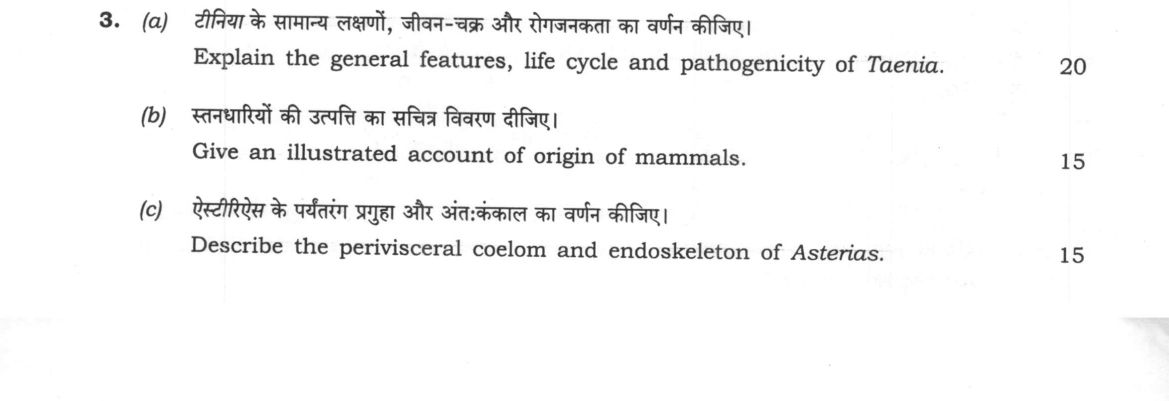
(a) Explain the general features, life cycle and pathogenicity of Taenia. (20 marks) (b) Give an illustrated account of origin of…
Explain the general features, life cycle and pathogenicity of Taenia. 20 marks
Give an illustrated account of origin of mammals. 15 marks
Describe the perivisceral coelom and endoskeleton of Asterias. 15 marks
हिंदी में प्रश्न पढ़ें
टीनिया के सामान्य लक्षणों, जीवन-चक्र और रोगजनकता का वर्णन कीजिए। (20 अंक)
स्तनधारियों की उत्पत्ति का सचित्र विवरण दीजिए। (15 अंक)
ऐस्टीरिएस के परिवर्तं प्रगुहा और अंतःकंकाल का वर्णन कीजिए। (15 अंक)
Model answer
Written by UPSC Answer Check against this question's marking rubric, to the expected length. UPSC does not publish answers for Mains — this is one way to score well, not an official key.
Taenia Taenia is an acoelomate tapeworm (Cestoda) whose adaptations are for intestinal parasitism. The adult is a flat, segmented hermaphrodite with a scolex bearing four suckers; in T. solium the scolex also has a retractile rostellum armed with scleroprotein hooks, whereas T. saginata is unarmed. The strobila contains immature, mature and gravid proglottids; mature segments carry male and female genitalia, and gravid segments are filled with eggs. Pathogenesis follows the life cycle, which shows an alternation of generations: the adult lives in the human definitive host, while the larval cysticercus lives in the intermediate host. Humans acquire taeniasis by eating undercooked pork containing Cysticercus cellulosae (T. solium) or beef containing Cysticercus bovis (T. saginata). The cysticercus evaginates, attaches by the scolex, and matures into an adult that releases eggs in faeces. In the intermediate host—pig for T. solium, cattle for *T. saginata*—ingested eggs hatch, oncospheres penetrate the gut wall, and develop in muscles as cysticerci. Taeniasis is usually mild, causing abdominal discomfort, weight loss and eosinophilia, because the adult occupies the lumen. The serious disease is cysticercosis, caused only by ingestion of T. solium eggs, not T. saginata eggs; oncospheres may lodge in brain, eye or muscle, and neurocysticercosis is a major cause of acquired epilepsy in India, where pig rearing, sanitation and meat handling create transmission risk.
Origin of mammals Mammals arose from the synapsid lineage, not from reptiles in a broad sense. In the Permian, early synapsids such as pelycosaurs had a single temporal fenestra and a primitive jaw joint. During the Permian–Triassic, therapsids evolved more mammal-like dentition, a diaphragmatic breathing pattern and increased brain size. In the Triassic, cynodonts developed a secondary palate, a dentary–squamosal jaw articulation, differentiated teeth, hair follicles and mammary glands, leading to mammaliaformes and true mammals. The dentary–squamosal joint allowed stronger chewing, while the abandoned articular–quadrate elements became the malleus and incus of the mammalian middle ear. The secondary palate separated air and food passages, supporting endothermy and active foraging. Gondwanan Permian–Triassic synapsid faunas from India provide fossil evidence for this transition, showing progressive changes in jaw, tooth and skull elements. This evolutionary history is relevant to conservation genetics because understanding synapsid–mammal transitions clarifies the deep phylogenetic structure used to infer relatedness and genetic diversity in modern mammals.
Asterias In Asterias, the perivisceral coelom is the true body cavity surrounding the viscera. It is enterocoelous in origin, formed from mesodermal pouches that pinched off from the archenteron during development. It is not anatomically continuous with the water vascular system; the latter is a separate coelomic derivative that opens to the sea through the madreporite. The coelomic fluid cushions organs and participates in respiration, excretion and circulation. The endoskeleton is made of calcareous ossicles embedded in the dermis, arranged in regular patterns on the aboral and oral surfaces. Pedicellariae are small pincer-like ossicular structures that clean the body and deter small organisms. In the ambulacral groove, ossicles and tube feet are organized for feeding and locomotion: tube feet extend by hydraulic pressure from the water vascular system, adhere to substrates, and pull the arms forward, while the groove collects food particles and directs them to the mouth. This integration of coelom, water vascular system and ossicles makes Asterias a free-living echinoderm with a distinct hydraulic endoskeleton, whose regenerative ability, especially arm regeneration, is studied for regenerative medicine.
Conclusion Across Platyhelminthes, Chordata and Echinodermata, these examples show both convergent and divergent strategies. Coeloms are modified for parasitism, endothermy or hydraulics, while body-cavity organization reflects free-living versus parasitic life. The common thread is evolutionary modification of ancestral body plans, with applied consequences for public health, conservation genetics and regenerative medicine.
What "Explain" is asking you to do
Make the working of something clear — what sets it off, what follows from what, and what it produces. Explain is the Commission's mechanism word: it dominates the technical papers and the “explain why” stems, where the marks sit in the causal chain and not in the label.
Structure that answers it
State what it is → the initiating condition → the chain of cause, step by step → an instance where it plays out → what the chain produces
Where marks are lost
Describing what something looks like instead of why it works that way. Naming the stages without linking them reads as description too.
How this answer will be evaluated
Approach
Framework: Zoology Paper 1: Define > Structure or mechanism > Diagram > Example taxon. (a) explain: definition/context > points in order > small example > short close | (b) discuss: intro > 3-4 dimensions > example > balanced close | (c) discuss: intro > 3-4 dimensions > example > balanced close Full marks: Precise taxon names, labelled diagrams, mechanisms explained, balanced view
Key points expected
- Taenia life cycle with intermediate and definitive hosts
- Mammalian origin with key evolutionary steps
- Asterias perivisceral coelom structure
- Asterias endoskeleton composition and function
- Labelled diagrams for all parts
- Named species and taxa
Evaluation rubric
Each sub-part is marked on its own, against the marks and word limit printed on the paper.
- (a) General features, life cycle, and pathogenicity of Taenia. 20 marks
explain— definition/context → points in order → small example → short close
Must cover
- General features of Taenia
- Life cycle of Taenia
- Pathogenicity of Taenia
- Labelled life cycle diagram
Loses marks
- Common names alone
- Diagrams without labels
- Listing without depth
Earns more
- Named species (e.g., T. saginata)
- Intermediate host details
- Definitive host details
- Specific pathogenic mechanisms
Extra mark
- Recent conservation status
- Vector or transmission details
- (b) Illustrated account of origin of mammals. 15 marks
discuss— intro → 3-4 dimensions → example → balanced close
Must cover
- Origin of mammals
- Illustrated account
- Key evolutionary steps
- Named taxa involved
Loses marks
- Common names alone
- Diagrams without labels
- One-sided argument
Earns more
- Specific fossil evidence
- Timeline of evolution
- Key anatomical changes
- Balanced view of theories
Extra mark
- Recent fossil discoveries
- Specific named committee or study
- (c) Perivisceral coelom and endoskeleton of Asterias. 15 marks
discuss— intro → 3-4 dimensions → example → balanced close
Must cover
- Perivisceral coelom of Asterias
- Endoskeleton of Asterias
- Structural details
- Functional significance
Loses marks
- Common names alone
- Diagrams without labels
- Listing without depth
Earns more
- Labelled diagrams
- Specific anatomical terms
- Comparison with other echinoderms
- Mechanism of function
Extra mark
- Recent research findings
- Specific named study or author
Practice this exact question
Write your answer and it is marked point by point against the model answer above — what you covered, what you missed, what you got wrong.
Evaluate my answer →More from Zoology 2023 Paper I
- Q1 Write short notes on the following in about 150 words each: (a) Erythrocytic schizogony (…
- Q2 (a) Define conjugation. Explain the mechanism of conjugation in Paramecium. Also give its…
- Q3 (a) Explain the general features, life cycle and pathogenicity of Taenia. (20 marks) (b)…
- Q4 (a) Draw a well-labelled diagram of adrenal gland and discuss the functions of its hormon…
- Q5 Write short notes on the following in about 150 words each: (a) Ecological niche (10 mark…
- Q6 (a) Define regression. Explain different methods and applications of regression analysis.…