Paper I — Q2
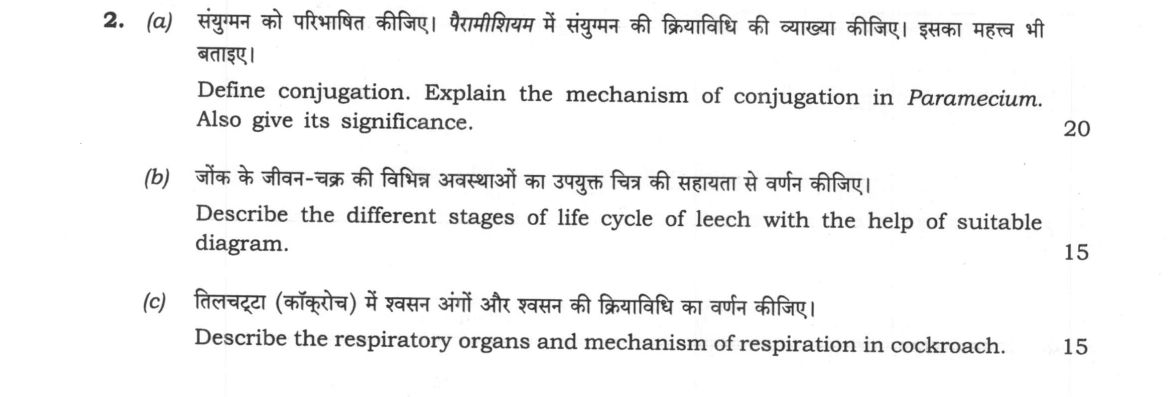
(a) Define conjugation. Explain the mechanism of conjugation in Paramecium. Also give its significance. (20 marks) (b) Describe…
Define conjugation. Explain the mechanism of conjugation in Paramecium. Also give its significance. 20 marks
Describe the different stages of life cycle of leech with the help of suitable diagram. 15 marks
Describe the respiratory organs and mechanism of respiration in cockroach. 15 marks
हिंदी में प्रश्न पढ़ें
संयुग्मन को परिभाषित कीजिए। पैरामीशियम में संयुग्मन की क्रियाविधि की व्याख्या कीजिए। इसका महत्व भी बताइए। (20 अंक)
जोंक के जीवन-चक्र की विभिन्न अवस्थाओं का उपयुक्त चित्र की सहायता से वर्णन कीजिए। (15 अंक)
तिलचट्टा (कॉक्रोच) में श्वसन अंगों और श्वसन की क्रियाविधि का वर्णन कीजिए। (15 अंक)
Model answer
Written by UPSC Answer Check against this question's marking rubric, to the expected length. UPSC does not publish answers for Mains — this is one way to score well, not an official key.
Conjugation in Paramecium. In lower invertebrates, asexual division is supplemented by sexual processes that restore nuclear balance. Conjugation is the temporary union of two Paramecia of opposite mating types with reciprocal exchange of nuclear material; unlike autogamy, where pronuclei fuse within one cell, and unlike endomixis, where the macronucleus undergoes reduction without another cell, conjugation involves two individuals and produces genetic mixing. The cells meet at the paroral cone/oral groove, form a cytoplasmic bridge, and the micronucleus enters meiotic prophase, metaphase and anaphase. Three of the four haploid products degenerate; the remaining one divides mitotically to give a stationary and a migratory pronucleus. The migratory pronucleus passes through the bridge and fuses with the partner’s stationary pronucleus, forming a diploid synkaryon. The old macronucleus degenerates. The synkaryon undergoes three mitotic divisions to produce eight nuclei; four become macronuclei and four become micronuclei. Each exconjugant then divides twice transversely, giving four daughter Paramecia, each with one macronucleus and one micronucleus. Conjugation’s significance is genetic recombination and the origin of new hereditary combinations, giving survival value beyond binary fission, which only produces genetically identical clones. It restores the normal nuclear relationship after repeated fissions. It has been associated with rejuvenation, but Woodruff’s long-term cultures showed that Paramecium can be maintained by periodic endomixis without conjugation; hence rejuvenation is not an exclusive consequence of conjugation.
Life cycle of leech. Hirudinaria, the Indian cattle leech, has direct development without a free larval stage. Adults are hermaphrodites but cross-fertilization occurs; internal fertilization follows sperm transfer. In the diagram, two aligned leeches show genital pores, spermatophore deposition and hypodermic impregnation: sperm is placed in the partner’s hypodermis and migrates to the oviducts. Breeding is seasonal, usually in warm, wet months when hosts are available; the pattern is linked to water temperature and host availability. The female secretes a silk cocoon, a protective tube attached to a stone or plant, often in water or on emergent vegetation; eggs with albumen are laid inside. The embryo develops directly into a young leech, which emerges from the cocoon, resembles the adult, feeds on blood, and grows by moulting to maturity. The young leech passes through several juvenile stages, increasing in size, segmental differentiation and feeding capacity. The diagram should also show the cocoon wall, developing embryo, and the emerging juvenile.
Respiration in cockroach. In Periplaneta americana, respiration is through a tracheal system. Ten pairs of spiracles—two thoracic and eight abdominal—open to the outside and are controlled by valves that can be closed by sphincter muscles. They lead to tracheae, which branch into tracheoles; the fluid-filled, non-chitinous tracheoles bring gases close to cells, where cellular respiration occurs. Air sacs, especially in the thorax and abdomen, store air and assist ventilation. In small insects or at rest gas exchange may be passive, but in cockroach active ventilation uses abdominal pumping, thoracic pumping and the valve mechanism of spiracles; air sacs help meet the high oxygen demand of flight. To prevent desiccation, cockroaches often show discontinuous gas exchange: spiracles close, open briefly to fill the tracheal system, then close again, limiting water loss. This differs from aquatic arthropods, which use gills, book gills or tracheal gills and exchange gases across moist surfaces in water; the tracheal system shortens the diffusion path by delivering air directly to tissues.
Thus, conjugation, leech development and cockroach respiration show a trend from simple nuclear exchange and direct development to specialized structures that improve genetic recombination and efficient aerial gas exchange. These examples illustrate how lower invertebrates combine simple asexual reproduction and diffusion with specialized nuclear and respiratory adaptations as body size and activity increase.
What "Describe" is asking you to do
Give a full, ordered account of the thing named — its parts, stages or mechanism — in the sequence in which it actually exists or occurs. Most describe questions come from the science optionals, where the marks sit in correct technical detail and, where the stem says so, a labelled diagram.
Structure that answers it
One-line identification of the subject → the parts or stages in their real order, each with its defining detail → labelled diagram where the subject is structural → closing line on function or significance
Where marks are lost
Loose general prose where the examiner is ticking named parts, correct terminology and their sequence; and in the General Studies papers, turning to evaluation before the description is finished.
How this answer will be evaluated
Approach
Framework: Zoology Paper 1: Define > Structure/Mechanism > Diagram > Example. (a) explain: definition/context > points in order > small example > short close | (b) describe: define > structure or process in order > labelled diagram > significance | (c) describe: define > structure or process in order > labelled diagram > significance Full marks: Precise definitions, stepwise mechanisms, labelled diagrams, and specific taxonomic examples.
Key points expected
- Precise definition of conjugation as sexual process
- Mechanism: Meiosis, micronucleus division, exchange of gametes
- Mechanism: Syngamy and karyokinesis (restoration of nuclei)
- Significance: Genetic recombination and variation
- Egg stage (ootheca/egg case) and hatching
- Larval stage (crawlers) and metamorphosis
- Juvenile stage and development of suckers
- Adult stage and reproductive cycle (oviposition)
Evaluation rubric
Each sub-part is marked on its own, against the marks and word limit printed on the paper.
- (a) Definition of conjugation, stepwise mechanism in Paramecium, and its biological significance. 20 marks
explain— definition/context → points in order → small example → short close
Must cover
- Precise definition of conjugation as sexual process
- Mechanism: Meiosis, micronucleus division, exchange of gametes
- Mechanism: Syngamy and karyokinesis (restoration of nuclei)
- Significance: Genetic recombination and variation
Loses marks
- Confusing conjugation with binary fission
- Omitting the exchange of micronuclear material
- Vague description of 'genetic mixing' without mechanism
Earns more
- Mention of specific species (e.g., P. caudatum)
- Distinction between macronucleus and micronucleus roles
- Mention of 'conjugation bridge' or cytophasmic connection
Extra mark
- Labelled diagram of the conjugation stages
- Mention of 'conjugants' vs 'exconjugants'
- (b) Sequential stages of the leech life cycle supported by a suitable diagram. 15 marks
describe— define → structure or process in order → labelled diagram → significance
Must cover
- Egg stage (ootheca/egg case) and hatching
- Larval stage (crawlers) and metamorphosis
- Juvenile stage and development of suckers
- Adult stage and reproductive cycle (oviposition)
Loses marks
- Omitting the larval stage entirely
- Diagram without labels or sequence
- Confusing leech life cycle with other annelids
Earns more
- Mention of specific leech species (e.g., Hirudo medicinalis)
- Description of the ootheca structure
- Mention of the 'crawlers' or 'swimmers' larval types
Extra mark
- Labelled diagram of the life cycle
- Mention of the 'hooked' larval stage
- (c) Description of cockroach respiratory organs and the mechanism of gas exchange. 15 marks
describe— define → structure or process in order → labelled diagram → significance
Must cover
- Identification of spiracles (number and location)
- Structure of tracheal system (tracheae and tracheoles)
- Mechanism of ventilation (abdominal pumping)
- Role of tracheoles in direct gas exchange
Loses marks
- Confusing tracheae with blood vessels
- Omitting the role of spiracles in gas entry
- Vague description of 'breathing' without mechanism
Earns more
- Mention of 'tracheal fluid' or 'tracheal blood'
- Description of the 'tracheal gill' in aquatic nymphs
- Mention of the 'tracheal air sacs'
Extra mark
- Labelled diagram of the tracheal system
- Mention of the 'tracheal ring' or 'tracheal valve'
Practice this exact question
Write your answer and it is marked point by point against the model answer above — what you covered, what you missed, what you got wrong.
Evaluate my answer →More from Zoology 2023 Paper I
- Q1 Write short notes on the following in about 150 words each: (a) Erythrocytic schizogony (…
- Q2 (a) Define conjugation. Explain the mechanism of conjugation in Paramecium. Also give its…
- Q3 (a) Explain the general features, life cycle and pathogenicity of Taenia. (20 marks) (b)…
- Q4 (a) Draw a well-labelled diagram of adrenal gland and discuss the functions of its hormon…
- Q5 Write short notes on the following in about 150 words each: (a) Ecological niche (10 mark…