Paper II — Q1
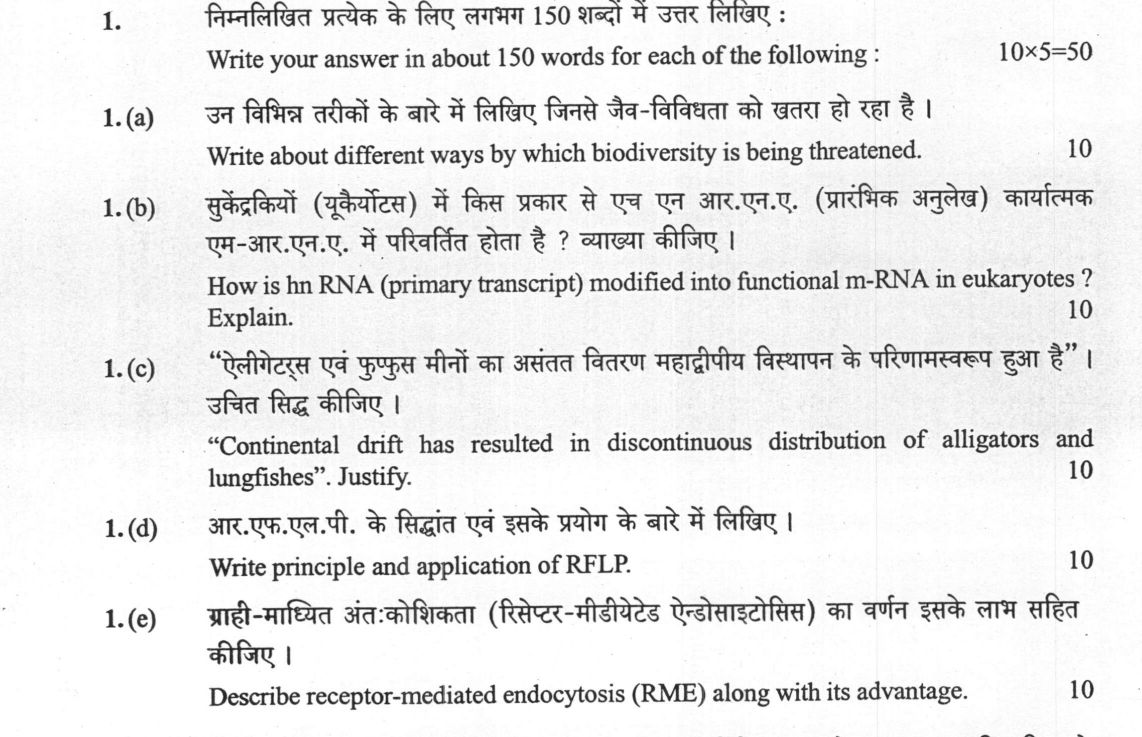
Write your answer in about 150 words for each of the following: (a) Write about different ways by which biodiversity is being…
Write your answer in about 150 words for each of the following: Write about different ways by which biodiversity is being threatened. 10 marks
How is hn RNA (primary transcript) modified into functional m-RNA in eukaryotes? Explain. 10 marks
"Continental drift has resulted in discontinuous distribution of alligators and lungfishes". Justify. 10 marks
Write principle and application of RFLP. 10 marks
Describe receptor-mediated endocytosis (RME) along with its advantage. 10 marks
हिंदी में प्रश्न पढ़ें
निम्नलिखित प्रत्येक के लिए लगभग 150 शब्दों में उत्तर लिखिए: उन विभिन्न तरीकों के बारे में लिखिए जिनसे जैव-विविधता को खतरा हो रहा है। (10 अंक)
सूकेंद्रिकियों (यूकेरियोट्स) में किस प्रकार से एच एन आर.एन.ए. (प्रारंभिक अनुलेख) कार्यात्मक एम-आर.एन.ए. में परिवर्तित होता है? व्याख्या कीजिए। (10 अंक)
"ऐलिगेटर्स एवं फुफुस मीनों का असंतत वितरण महाद्वीपीय विस्थापन के परिणामस्वरूप हुआ है"। उचित सिद्ध कीजिए। (10 अंक)
आर.एफ.एल.पी. के सिद्धांत एवं इसके प्रयोग के बारे में लिखिए। (10 अंक)
ग्राही-माध्यित अंतःकोशिकता (रिसेप्टर-मीडिएटेड एंडोसाइटोसिस) का वर्णन इसके लाभ सहित कीजिए। (10 अंक)
Model answer
Written by UPSC Answer Check against this question's marking rubric, to the 150-word length. UPSC does not publish answers for Mains — this is one way to score well, not an official key.
(a) Threats to biodiversity Biodiversity is threatened when the processes that maintain species, genetic and ecosystem diversity are disrupted. Habitat destruction is the dominant cause: deforestation, wetland drainage, urbanisation and agricultural conversion fragment populations, reduce carrying capacity and increase extinction risk. Invasive species such as Lantana camara and Parthenium hysterophorus outcompete natives, alter fire regimes and pollination networks, and can drive endemic species into IUCN Red List categories such as Vulnerable, Endangered or Critically Endangered. Pollution adds further pressure; eutrophication depletes oxygen in water bodies, while persistent toxins cause biomagnification through food chains, affecting predators. Population overgrowth intensifies all these impacts by increasing demand for land, water and energy. Overexploitation, including overfishing, illegal wildlife trade and poaching, removes individuals faster than populations can replace them, as seen in tigers, rhinoceroses and many marine fish stocks. These five pressures are often summarised as H-I-P-P-O, and they interact cumulatively.
(b) hnRNA processing In eukaryotes, hnRNA is not immediately functional; it must be processed in the nucleus to become stable, exportable and translatable mRNA. First, a 5′ methylguanosine cap is added to the 5′ end, protecting the transcript from exonucleases, helping ribosome recognition and assisting nuclear export. Next, the 3′ end is cleaved and a poly-A tail is added by poly-A polymerase, increasing stability and aiding translation. The central step is splicing: introns are removed and exons joined by the spliceosome, a complex assembled from snRNPs (U1, U2, U4, U5 and U6) and proteins. The spliceosome recognises conserved GU at the 5′ splice site and AG at the 3′ splice site, following the GU-AG rule, and catalyses two transesterification reactions. Alternative splicing, in which different exons are included or excluded, allows one gene to produce multiple mRNAs and proteins, increasing functional diversity without increasing gene number. The mature mRNA is then exported to the cytoplasm for translation.
(c) Continental drift The statement is justified by vicariance biogeography. When Gondwanaland fragmented, roughly between 180 and 30 million years ago, populations of organisms that were once continuous were separated by newly formed oceans and land barriers. Alligatorids illustrate this: Alligator mississippiensis in North America and Alligator sinensis in China occupy disjunct regions, yet their similarity and fossil record indicate a common ancestral distribution before continental separation. Similarly, lungfishes are relictual and disjunct: Protopterus in Africa, Lepidosiren in South America and Neoceratodus in Australia occur on former Gondwanan landmasses. Their limited dispersal ability and ancient lineage make long-distance oceanic dispersal unlikely. Thus, the present distribution is better explained by continental drift and subsequent isolation than by active dispersal. The pattern supports vicariance, where geographic barriers split ancestral ranges, leading to endemic lineages on different continents. This explains why related but non-contiguous species are found on separated continents, and why their distributions mirror former continental connections rather than current dispersal routes.
(d) RFLP RFLP analysis is based on natural variation in restriction fragment lengths. DNA is digested with restriction endonucleases that cut at specific recognition sequences. If a point mutation, insertion or deletion creates or destroys a restriction site, the resulting fragment lengths differ between individuals. These polymorphic fragments are separated by gel electrophoresis, transferred to a membrane by Southern blotting, and detected with a labelled probe complementary to a known DNA sequence. Because fragment patterns are inherited, RFLP can be used for DNA fingerprinting, as developed by Alec Jeffreys, for paternity testing, genetic mapping, and disease diagnosis, such as sickle-cell anaemia and Huntington’s disease. In forensic science, RFLP was historically important, but modern profiling, including in the Nirbhaya case, uses STR analysis rather than RFLP. Thus, RFLP remains a foundational molecular tool for identifying genetic variation and linking DNA to specific loci.
(e) Receptor-mediated endocytosis Receptor-mediated endocytosis is a selective uptake mechanism in which extracellular ligands bind specific cell-surface receptors. In the LDL pathway, apolipoprotein B-containing LDL particles bind LDL receptors, causing receptor clustering in clathrin-coated pits. Dynamin then pinches off the coated vesicle, which uncoats and fuses with an early endosome. In the acidic endosome, LDL dissociates from the receptor; the receptor is recycled to the plasma membrane, while LDL is delivered to lysosomes for cholesterol release. Similar pathways operate for transferrin and insulin. The advantages are high specificity, efficient concentration of ligands against a concentration gradient, protection of selected ligands and receptors from unnecessary lysosomal degradation, and maintenance of cellular cholesterol homeostasis. This controlled recycling also prevents wasteful loss of receptors and allows cells to regulate uptake according to metabolic need. Defects in LDL receptor function can cause familial hypercholesterolaemia, showing the physiological importance of RME.
What "Explain" is asking you to do
Make the working of something clear — what sets it off, what follows from what, and what it produces. Explain is the Commission's mechanism word: it dominates the technical papers and the “explain why” stems, where the marks sit in the causal chain and not in the label.
Structure that answers it
State what it is → the initiating condition → the chain of cause, step by step → an instance where it plays out → what the chain produces
Where marks are lost
Describing what something looks like instead of why it works that way. Naming the stages without linking them reads as description too.
How this answer will be evaluated
Approach
Framework: Zoology Paper 2: Define > Structure/Mechanism > Diagram > Example. (a) write short notes: define > 3-4 key features > one example > one-line significance | (b) explain: definition/context > points in order > small example > short close | (c) justify: claim > 3-4 reasons > evidence > conclusion | (d) write short notes: define > 3-4 key features > one example > one-line significance | (e) describe: define > structure or process in order > labelled diagram > significance Full marks: Precise mechanism, named species, labelled diagrams, conservation links.
Key points expected
- Habitat loss/fragmentation
- Over-exploitation of resources
- Invasive alien species
- Pollution or climate change
- 5' Capping (m7G)
- 3' Polyadenylation
- Splicing (intron removal)
- Mechanism of exon ligation
Evaluation rubric
Each sub-part is marked on its own, against the marks and word limit printed on the paper.
- (a) List and explain 4-5 distinct threats to biodiversity. 10 marks · 150 words
write short notes— define → 3-4 key features → one example → one-line significance
Must cover
- Habitat loss/fragmentation
- Over-exploitation of resources
- Invasive alien species
- Pollution or climate change
Loses marks
- Common names without scientific names
- Vague generalities without mechanism
Earns more
- Mention of specific conservation status
- Link to fisheries or vectors
Extra mark
- Named species example
- Recent conservation data
- (b) Sequence of hnRNA processing steps into functional mRNA. 10 marks · 150 words
explain— definition/context → points in order → small example → short close
Must cover
- 5' Capping (m7G)
- 3' Polyadenylation
- Splicing (intron removal)
- Mechanism of exon ligation
Loses marks
- Omitting capping or poly-A
- Confusing prokaryotic/eukaryotic processes
Earns more
- Mention of snRNPs
- Alternative splicing
Extra mark
- Labelled diagram of splicing
- Specific enzyme names
- (c) Evidence linking continental drift to alligator/lungfish distribution. 10 marks · 150 words
justify— claim → 3-4 reasons → evidence → conclusion
Must cover
- Gondwana supercontinent reference
- Alligator distribution (India/Africa/Americas)
- Lungfish distribution (Australia/Africa/S. America)
- Biogeographical reasoning
Loses marks
- No mention of Gondwana
- Vague 'drift' without mechanism
Earns more
- Mention of specific species
- Fossil evidence
Extra mark
- Map of Gondwana
- Specific geological era
- (d) Principle of RFLP and its specific applications. 10 marks · 150 words
write short notes— define → 3-4 key features → one example → one-line significance
Must cover
- Restriction enzyme digestion
- Gel electrophoresis separation
- Southern blotting
- Application in DNA fingerprinting
Loses marks
- Confusing RFLP with PCR
- No mention of electrophoresis
Earns more
- Mention of VNTRs
- Forensic application
Extra mark
- Labelled gel diagram
- Specific probe example
- (e) Process of RME and its specific advantage. 10 marks · 150 words
describe— define → structure or process in order → labelled diagram → significance
Must cover
- Ligand-receptor binding
- Clathrin-coated pit formation
- Endosome/lysosome fusion
- Advantage: specificity/concentration
Loses marks
- Confusing with phagocytosis
- No mention of clathrin
Earns more
- LDL uptake example
- Iron transport example
Extra mark
- Labelled diagram of vesicle
- Specific receptor name
Practice this exact question
Write your answer and it is marked point by point against the model answer above — what you covered, what you missed, what you got wrong.
Evaluate my answer →More from Zoology 2023 Paper II
- Q1 Write your answer in about 150 words for each of the following: (a) Write about different…
- Q2 (a) Give structure of t-RNA. Write role of different RNAs in the translation process. (20…
- Q3 (a) Describe the structure of mitochondrion. Why is it known as powerhouse of the cell? (…
- Q4 (a) Explain the following: (10×2=20 marks) (i) Haemophilia (ii) Red-green colour blindnes…