Paper II — Q2
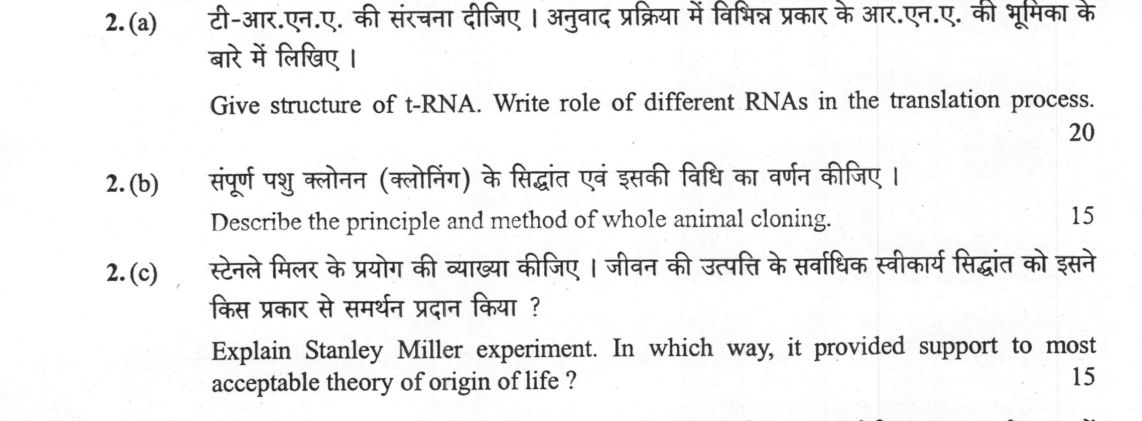
(a) Give structure of t-RNA. Write role of different RNAs in the translation process. (20 marks) (b) Describe the principle and…
Give structure of t-RNA. Write role of different RNAs in the translation process. 20 marks
Describe the principle and method of whole animal cloning. 15 marks
Explain Stanley Miller experiment. In which way, it provided support to most acceptable theory of origin of life? 15 marks
हिंदी में प्रश्न पढ़ें
टी-आर.एन.ए. की संरचना दीजिए। अनुवाद प्रक्रिया में विभिन्न प्रकार के आर.एन.ए. की भूमिका के बारे में लिखिए। (20 अंक)
संपूर्ण पशु क्लोनन (क्लोनिंग) के सिद्धांत एवं इसकी विधि का वर्णन कीजिए। (15 अंक)
स्टैनले मिलर के प्रयोग की व्याख्या कीजिए। जीवन की उत्पत्ति के सर्वाधिक स्वीकार्य सिद्धांत को इसने किस प्रकार से समर्थन प्रदान किया? (15 अंक)
Model answer
Written by UPSC Answer Check against this question's marking rubric, to the expected length. UPSC does not publish answers for Mains — this is one way to score well, not an official key.
Part (a): t-RNA and translation RNAs t-RNA is a small RNA (~70–90 nt) whose secondary structure is a cloverleaf formed by intramolecular base pairing. It has an acceptor stem ending in an unpaired 3′-CCA terminus, to which the amino acid is esterified at the 3′-OH of the terminal adenosine. The DHU loop contains dihydrouridine residues; the TΨC loop contains thymidine and pseudouridine; the anticodon loop carries the three-base anticodon and is flanked by a conserved uridine on the 5′ side and a hypermodified purine on the 3′ side. A variable loop completes the cloverleaf. In solution it folds into an L-shaped tertiary structure, in which the D and TΨC stems stack, and modified bases and hydrogen bonds position the amino-acid end and anticodon at opposite ends.
In translation, mRNA is the template: its 5′ cap and 3′ poly-A tail (eukaryotes) or Shine-Dalgarno sequence (prokaryotes) help ribosome positioning, while codons specify amino acids. t-RNA is the adaptor: aminoacyl-tRNA synthetases charge it with the cognate amino acid, and its anticodon pairs with the mRNA codon in the ribosome A site. r-RNA is structural and catalytic: 16S/18S rRNA in the small subunit helps mRNA binding and decoding, while 23S/28S and 5S rRNA in the large subunit form the peptidyl-transferase centre. In prokaryotes 16S rRNA pairs with the Shine-Dalgarno sequence; in eukaryotes initiation is cap-dependent scanning, not base-pairing by 18S rRNA. Small regulatory RNAs can also influence initiation or termination by binding mRNA and affecting ribosome access or stability.
Part (b): Whole animal cloning Whole animal cloning is reproductive somatic-cell nuclear transfer (SCNT). Its principle is genomic equivalence: a differentiated somatic nucleus contains the full genome, and oocyte cytoplasmic factors epigenetically reprogram it to totipotency, allowing development into an embryo. This differs from therapeutic cloning, where SCNT yields embryonic stem cells for research or therapy rather than an animal.
The method begins with a donor somatic cell, usually a fibroblast. A mature oocyte is enucleated by removing the first polar body or germinal vesicle. The donor cell is introduced into the enucleated oocyte and fused by electric pulse or chemical means. The reconstructed oocyte is activated, often by calcium ionophore or electric stimulation, to initiate division. It is cultured in vitro to the blastocyst stage, then transferred to a surrogate. The offspring is genetically identical to the nuclear donor, though mitochondrial DNA derives mainly from the oocyte. Dolly the sheep (1997) demonstrated the principle; in India, Garima II, a cloned buffalo reported from NDRI, Karnal, showed its livestock application.
Part (c): Miller experiment Stanley Miller, with Harold Urey, simulated early-Earth conditions in a closed apparatus. A flask of water was heated to produce steam, and a reducing gas mixture of methane, ammonia and hydrogen—commonly taken as CH4:NH3:H2 = 2:1:2, with water vapour separate—was circulated. Electric sparks provided energy, a condenser cooled the vapours, and a trap collected the condensed liquids. The experiment yielded small organic monomers, especially glycine and alanine, along with hydroxy acids and other simple organic compounds. It did not produce macromolecules or cells, but it showed that prebiotic energy could convert simple inorganic gases into biologically relevant building blocks.
Thus the experiment supported the Oparin-Haldane primordial-soup idea of chemical evolution: non-living organic molecules accumulated in the early environment, later forming more complex systems before biological evolution began. It provided experimental support, not proof, for that theory.
Together, these topics trace biological organisation from molecules to organisms: translation machinery decodes genetic information, reproductive biotechnology manipulates whole organisms, and prebiotic chemistry explains how the molecular precursors of life may have arisen.
What "Describe" is asking you to do
Give a full, ordered account of the thing named — its parts, stages or mechanism — in the sequence in which it actually exists or occurs. Most describe questions come from the science optionals, where the marks sit in correct technical detail and, where the stem says so, a labelled diagram.
Structure that answers it
One-line identification of the subject → the parts or stages in their real order, each with its defining detail → labelled diagram where the subject is structural → closing line on function or significance
Where marks are lost
Loose general prose where the examiner is ticking named parts, correct terminology and their sequence; and in the General Studies papers, turning to evaluation before the description is finished.
How this answer will be evaluated
Approach
(a) describe: define > structure or process in order > labelled diagram > significance | (b) describe: define > structure or process in order > labelled diagram > significance | (c) explain: definition/context > points in order > small example > short close Full marks: Precise diagrams, correct mechanisms, and clear theoretical links.
Key points expected
- Labelled cloverleaf structure of tRNA
- Role of mRNA as template
- Role of rRNA in ribosome
- Role of tRNA in amino acid transport
- Principle of somatic cell nuclear transfer
- Enucleation of recipient oocyte
- Fusion of donor nucleus and oocyte
- Embryo transfer to surrogate
Evaluation rubric
Each sub-part is marked on its own, against the marks and word limit printed on the paper.
- (a) Structure of tRNA and roles of mRNAs, rRNAs, and tRNAs in translation. 20 marks
describe— define → structure or process in order → labelled diagram → significance
Must cover
- Labelled cloverleaf structure of tRNA
- Role of mRNA as template
- Role of rRNA in ribosome
- Role of tRNA in amino acid transport
Loses marks
- Unlabelled or missing tRNA diagram
- Confusing transcription with translation
Earns more
- Mention of anticodon loop
- Description of initiation/elongation/termination
- Distinction between prokaryotic/eukaryotic tRNA
Extra mark
- Mention of specific tRNA isotypes
- (b) Principle and method of whole animal cloning. 15 marks
describe— define → structure or process in order → labelled diagram → significance
Must cover
- Principle of somatic cell nuclear transfer
- Enucleation of recipient oocyte
- Fusion of donor nucleus and oocyte
- Embryo transfer to surrogate
Loses marks
- Confusing cloning with embryo splitting
- Missing the enucleation step
Earns more
- Mention of Dolly the sheep
- Description of activation process
Extra mark
- Mention of cloning efficiency rates
- (c) Miller experiment details and its support for origin of life. 15 marks
explain— definition/context → points in order → small example → short close
Must cover
- Description of Miller-Urey apparatus
- Gases used (CH4, NH3, H2O, H2)
- Formation of amino acids
- Link to chemical evolution theory
Loses marks
- Failing to link results to origin of life
- Incorrect list of gases
Earns more
- Mention of spark discharge
- Specific amino acids found (glycine, alanine)
Extra mark
- Mention of Miller's 1953 publication
Practice this exact question
Write your answer and it is marked point by point against the model answer above — what you covered, what you missed, what you got wrong.
Evaluate my answer →More from Zoology 2023 Paper II
- Q1 Write your answer in about 150 words for each of the following: (a) Write about different…
- Q2 (a) Give structure of t-RNA. Write role of different RNAs in the translation process. (20…
- Q3 (a) Describe the structure of mitochondrion. Why is it known as powerhouse of the cell? (…
- Q4 (a) Explain the following: (10×2=20 marks) (i) Haemophilia (ii) Red-green colour blindnes…
- Q5 Write your answer in about 150 words for each of the following: (a) Highlight role of var…