Paper II — Q7
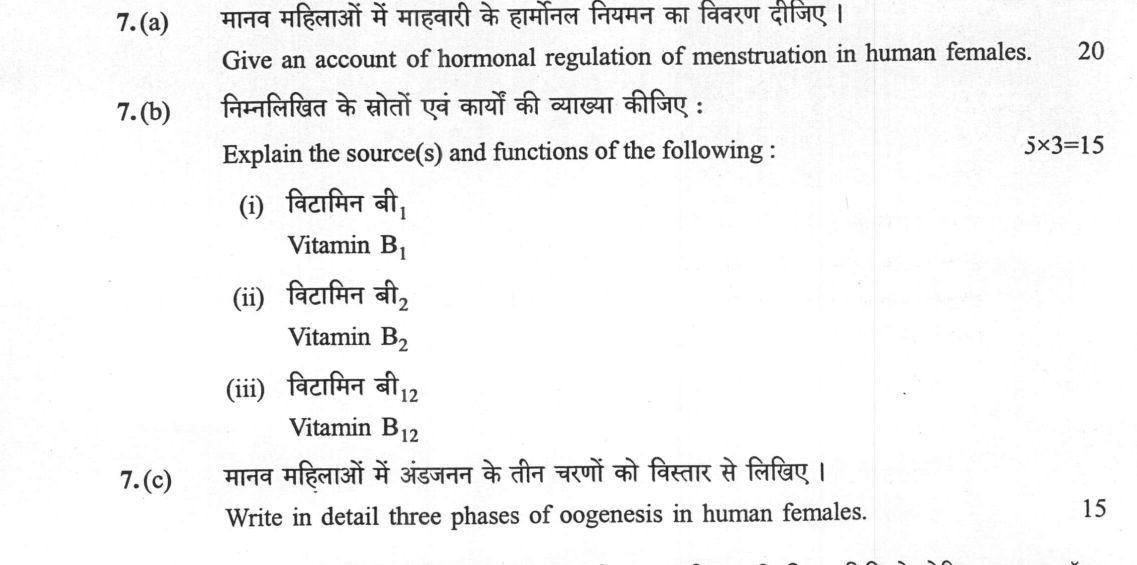
(a) Give an account of hormonal regulation of menstruation in human females. (20 marks) (b) Explain the source(s) and functions…
Give an account of hormonal regulation of menstruation in human females. 20 marks
Explain the source(s) and functions of the following: (5×3=15 marks) Vitamin B₁
Vitamin B₂
Vitamin B₁₂
Write in detail three phases of oogenesis in human females. 15 marks
हिंदी में प्रश्न पढ़ें
मानव महिलाओं में माहवारी के हार्मोनल नियमन का विवरण दीजिए। (20 अंक)
निम्नलिखित के स्रोतों एवं कार्यों की व्याख्या कीजिए: (5×3=15 अंक) विटामिन बी₁
विटामिन बी₂
विटामिन बी₁₂
मानव महिलाओं में अंडजनन के तीन चरणों को विस्तार से लिखिए। (15 अंक)
Model answer
Written by UPSC Answer Check against this question's marking rubric, to the expected length. UPSC does not publish answers for Mains — this is one way to score well, not an official key.
(a) Hormonal regulation of menstruation Menstruation is cyclic endometrial shedding controlled by the hypothalamic–pituitary–ovarian (HPO) axis. The hypothalamus releases GnRH in pulses, stimulating the anterior pituitary to secrete FSH and LH. In the early follicular phase, low estrogen and progesterone allow FSH to rise. FSH acts on ovarian follicles, increasing granulosa cell proliferation, aromatase activity and estradiol synthesis. Rising estradiol first exerts negative feedback on FSH; after reaching a threshold for about 50 hours, it gives positive feedback on LH, causing the pre-ovulatory LH surge. This surge triggers ovulation, completion of meiosis I in the dominant oocyte, and luteinisation of the ruptured follicle. The corpus luteum then secretes progesterone and estradiol. Progesterone converts the endometrium to a secretory, receptive state and maintains it. If fertilisation does not occur, luteolysis begins; progesterone and estradiol fall, spiral arteries constrict, and the functional layer of the endometrium breaks down, causing menstrual bleeding. The basalis layer regenerates the next cycle. The fall in steroids removes negative feedback, so GnRH, FSH and LH rise again and recruit the next follicular cohort. Thus the follicular phase is dominated by estradiol, the luteal phase by progesterone, and the menstrual phase by low steroid levels.
(b) B vitamins Thiamine (vitamin B₁) comes from whole grains, legumes, nuts, yeast and lean meats. It is converted to thiamine pyrophosphate (TPP), a coenzyme for pyruvate dehydrogenase, alpha-ketoglutarate dehydrogenase and transketolase. These TPP-dependent decarboxylation reactions are central to citric acid cycle and pentose phosphate pathway energy metabolism and support nerve conduction. Deficiency causes beriberi and Wernicke–Korsakoff syndrome. Riboflavin (vitamin B₂) is abundant in milk, eggs, green leafy vegetables, yeast and organ meats. It forms FMN and FAD, prosthetic groups of dehydrogenases in the electron transport chain, including NADH dehydrogenase and succinate dehydrogenase, making it essential for oxidative phosphorylation. Riboflavin also supports antioxidant defence through glutathione reductase, which regenerates reduced glutathione and protects cells from oxidative damage. Cobalamin (vitamin B₁₂) occurs only in animal foods such as liver, kidney, dairy, eggs and fish; it is absent from unfortified plant foods, a concern for Indian vegetarians. It acts as coenzyme for methylmalonyl-CoA mutase, converting methylmalonyl-CoA to succinyl-CoA, and for methionine synthase, transferring a methyl group from 5-methyltetrahydrofolate to homocysteine. This maintains folate cycle function and S-adenosylmethionine supply for myelin synthesis. Deficiency causes megaloblastic anaemia, neurological damage and, in pernicious anaemia, failure of intrinsic factor-mediated absorption.
(c) Oogenesis Oogenesis in human females has three phases. In the multiplication phase, primordial germ cells migrate to the gonadal ridge and divide mitotically to form oogonia. During fetal life, oogonia enter meiosis and become primary oocytes, which arrest in diplotene of prophase I (dictyate stage). At birth and in childhood, these oocytes remain relatively small and quiescent in primordial follicles. In the growth phase, after puberty, cyclic FSH recruits a cohort of follicles; the oocyte enlarges, accumulates cytoplasm, organelles and yolk-like precursors, and the follicle develops granulosa and theca layers. Usually one follicle becomes dominant. In the maturation phase, the pre-ovulatory LH surge, supported by estradiol, causes the dominant primary oocyte to resume meiosis I, extrude the first polar body and become a secondary oocyte. It begins meiosis II and arrests at metaphase II. It is ovulated in this state; meiosis II completes only if fertilisation occurs, producing the ovum and second polar body. Thus oogenesis is hormonally gated, with meiotic arrest preserving oocyte quality until the reproductive window.
Conclusion Together, these processes show that human reproduction depends on precise neuroendocrine feedback, follicular development and micronutrient support; disruption of hormonal regulation or B-vitamin status can impair fertility, pregnancy and health.
What "Explain" is asking you to do
Make the working of something clear — what sets it off, what follows from what, and what it produces. Explain is the Commission's mechanism word: it dominates the technical papers and the “explain why” stems, where the marks sit in the causal chain and not in the label.
Structure that answers it
State what it is → the initiating condition → the chain of cause, step by step → an instance where it plays out → what the chain produces
Where marks are lost
Describing what something looks like instead of why it works that way. Naming the stages without linking them reads as description too.
How this answer will be evaluated
Approach
Framework: UPSC Zoology Paper 2. (a) account for: state the phenomenon > the causes in order of weight > conclusion | (b(i)) explain: definition/context > points in order > small example > short close | (b(ii)) explain: definition/context > points in order > small example > short close | (b(iii)) explain: definition/context > points in order > small example > short close | (c) describe: define > structure or process in order > labelled diagram > significance Full marks: Comprehensive, accurate, and well-structured with all required elements and diagrams.
Key points expected
- Hypothalamic GnRH release
- Pituitary FSH and LH secretion
- Ovarian estrogen and progesterone feedback
- Corpus luteum regression and menstruation
- Source: whole grains, legumes
- Function: coenzyme in carbohydrate metabolism
- Deficiency: Beriberi
- Source: milk, eggs, green vegetables
Evaluation rubric
Each sub-part is marked on its own, against the marks and word limit printed on the paper.
- (a) State the phenomenon and explain the hormonal causes in order of weight. 20 marks
account for— state the phenomenon → the causes in order of weight → conclusion
Must cover
- Hypothalamic GnRH release
- Pituitary FSH and LH secretion
- Ovarian estrogen and progesterone feedback
- Corpus luteum regression and menstruation
Loses marks
- Omitting pituitary hormones
- Confusing estrogen and progesterone roles
- No mention of corpus luteum
Earns more
- LH surge and ovulation
- Endometrial proliferation and secretion
- Negative feedback mechanisms
- Positive feedback loop
Extra mark
- Labelled hormonal cycle diagram
- Specific day numbers for phases
- (b(i)) Define Vitamin B1, its source, and its specific function. 5 marks
explain— definition/context → points in order → small example → short close
Must cover
- Source: whole grains, legumes
- Function: coenzyme in carbohydrate metabolism
- Deficiency: Beriberi
Loses marks
- Confusing B1 with B12
- No mention of deficiency
Earns more
- Role in nervous system
- Pyridoxal phosphate mechanism
Extra mark
- Specific food examples
- (b(ii)) Define Vitamin B2, its source, and its specific function. 5 marks
explain— definition/context → points in order → small example → short close
Must cover
- Source: milk, eggs, green vegetables
- Function: coenzyme in redox reactions
- Deficiency: Cheilosis, glossitis
Loses marks
- Confusing B2 with B1
- No mention of deficiency
Earns more
- FAD and FMN roles
- Electron transport chain
Extra mark
- Specific food examples
- (b(iii)) Define Vitamin B12, its source, and its specific function. 5 marks
explain— definition/context → points in order → small example → short close
Must cover
- Source: animal products
- Function: DNA synthesis, red blood cell formation
- Deficiency: Pernicious anemia
Loses marks
- Confusing B12 with B1
- No mention of deficiency
Earns more
- Methylmalonyl-CoA mutase role
- Intrinsic factor requirement
Extra mark
- Specific food examples
- (c) Define oogenesis and describe the three phases in order. 15 marks
describe— define → structure or process in order → labelled diagram → significance
Must cover
- Phases: Oogonia, Primary oocyte, Secondary oocyte
- Meiosis I and II
- Polar body formation
- Ovulation
Loses marks
- Omitting polar bodies
- Confusing mitosis with meiosis
- No mention of ovulation
Earns more
- Labelled diagram of oogenesis
- Specific cell stages
- Hormonal regulation
Extra mark
- Detailed meiotic stages
- Specific day numbers
Practice this exact question
Write your answer and it is marked point by point against the model answer above — what you covered, what you missed, what you got wrong.
Evaluate my answer →More from Zoology 2023 Paper II
- Q4 (a) Explain the following: (10×2=20 marks) (i) Haemophilia (ii) Red-green colour blindnes…
- Q5 Write your answer in about 150 words for each of the following: (a) Highlight role of var…
- Q6 (a) Classify carbohydrates by giving suitable examples. Also, mention characteristics of…
- Q7 (a) Give an account of hormonal regulation of menstruation in human females. (20 marks) (…
- Q8 (a) Explain enzymes, their characteristics as well as induced-fit model of mechanism of e…