Paper II — Q6
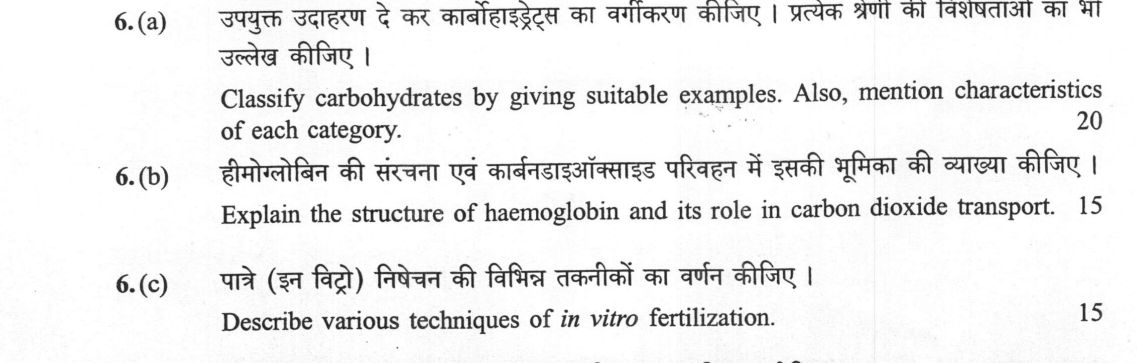
(a) Classify carbohydrates by giving suitable examples. Also, mention characteristics of each category. (20 marks) (b) Explain…
Classify carbohydrates by giving suitable examples. Also, mention characteristics of each category. 20 marks
Explain the structure of haemoglobin and its role in carbon dioxide transport. 15 marks
Describe various techniques of in vitro fertilization. 15 marks
हिंदी में प्रश्न पढ़ें
उपयुक्त उदाहरण दे कर कार्बोहाइड्रेट्स का वर्गीकरण कीजिए। प्रत्येक श्रेणी की विशेषताओं का भी उल्लेख कीजिए। (20 अंक)
हीमोग्लोबिन की संरचना एवं कार्बनडाइऑक्साइड परिवहन में इसकी भूमिका की व्याख्या कीजिए। (15 अंक)
पात्रे (इन विट्रो) निषेचन की विभिन्न तकनीकों का वर्णन कीजिए। (15 अंक)
Model answer
Written by UPSC Answer Check against this question's marking rubric, to the expected length. UPSC does not publish answers for Mains — this is one way to score well, not an official key.
Carbohydrates. Carbohydrates are classified by hydrolytic complexity and monomer composition. Monosaccharides are single units; aldoses such as glucose and galactose contain an aldehyde group, while ketoses such as fructose contain a ketone group. They are generally soluble, sweet and metabolically active; glucose is a reducing sugar, and fructose can also reduce due to tautomerism. The reducing property depends on a free anomeric carbon: reducing sugars can donate electrons in Benedict’s or Fehling’s tests, while non-reducing sugars cannot. Disaccharides contain two monosaccharides: maltose (glucose–glucose) and lactose (galactose–glucose) are reducing, whereas sucrose (glucose–fructose) is non-reducing because both anomeric carbons are locked in the glycosidic bond. Oligosaccharides contain three to ten units, for example raffinose and stachyose in pulses, and often participate in cell-surface recognition. Polysaccharides are long chains; homopolysaccharides include starch from rice and wheat (amylose and amylopectin, storage), glycogen (animal storage), cellulose (β-1,4 glucose, structural) and chitin (N-acetylglucosamine, arthropod/fungal support). Heteropolysaccharides contain different monomers, such as hyaluronic acid, chondroitin sulphate and guar gum, a galactomannan used as a thickener. Their characteristics vary with linkage, branching and solubility, determining energy storage, structure or matrix function.
Haemoglobin and CO₂ transport. Haemoglobin is a tetramer with quaternary structure α₂β₂, 574 amino acids, each chain carrying one heme with Fe²⁺. A labelled diagram would show two α-chains and two β-chains, four heme groups, the central cavity and allosteric sites. Its four subunits bind oxygen cooperatively: initial binding shifts the molecule from tense to relaxed state, producing a sigmoid oxygen-dissociation curve. The Bohr effect describes how increased H⁺ and CO₂ in tissues shift the curve right, promoting oxygen release. CO₂ is transported mainly as bicarbonate (about 70%) formed in red cells by carbonic anhydrase, as carbamino-haemoglobin (about 20–25%) when CO₂ binds amino groups of globin, and about 7% dissolved in plasma. The Haldane effect, whereby deoxygenated haemoglobin binds H⁺ and CO₂ more readily, and the Bohr effect modulate CO₂/O₂ exchange; they are not separate transport forms. In lungs, oxygenation releases CO₂ for exhalation.
In vitro fertilization techniques. Conventional IVF involves controlled ovarian stimulation, oocyte retrieval, in-vitro fertilization with washed sperm, embryo culture and transfer to the uterus; it is used for tubal blockage, endometriosis or unexplained infertility. Stimulation protocols are individualized; embryo transfer is timed to the endometrial window. ICSI injects a single sperm into an oocyte, indicated in severe male-factor infertility or failed conventional IVF. GIFT transfers oocytes and sperm into the fallopian tube, where fertilization occurs in vivo; it is therefore an assisted reproductive technique rather than strict IVF, used in selected tubal-factor cases. ZIFT transfers an in-vitro-fertilized zygote into the fallopian tube, indicated when tubal function is present but IVF embryo transfer has failed. Frozen embryo transfer (FET) involves cryopreservation and later transfer of embryos, useful for endometrial receptivity, multiple cycles, or to reduce multiple pregnancy risk. In India, ICMR guidelines regulate consent, donor screening, age limits and ethical oversight, while the ART (Regulation) Bill, 2021 proposes licensing, registries and accountability. Success rates vary with age and aetiology; live-birth rates of about 20–35% per transfer are reported for women under 35 at major Indian centres such as AIIMS, CMC Vellore and Manipal, which also contribute to national ART data and guideline implementation. Ethical care requires informed consent, embryo-number limits and prevention of sex selection.
Thus, carbohydrate classification, haemoglobin biochemistry and IVF techniques together show how molecular structure underlies metabolism, gas exchange and reproductive intervention. In the Indian biomedical context, accurate biochemical understanding supports nutrition, anaesthesia and safe, regulated ART practice; this integration is important for clinical medicine, where carbohydrate disorders affect energy and immunity, haemoglobin variants affect oxygen delivery, and ART outcomes depend on molecular, cellular and regulatory safeguards.
What "Describe" is asking you to do
Give a full, ordered account of the thing named — its parts, stages or mechanism — in the sequence in which it actually exists or occurs. Most describe questions come from the science optionals, where the marks sit in correct technical detail and, where the stem says so, a labelled diagram.
Structure that answers it
One-line identification of the subject → the parts or stages in their real order, each with its defining detail → labelled diagram where the subject is structural → closing line on function or significance
Where marks are lost
Loose general prose where the examiner is ticking named parts, correct terminology and their sequence; and in the General Studies papers, turning to evaluation before the description is finished.
How this answer will be evaluated
Approach
(a) describe: define > structure or process in order > labelled diagram > significance | (b) explain: definition/context > points in order > small example > short close | (c) describe: define > structure or process in order > labelled diagram > significance Full marks: Precise classification, accurate structural details, clear mechanism explanations, correct terminology throughout.
Key points expected
- Monosaccharides, disaccharides, polysaccharides categories
- Examples: glucose, sucrose, starch
- Characteristics: hydrolysis, reducing nature
- Structural differences between categories
- Quaternary structure: 4 subunits (2α, 2β)
- Heme group with iron (Fe2+)
- CO2 transport mechanism (carbaminohemoglobin)
- Bohr effect or pH influence
Evaluation rubric
Each sub-part is marked on its own, against the marks and word limit printed on the paper.
- (a) Classification of carbohydrates with examples and characteristics of each category. 20 marks
describe— define → structure or process in order → labelled diagram → significance
Must cover
- Monosaccharides, disaccharides, polysaccharides categories
- Examples: glucose, sucrose, starch
- Characteristics: hydrolysis, reducing nature
- Structural differences between categories
Loses marks
- Listing examples without classification
- Missing characteristics of categories
- Confusing monosaccharides with disaccharides
Earns more
- Mention of oligosaccharides
- Specific examples like cellulose, glycogen
- Chemical formulae or general structures
Extra mark
- Mention of glycosidic linkage types
- Reference to specific biological functions
- (b) Structure of haemoglobin and its role in carbon dioxide transport. 15 marks
explain— definition/context → points in order → small example → short close
Must cover
- Quaternary structure: 4 subunits (2α, 2β)
- Heme group with iron (Fe2+)
- CO2 transport mechanism (carbaminohemoglobin)
- Bohr effect or pH influence
Loses marks
- Confusing O2 and CO2 transport mechanisms
- Missing subunit structure details
- Incorrect iron oxidation state
Earns more
- Mention of oxygen transport role
- Diagram of haemoglobin structure
- Specific amino acid residues
Extra mark
- Mention of 2,3-BPG regulation
- Comparison with myoglobin
- (c) Various techniques of in vitro fertilization. 15 marks
describe— define → structure or process in order → labelled diagram → significance
Must cover
- IVF process: oocyte retrieval, fertilization
- ICSI: intracytoplasmic sperm injection
- Embryo culture and transfer
- Hormonal stimulation protocols
Loses marks
- Confusing IVF with natural fertilization
- Missing key steps in process
- Incorrect terminology for techniques
Earns more
- Mention of ZIFT/GIFT techniques
- Preimplantation genetic diagnosis
- Success rates or applications
Extra mark
- Mention of specific lab conditions
- Reference to ethical considerations
Practice this exact question
Write your answer and it is marked point by point against the model answer above — what you covered, what you missed, what you got wrong.
Evaluate my answer →More from Zoology 2023 Paper II
- Q3 (a) Describe the structure of mitochondrion. Why is it known as powerhouse of the cell? (…
- Q4 (a) Explain the following: (10×2=20 marks) (i) Haemophilia (ii) Red-green colour blindnes…
- Q5 Write your answer in about 150 words for each of the following: (a) Highlight role of var…
- Q6 (a) Classify carbohydrates by giving suitable examples. Also, mention characteristics of…
- Q7 (a) Give an account of hormonal regulation of menstruation in human females. (20 marks) (…
- Q8 (a) Explain enzymes, their characteristics as well as induced-fit model of mechanism of e…