Paper II — Q5
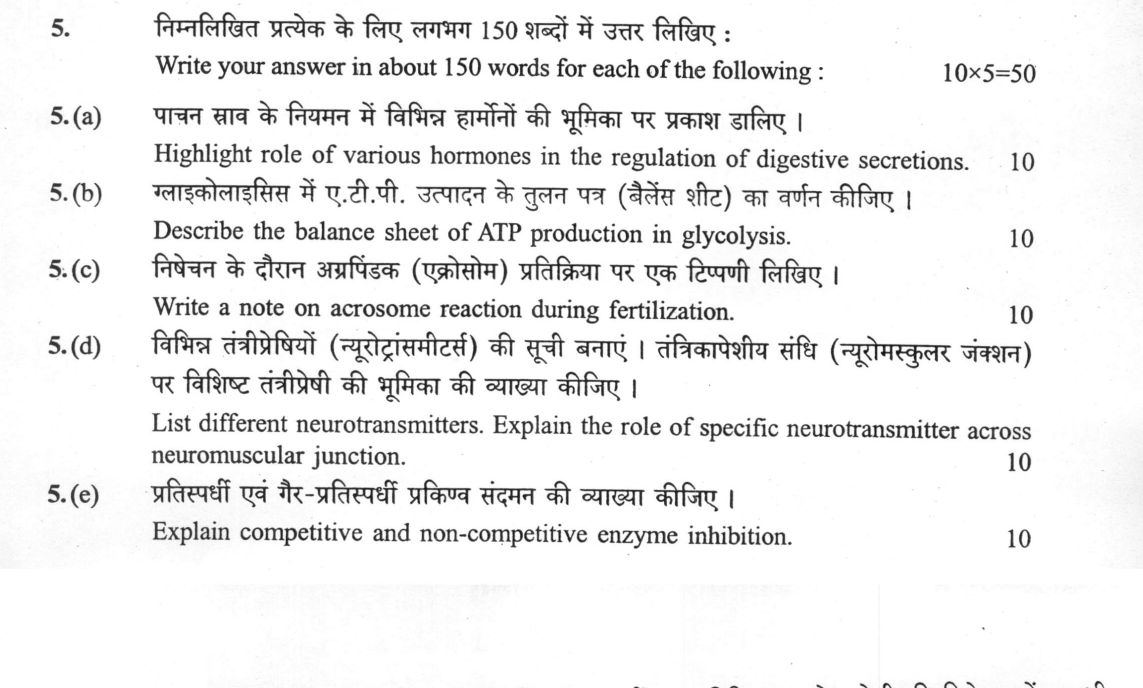
Write your answer in about 150 words for each of the following: (a) Highlight role of various hormones in the regulation of…
Write your answer in about 150 words for each of the following: Highlight role of various hormones in the regulation of digestive secretions. 10 marks
Describe the balance sheet of ATP production in glycolysis. 10 marks
Write a note on acrosome reaction during fertilization. 10 marks
List different neurotransmitters. Explain the role of specific neurotransmitter across neuromuscular junction. 10 marks
Explain competitive and non-competitive enzyme inhibition. 10 marks
हिंदी में प्रश्न पढ़ें
निम्नलिखित प्रत्येक के लिए लगभग 150 शब्दों में उत्तर लिखिए: पाचन स्राव के नियमन में विभिन्न हार्मोनों की भूमिका पर प्रकाश डालिए। (10 अंक)
ग्लाइकोलाइसिस में ए.टी.पी. उत्पादन के तुलन पत्र (बैलेंस शीट) का वर्णन कीजिए। (10 अंक)
निषेचन के दौरान अग्रापिंडक (एक्रोसोम) प्रतिक्रिया पर एक टिप्पणी लिखिए। (10 अंक)
विभिन्न तंत्रीप्रेषियों (न्यूरोट्रांसमिटर्स) की सूची बनाएं। तंत्रिकापेशीय संधि (न्यूरोमस्कुलर जंक्शन) पर विशिष्ट तंत्रीप्रेषी की भूमिका की व्याख्या कीजिए। (10 अंक)
प्रतिस्पर्धी एवं गैर-प्रतिस्पर्धी प्रकिण्व संदमन की व्याख्या कीजिए। (10 अंक)
Model answer
Written by UPSC Answer Check against this question's marking rubric, to the 150-word length. UPSC does not publish answers for Mains — this is one way to score well, not an official key.
(a) Hormonal regulation of digestive secretions. The gastrointestinal tract is controlled by peptide hormones released in response to chyme composition. Gastrin, from antral G-cells, is stimulated by peptides and gastric distension; it acts on parietal cells to increase HCl and pepsinogen secretion. Secretin, from duodenal S-cells, is released by acid in the duodenum; it stimulates pancreatic duct cells to secrete a watery HCO3-rich juice that neutralises acid and also inhibits gastric acid secretion. Cholecystokinin, from I-cells, responds to fatty acids and amino acids; it promotes pancreatic acinar enzyme secretion, gallbladder contraction, and relaxation of the sphincter of Oddi, while slowing gastric emptying. Glucose-dependent insulinotropic peptide, from K-cells, stimulates insulin release and can modulate pancreatic bicarbonate and gastric acid secretion. Motilin, from M-cells, promotes the migrating motor complex and gastric/colonic motility, helping coordinate secretion and propulsion.
(b) Glycolytic ATP balance. In glycolysis, one glucose molecule is converted to two pyruvate molecules through an investment and a payoff phase. The investment phase consumes two ATP: hexokinase phosphorylates glucose to glucose-6-phosphate, and phosphofructokinase-1 phosphorylates fructose-6-phosphate to fructose-1,6-bisphosphate. The payoff phase generates four ATP by substrate-level phosphorylation: phosphoglycerate kinase transfers a phosphate from 1,3-bisphosphoglycerate to ADP, and pyruvate kinase transfers a phosphate from phosphoenolpyruvate to ADP, each occurring twice per glucose. Thus gross ATP production is four ATP, while net gain is two ATP per glucose. In addition, glyceraldehyde-3-phosphate dehydrogenase oxidises glyceraldehyde-3-phosphate to 1,3-bisphosphoglycerate, reducing NAD+ to 2 NADH + 2 H+. These NADH molecules can yield additional ATP, commonly three or five ATP per glucose depending on the cytosolic shuttle used, but the direct glycolytic ATP balance remains two ATP net.
(c) Acrosome reaction. The acrosome reaction is the first species-specific step in mammalian fertilisation. After capacitation, the sperm head contacts the cumulus oophorus; hyaluronidase released from the acrosome digests the hyaluronic acid matrix of the cumulus oophorus, allowing the sperm to reach the zona pellucida. Binding of the sperm to zona pellucida glycoproteins, especially ZP3, triggers a rise in intracellular calcium and acrosomal exocytosis. The outer acrosomal membrane fuses with the sperm plasma membrane, releasing acrosomal enzymes such as acrosin and further hyaluronidase. Acrosin helps digest zona pellucida proteins and exposes ZP2, which supports the second binding step. The sperm then penetrates the zona pellucida, reaches the oolemma, and the sperm plasma membrane fuses with the oocyte plasma membrane. This fusion permits sperm entry, depolarises the oocyte for the fast block, and initiates cortical granule exocytosis, which modifies ZP2 for the slow block to polyspermy.
(d) Neurotransmitters and the neuromuscular junction. Neurotransmitters are chemical messengers that transmit signals across synapses. They include acetylcholine; catecholamines such as noradrenaline, adrenaline, and dopamine; biogenic amines such as serotonin; amino acids such as glutamate, gamma-aminobutyric acid, and glycine; gaseous messengers such as nitric oxide; purines such as ATP; and neuropeptides such as substance P, enkephalins, and endorphins. At the neuromuscular junction, the specific neurotransmitter is acetylcholine. An action potential in the motor neuron opens voltage-gated calcium channels at the presynaptic terminal, causing synaptic vesicles to release acetylcholine in quanta into the synaptic cleft. Acetylcholine binds nicotinic cholinergic receptors on the motor end plate, opening cation channels that allow sodium influx and potassium efflux. This produces an end-plate potential, which, if sufficient, triggers an action potential in the muscle fibre and contraction. The signal is terminated rapidly by acetylcholinesterase, which hydrolyses acetylcholine, preventing repetitive stimulation.
(e) Enzyme inhibition. Enzyme inhibition reduces catalytic activity by binding to the enzyme. Competitive inhibition occurs when an inhibitor resembles the substrate and binds reversibly to the active site. Because it competes with substrate for the same site, increasing substrate concentration can displace the inhibitor and restore the maximum rate. In Michaelis-Menten terms, Vmax remains unchanged, but Km increases, meaning a higher substrate concentration is needed to reach half-maximal velocity. This pattern is typical of many drug designs, where the inhibitor blocks the active site without altering the enzyme's maximum catalytic capacity. Non-competitive inhibition occurs when the inhibitor binds to an allosteric site, not the active site. It may bind to the free enzyme or enzyme-substrate complex, changing enzyme conformation so that catalysis is reduced. Since substrate binding is not directly blocked, Km remains unchanged, but Vmax decreases because a fraction of enzyme is rendered less active or inactive. Increasing substrate concentration cannot fully overcome non-competitive inhibition, because the inhibitor still reduces the effective amount of active enzyme.
Together, these highlighted mechanisms show how digestive, energetic, reproductive, neural, and enzymatic processes are regulated by precise molecular signals, ensuring coordinated physiological function.
What "Highlight" is asking you to do
Bring the notable features of the named material forward and make their weight visible — what each feature is, and what gives it importance. Highlight expects substantive coverage of the features, not a thin selection from them.
Structure that answers it
The material and what makes a feature notable within it → feature, with the point that gives it weight → the same for each further feature → the composite picture they form
Where marks are lost
Naming features flatly as a list and never showing why any one of them signifies.
How this answer will be evaluated
Approach
Framework: Zoology Paper 2: Define > Structure/Mechanism > Diagram > Example. (a) highlight: name the salient points > one line of substance each > close | (b) describe: define > structure or process in order > labelled diagram > significance | (c) write short notes: define > 3-4 key features > one example > one-line significance | (d) explain: definition/context > points in order > small example > short close | (e) explain: definition/context > points in order > small example > short close Full marks: Precise mechanisms, correct terminology, and clear distinction between concepts.
Key points expected
- Gastrin stimulates gastric acid secretion
- Secretin stimulates pancreatic bicarbonate release
- Cholecystokinin stimulates bile and enzyme release
- Salivary reflex involves parasympathetic stimulation
- Investment phase: 2 ATP consumed (hexokinase, PFK-1)
- Payoff phase: 4 ATP produced (substrate-level phosphorylation)
- Net gain: 2 ATP per glucose molecule
- Production of 2 NADH molecules
Evaluation rubric
Each sub-part is marked on its own, against the marks and word limit printed on the paper.
- (a) Name salient points of hormonal regulation of digestive secretions. 10 marks · 150 words
highlight— name the salient points → one line of substance each → close
Must cover
- Gastrin stimulates gastric acid secretion
- Secretin stimulates pancreatic bicarbonate release
- Cholecystokinin stimulates bile and enzyme release
- Salivary reflex involves parasympathetic stimulation
Loses marks
- Listing hormones without their specific target organ
- Confusing secretin and CCK functions
Earns more
- Mention of GIP or VIP
- Link to cephalic/gastric/intestinal phases
Extra mark
- Specific receptor names (e.g., CCK-A)
- (b) Define and present the ATP balance sheet of glycolysis. 10 marks · 150 words
describe— define → structure or process in order → labelled diagram → significance
Must cover
- Investment phase: 2 ATP consumed (hexokinase, PFK-1)
- Payoff phase: 4 ATP produced (substrate-level phosphorylation)
- Net gain: 2 ATP per glucose molecule
- Production of 2 NADH molecules
Loses marks
- Incorrect net ATP calculation
- Omitting the NADH production
Earns more
- Mention of 2 pyruvate end products
- Step-by-step enzyme names
Extra mark
- Mention of anaerobic vs aerobic fate of NADH
- (c) Define and describe key features of the acrosome reaction. 10 marks · 150 words
write short notes— define → 3-4 key features → one example → one-line significance
Must cover
- Definition: Enzymatic release from sperm head
- Triggered by contact with zona pellucida
- Release of hyaluronidase and acrosin
- Allows sperm to penetrate the egg coat
Loses marks
- Confusing acrosome with the sperm nucleus
- Failing to mention the zona pellucida
Earns more
- Mention of capacitation as a prerequisite
- Specificity of the reaction
Extra mark
- Mention of the acrosomal membrane fusion mechanism
- (d) List neurotransmitters and explain the role at the neuromuscular junction. 10 marks · 150 words
explain— definition/context → points in order → small example → short close
Must cover
- List: Acetylcholine, Dopamine, Serotonin, GABA, Glutamate
- Identify Acetylcholine (ACh) as the specific transmitter
- ACh binds to nicotinic receptors on motor end plate
- Causes depolarization and muscle contraction
Loses marks
- Listing only one neurotransmitter
- Failing to link ACh to muscle contraction
Earns more
- Mention of AChE (acetylcholinesterase) for termination
- Distinction between excitatory and inhibitory types
Extra mark
- Mention of specific ion channels (Na+ influx)
- (e) Explain the mechanisms of competitive and non-competitive inhibition. 10 marks · 150 words
explain— definition/context → points in order → small example → short close
Must cover
- Competitive: Inhibitor binds to active site
- Competitive: Reversible by increasing substrate concentration
- Non-competitive: Inhibitor binds to allosteric site
- Non-competitive: Not overcome by increasing substrate
Loses marks
- Confusing the binding sites of the two types
- Failing to mention the effect on substrate concentration
Earns more
- Mention of Km and Vmax changes
- Example of a specific inhibitor (e.g., malonate)
Extra mark
- Mention of uncompetitive inhibition
Practice this exact question
Write your answer and it is marked point by point against the model answer above — what you covered, what you missed, what you got wrong.
Evaluate my answer →More from Zoology 2023 Paper II
- Q2 (a) Give structure of t-RNA. Write role of different RNAs in the translation process. (20…
- Q3 (a) Describe the structure of mitochondrion. Why is it known as powerhouse of the cell? (…
- Q4 (a) Explain the following: (10×2=20 marks) (i) Haemophilia (ii) Red-green colour blindnes…
- Q5 Write your answer in about 150 words for each of the following: (a) Highlight role of var…
- Q6 (a) Classify carbohydrates by giving suitable examples. Also, mention characteristics of…
- Q7 (a) Give an account of hormonal regulation of menstruation in human females. (20 marks) (…
- Q8 (a) Explain enzymes, their characteristics as well as induced-fit model of mechanism of e…