Paper II — Q3
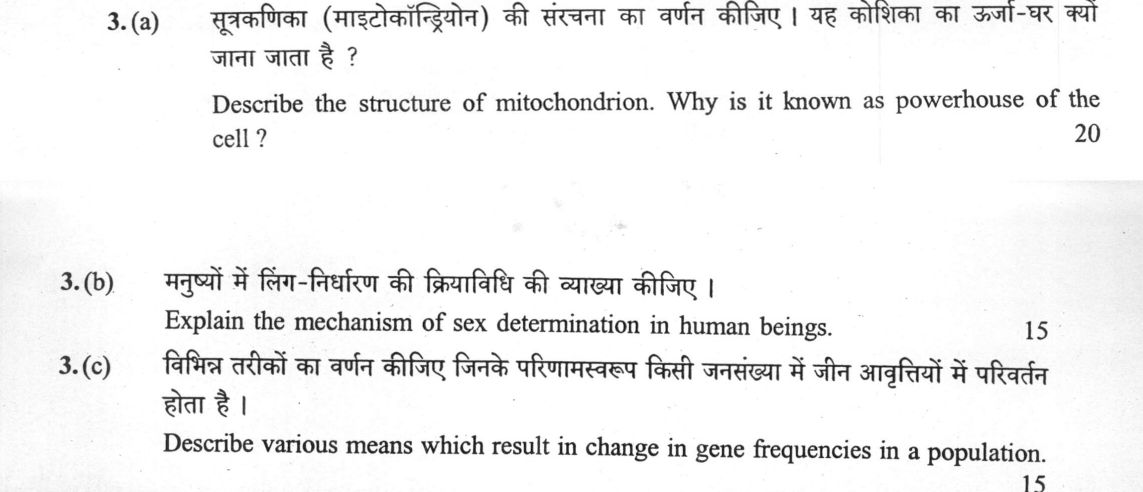
(a) Describe the structure of mitochondrion. Why is it known as powerhouse of the cell? (20 marks) (b) Explain the mechanism of…
Describe the structure of mitochondrion. Why is it known as powerhouse of the cell? 20 marks
Explain the mechanism of sex determination in human beings. 15 marks
Describe various means which result in change in gene frequencies in a population. 15 marks
हिंदी में प्रश्न पढ़ें
सूत्रकणिका (माइटोकॉन्ड्रियन) की संरचना का वर्णन कीजिए। यह कोशिका का ऊर्जा-घर क्यों जाना जाता है? (20 अंक)
मनुष्यों में लिंग-निर्धारण की क्रियाविधि की व्याख्या कीजिए। (15 अंक)
विभिन्न तरीकों का वर्णन कीजिए जिनके परिणामस्वरूप किसी जनसंख्या में जीन आवृत्तियों में परिवर्तन होता है। (15 अंक)
Model answer
Written by UPSC Answer Check against this question's marking rubric, to the expected length. UPSC does not publish answers for Mains — this is one way to score well, not an official key.
Mitochondrion. The mitochondrion is a double-membrane-bound organelle. The outer membrane is smooth and permeable to small molecules, while the inner membrane is folded into cristae, greatly increasing surface area. The cristae bear elementary particles, also called F1 particles, which are the visible heads of ATP synthase. The enclosed matrix contains mitochondrial DNA, 70S ribosomes, tRNA, and enzymes of the Krebs cycle and oxidative phosphorylation, including NADH dehydrogenase and cytochrome oxidase. During respiration, NADH and FADH2 deliver electrons to the electron transport chain embedded in the inner membrane. As electrons pass through complexes, protons are pumped from the matrix to the intermembrane space, creating an electrochemical proton gradient. ATP synthase uses the return of protons down this gradient to phosphorylate ADP, a process explained by the chemiosmotic mechanism. Because mitochondria generate most of the cell’s ATP through this coupling of electron transport and oxidative phosphorylation, they are called the powerhouse of the cell.
Sex determination in humans. Human sex determination follows the XX-XY system. Females have two X chromosomes, while males have one X and one Y. The Y chromosome carries the SRY gene, whose product initiates testis differentiation from the indifferent gonad. In the absence of a functional SRY, the gonad develops into an ovary. Once testes form, Sertoli cells secrete anti-Mullerian hormone, causing regression of Mullerian ducts, while Leydig cells secrete testosterone, promoting Wolffian duct development and male structures. In females, absence of testicular hormones allows Mullerian ducts to persist, and estrogen supports ovarian and female development. Dosage compensation is achieved by X-inactivation, in which one X chromosome in each female cell is condensed into a Barr body, equalising X-linked gene expression. The system is supported by sex-chromosome aneuploidies: Klinefelter syndrome (47,XXY) usually gives a male phenotype because SRY is present, while Turner syndrome (45,X) gives a female phenotype with ovarian failure. Modern genetics also recognises genes beyond SRY, such as SOX9 and DAX1, which refine gonadal development and show that sex determination is a pathway rather than a single switch.
Changes in gene frequencies. In an ideal population, Hardy-Weinberg equilibrium predicts that allele and genotype frequencies remain constant when mating is random, population size is infinite, and there is no mutation, migration or selection. Real populations deviate from this baseline. The processes usually considered are mutation, genetic drift, gene flow, natural selection, and non-random mating. Mutation is the ultimate source of new alleles; although individual mutation rates are low, it supplies raw variation for evolution. Genetic drift changes allele frequencies by chance, especially in small populations; founder effects occur when a few individuals colonise a new area, and bottleneck effects follow a sharp reduction in population size. In India, isolated tribal groups, such as some Andaman populations, can show pronounced drift because of small effective population sizes and limited gene exchange. Gene flow, or migration, introduces or removes alleles when individuals move between populations, tending to reduce differences among them. Natural selection changes frequencies when alleles affect survival or reproduction; directional selection favours one extreme, stabilizing selection favours the mean, and disruptive selection favours extremes. A classic example is the sickle-cell trait, where heterozygotes have an advantage in malaria-endemic regions, including parts of India, maintaining the allele despite the cost of homozygous disease. Non-random mating, such as assortative mating or consanguinity, changes genotype frequencies by increasing homozygosity; it does not directly alter allele frequencies, though it can make selection on recessive alleles more effective.
Together, these topics show that inheritance operates at several levels: mitochondrial inheritance demonstrates cytoplasmic and organelle genetics, human sex determination shows chromosomal and gene-regulatory control, and population genetics shows how allele frequencies respond to mutation, drift, migration and selection.
What "Describe" is asking you to do
Give a full, ordered account of the thing named — its parts, stages or mechanism — in the sequence in which it actually exists or occurs. Most describe questions come from the science optionals, where the marks sit in correct technical detail and, where the stem says so, a labelled diagram.
Structure that answers it
One-line identification of the subject → the parts or stages in their real order, each with its defining detail → labelled diagram where the subject is structural → closing line on function or significance
Where marks are lost
Loose general prose where the examiner is ticking named parts, correct terminology and their sequence; and in the General Studies papers, turning to evaluation before the description is finished.
How this answer will be evaluated
Approach
Framework: UPSC Zoology Paper 2. (a) describe: define > structure or process in order > labelled diagram > significance | (b) explain: definition/context > points in order > small example > short close | (c) describe: define > structure or process in order > labelled diagram > significance Full marks: Precise anatomical/physiological terminology, labelled diagrams, and clear mechanistic links.
Key points expected
- Double membrane system (outer/inner) with cristae
- Matrix components (DNA, ribosomes, enzymes)
- Mechanism of ATP synthesis (oxidative phosphorylation)
- Labelled diagram of mitochondrion
- Chromosomal basis (XX female, XY male)
- Sperm-determinant mechanism (X vs Y sperm)
- Role of SRY gene on Y chromosome
- Punnett square or diagram of fertilization
Evaluation rubric
Each sub-part is marked on its own, against the marks and word limit printed on the paper.
- (a) Structural description of mitochondrion and justification of its 'powerhouse' status. 20 marks
describe— define → structure or process in order → labelled diagram → significance
Must cover
- Double membrane system (outer/inner) with cristae
- Matrix components (DNA, ribosomes, enzymes)
- Mechanism of ATP synthesis (oxidative phosphorylation)
- Labelled diagram of mitochondrion
Loses marks
- Diagram without labels
- Confusing inner membrane with matrix
- Omitting the 'powerhouse' justification
Earns more
- Mention of mitochondrial DNA (mtDNA) inheritance
- Reference to electron transport chain (ETC) complexes
- Comparison with prokaryotic cell (endosymbiotic theory)
Extra mark
- Specific mention of ATP synthase (Complex V)
- Reference to specific cristae types (tubular vs lamellar)
- (b) Mechanism of sex determination in humans involving gametes and zygote. 15 marks
explain— definition/context → points in order → small example → short close
Must cover
- Chromosomal basis (XX female, XY male)
- Sperm-determinant mechanism (X vs Y sperm)
- Role of SRY gene on Y chromosome
- Punnett square or diagram of fertilization
Loses marks
- Stating egg determines sex
- Omitting the role of the Y chromosome
- Confusing genotype with phenotype
Earns more
- Mention of Barr body (X inactivation)
- Reference to gonadal differentiation (testes/ovaries)
- Mention of dosage compensation
Extra mark
- Reference to Turner syndrome (45,X) or Klinefelter (47,XXY)
- Mention of H-Y antigen
- (c) Factors causing changes in gene frequencies within a population. 15 marks
describe— define → structure or process in order → labelled diagram → significance
Must cover
- Natural selection (directional/stabilizing)
- Genetic drift (bottleneck/founder effect)
- Gene flow (migration/immigration)
- Mutation as a source of variation
Loses marks
- Confusing gene frequency with allele frequency
- Omitting the mechanism of drift
- Listing factors without explaining the change
Earns more
- Mention of non-random mating (inbreeding)
- Reference to Hardy-Weinberg equilibrium conditions
- Example of a specific population (e.g., peppered moth)
Extra mark
- Mention of genetic load
- Reference to specific conservation genetics case study
Practice this exact question
Write your answer and it is marked point by point against the model answer above — what you covered, what you missed, what you got wrong.
Evaluate my answer →More from Zoology 2023 Paper II
- Q1 Write your answer in about 150 words for each of the following: (a) Write about different…
- Q2 (a) Give structure of t-RNA. Write role of different RNAs in the translation process. (20…
- Q3 (a) Describe the structure of mitochondrion. Why is it known as powerhouse of the cell? (…
- Q4 (a) Explain the following: (10×2=20 marks) (i) Haemophilia (ii) Red-green colour blindnes…
- Q5 Write your answer in about 150 words for each of the following: (a) Highlight role of var…
- Q6 (a) Classify carbohydrates by giving suitable examples. Also, mention characteristics of…