Paper II — Q8
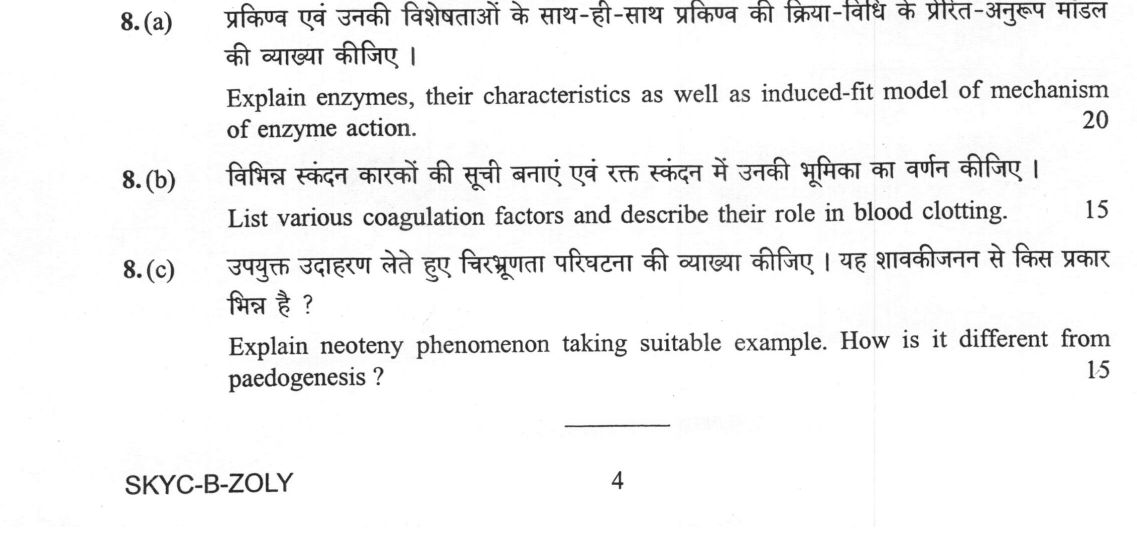
(a) Explain enzymes, their characteristics as well as induced-fit model of mechanism of enzyme action. (20 marks) (b) List…
Explain enzymes, their characteristics as well as induced-fit model of mechanism of enzyme action. 20 marks
List various coagulation factors and describe their role in blood clotting. 15 marks
Explain neoteny phenomenon taking suitable example. How is it different from paedogenesis? 15 marks
हिंदी में प्रश्न पढ़ें
प्रकिण्व एवं उनकी विशेषताओं के साथ-ही-साथ प्रकिण्व की क्रिया-विधि के प्रेरित-अनुरूप मॉडल की व्याख्या कीजिए। (20 अंक)
विभिन्न स्कंदन कारकों की सूची बनाएं एवं रक्त स्कंदन में उनकी भूमिका का वर्णन कीजिए। (15 अंक)
उपयुक्त उदाहरण लेते हुए चिरभूणता परिघटना की व्याख्या कीजिए। यह शावकीजनन से किस प्रकार भिन्न है? (15 अंक)
Model answer
Written by UPSC Answer Check against this question's marking rubric, to the expected length. UPSC does not publish answers for Mains — this is one way to score well, not an official key.
Enzymes are specialized biocatalysts, predominantly proteinaceous in nature (with exceptions like ribozymes), that accelerate biochemical reactions by lowering their activation energy without being consumed in the process.
Characteristics of Enzymes and Induced-Fit Model
Enzymes exhibit distinct physiological characteristics:
- Catalytic efficiency: They display high turnover numbers (k_cat), accelerating reactions by 10^6to10¹² fold.
- Substrate specificity: Exhibited at stereo, absolute, or group levels due to complementary active-site geometry.
- Reversibility and regulation: Most catalyzed reactions are reversible, and catalytic rates depend on environmental factors including optimum temperature, optimum pH, substrate concentration, and presence of allosteric modulators or competitive/non-competitive inhibitors.
According to the International Union of Biochemistry and Molecular Biology (IUBMB), enzymes are classified into six systematic classes: Oxidoreductases, Transferases, Hydrolases, Lyases, Isomerases, and Ligases.
Daniel Koshland (1958) proposed the Induced-Fit Model of enzyme action, advancing Emil Fischer’s rigid "Lock-and-Key" hypothesis. Koshland posited that the enzyme's active site is structurally flexible rather than pre-shaped. When the substrate approaches, weak non-covalent interactions (hydrogen bonds, electrostatic forces, hydrophobic interactions) induce a precise conformational change in the enzyme. This realigns catalytic residues (e.g., nucleophiles, acid-base groups) into an optimal geometry around the substrate, straining the substrate's critical bonds, stabilizing the transition state (ES^ddagger), and facilitating conversion into products (E + S rightleftharpoons ES → EP → E + P).
Coagulation Factors and the Blood Clotting Cascade
Blood clotting operates via a sequential enzymatic cascade involving thirteen plasma coagulation factors designated by Roman numerals:
- Factor I: Fibrinogen (soluble precursor)
- Factor II: Prothrombin (zymogen; Vitamin K-dependent)
- Factor III: Tissue Factor / Thromboplastin
- Factor IV: Calcium ions (Ca²⁺, required across multiple cleavage steps)
- Factor V: Proaccelerin / Labile factor
- Factor VI: Accelerin (obsolete; active form of Factor V)
- Factor VII: Proconvertin / Stable factor (Vitamin K-dependent)
- Factor VIII: Antihemophilic factor A
- Factor IX: Christmas factor / Plasma thromboplastic component (Vitamin K-dependent)
- Factor X: Stuart-Prower factor (Vitamin K-dependent)
- Factor XI: Plasma thromboplastin antecedent (PTA)
- Factor XII: Hageman factor (contact factor)
- Factor XIII: Fibrin-stabilizing factor (transglutaminase)
The cascade proceeds along three interconnected pathways:
- Extrinsic Pathway: Vascular injury exposes Factor III, which binds circulating Factor VII in the presence of Factor IV (Ca²⁺) to form the VIIa-III complex, rapidly activating Factor X.
- Intrinsic Pathway: Damage exposing subendothelial collagen activates Factor XII → XIIa, sequentially activating Factor XI → XIa, then Factor IX → IXa. The active IXa, together with cofactor VIIIa and Ca²⁺, forms the "tenase" complex on platelet membranes, cleaving Factor X to Xa.
- Common Pathway: Factor Xa unites with Factor Va, phospholipids, and Ca²⁺ to form the prothrombinase complex. This complex cleaves Factor II (prothrombin) into active thrombin (IIa). Thrombin subsequently cleaves Factor I (fibrinogen) into insoluble fibrin monomers. Finally, Factor XIIIa (activated by thrombin and Ca²⁺) cross-links these monomers via covalent isopeptide bonds, transforming the fragile mesh into a stabilized haemostatic clot.
Neoteny versus Paedogenesis
Neoteny is an evolutionary and developmental phenomenon (a form of heterochrony) wherein an organism decelerates or retards somatic development relative to normal gonadal maturation, resulting in sexually mature adults retaining larval or juvenile morphological characteristics.
A classic example is the Mexican axolotl (Ambystoma mexicanum), which retains larval external gills, a flattened swimming tail, and an entirely aquatic lifestyle throughout adult life due to low thyroid-stimulating hormone (TSH) release. Similarly, the mudpuppy (Necturus maculosus) exhibits permanent, obligatory neoteny. In human evolution, paedomorphic/neotenic somatic retention is evident in our large brain-to-body ratio, flattened orthognathic facial plane, and sparse body hair compared to adult non-human primates.
Neoteny differs fundamentally from paedogenesis based on the underlying heterochronic mechanism:
- Somatosensory vs. Gonadal Timing: Neoteny represents delayed somatic maturation while reproductive organs mature at the normal chronological rate. In contrast, paedogenesis (progenesis) is characterized by accelerated, precocious gonadal maturation within a developmentally unaltered larval or juvenile body.
- Occurrence: Neoteny is prevalent in amphibians (Ambystoma, Proteus) and chordate evolution. Paedogenesis typically occurs in invertebrates as a rapid reproductive strategy under nutrient-rich conditions, such as larval reproduction in gall midges (Miastor), the beetle Micromalthus debilis, and sporocysts/rediae of trematode flatworms (Fasciola hepatica).
Thus, while both processes culminate in paedomorphosis, neoteny slows the body's clock, whereas paedogenesis speeds the reproductive clock.
What "Explain" is asking you to do
Make the working of something clear — what sets it off, what follows from what, and what it produces. Explain is the Commission's mechanism word: it dominates the technical papers and the “explain why” stems, where the marks sit in the causal chain and not in the label.
Structure that answers it
State what it is → the initiating condition → the chain of cause, step by step → an instance where it plays out → what the chain produces
Where marks are lost
Describing what something looks like instead of why it works that way. Naming the stages without linking them reads as description too.
How this answer will be evaluated
Approach
Framework: Zoology Paper 2: Define > Structure/Mechanism > Diagram > Example. (a) explain: definition/context > points in order > small example > short close | (b) enumerate: list the items in order > one line each > no commentary | (c) explain: definition/context > points in order > small example > short close Full marks: Precise definitions, clear mechanisms, labelled diagrams, specific examples, and accurate distinctions.
Key points expected
- Definition of enzymes as biological catalysts
- List of key characteristics (specificity, efficiency, regulation)
- Explanation of induced-fit model mechanism
- Comparison with lock-and-key model
- List of coagulation factors (I-XIII)
- Description of intrinsic pathway
- Description of extrinsic pathway
- Role of thrombin in fibrin formation
Evaluation rubric
Each sub-part is marked on its own, against the marks and word limit printed on the paper.
- (a) Definition of enzymes, their characteristics, and the induced-fit model of action. 20 marks
explain— definition/context → points in order → small example → short close
Must cover
- Definition of enzymes as biological catalysts
- List of key characteristics (specificity, efficiency, regulation)
- Explanation of induced-fit model mechanism
- Comparison with lock-and-key model
Loses marks
- Confusing induced-fit with lock-and-key
- Missing the mechanism of action
- Vague description of characteristics
Earns more
- Mention of active site conformational change
- Reference to transition state stabilization
- Mention of co-factors or co-enzymes
Extra mark
- Labelled diagram of induced-fit mechanism
- Specific example of enzyme (e.g., Hexokinase)
- (b) List of coagulation factors and description of their role in blood clotting. 15 marks
enumerate— list the items in order → one line each → no commentary
Must cover
- List of coagulation factors (I-XIII)
- Description of intrinsic pathway
- Description of extrinsic pathway
- Role of thrombin in fibrin formation
Loses marks
- Listing factors without describing roles
- Confusing intrinsic and extrinsic pathways
- Missing the final common pathway
Earns more
- Mention of calcium ions (Factor IV)
- Reference to platelet plug formation
- Mention of fibrinolysis
Extra mark
- Labelled diagram of coagulation cascade
- Mention of specific deficiency (e.g., Hemophilia)
- (c) Explanation of neoteny with example and difference from paedogenesis. 15 marks
explain— definition/context → points in order → small example → short close
Must cover
- Definition of neoteny
- Suitable example (e.g., Axolotl)
- Definition of paedogenesis
- Clear distinction between neoteny and paedogenesis
Loses marks
- Confusing neoteny with paedogenesis
- Missing the example
- Vague distinction between the two phenomena
Earns more
- Mention of evolutionary significance
- Reference to specific taxa (e.g., Salamanders)
- Mention of environmental factors
Extra mark
- Labelled diagram of neotenic development
- Reference to specific conservation status
Practice this exact question
Write your answer and it is marked point by point against the model answer above — what you covered, what you missed, what you got wrong.
Evaluate my answer →More from Zoology 2023 Paper II
- Q5 Write your answer in about 150 words for each of the following: (a) Highlight role of var…
- Q6 (a) Classify carbohydrates by giving suitable examples. Also, mention characteristics of…
- Q7 (a) Give an account of hormonal regulation of menstruation in human females. (20 marks) (…
- Q8 (a) Explain enzymes, their characteristics as well as induced-fit model of mechanism of e…