Paper II — Q4
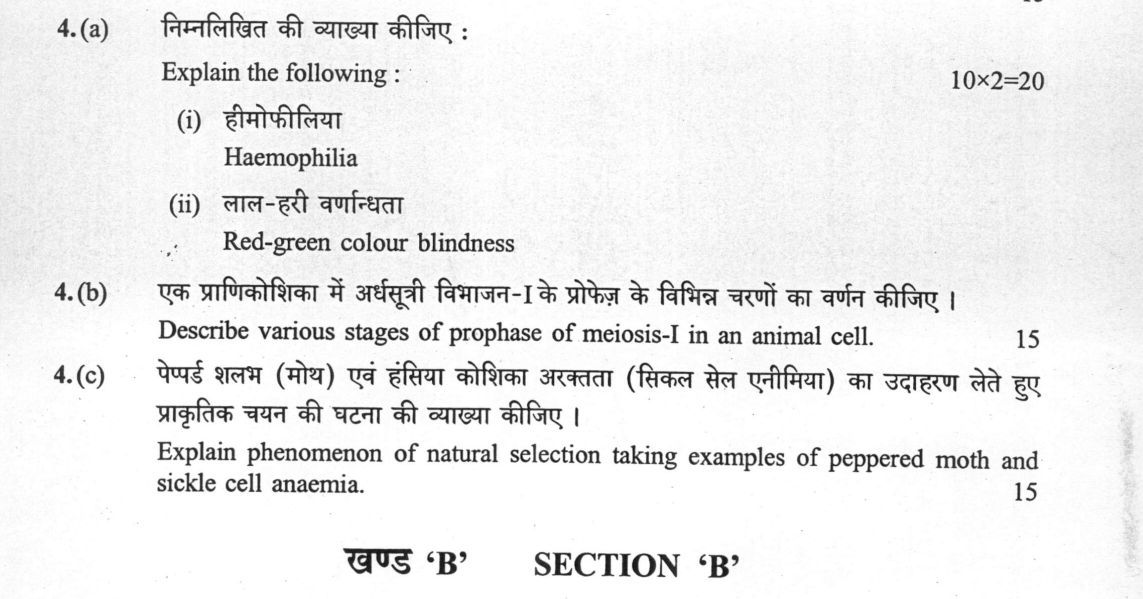
(a) Explain the following: (10×2=20 marks) (i) Haemophilia (ii) Red-green colour blindness (b) Describe various stages of…
Explain the following: (10×2=20 marks) Haemophilia
Red-green colour blindness
Describe various stages of prophase of meiosis-I in an animal cell. 15 marks
Explain phenomenon of natural selection taking examples of peppered moth and sickle cell anaemia. 15 marks
हिंदी में प्रश्न पढ़ें
निम्नलिखित की व्याख्या कीजिए: (10×2=20 अंक) हीमोफीलिया
लाल-हरी वर्णांधता
एक प्राणिकोशिका में अर्धसूत्री विभाजन-I के प्रोफेज के विभिन्न चरणों का वर्णन कीजिए। (15 अंक)
पेपर्ड शलभ (मोथ) एवं हँसिया कोशिका अरक्तता (सिकल सेल एनीमिया) का उदाहरण लेते हुए प्राकृतिक चयन की घटना की व्याख्या कीजिए। (15 अंक)
Model answer
Written by UPSC Answer Check against this question's marking rubric, to the expected length. UPSC does not publish answers for Mains — this is one way to score well, not an official key.
X-Linked Recessive Genetic Disorders
Haemophilia is an X-linked recessive bleeding disorder caused by mutations disrupting the intrinsic blood coagulation cascade, preventing effective fibrin clot formation. Haemophilia A arises from a deficiency of clotting Factor VIII (FVIII), whereas Haemophilia B (Christmas disease) is caused by a deficiency of Factor IX (FIX). Because males possess a single X chromosome (hemizygous, X^hY), a single defective allele manifests the disease, while heterozygous females (X^H X^h) remain largely asymptomatic carriers. The classic inheritance pattern is historically exemplified by the European Royal pedigree descending from Queen Victoria, passing the mutant allele through carrier daughters to male descendants across generations.
Red-green colour blindness is an X-linked condition characterized by an inability to discriminate red and green hues. The photopigment genes encoding long-wavelength-sensitive (L-opsin/red) and medium-wavelength-sensitive (M-opsin/green) cone opsins are clustered on chromosome locus Xq28, having evolved via tandem gene duplication. Unequal homologous recombination between these tandem arrays causes gene deletions or chimeric gene fusion. Complete loss of function leads to dichromacy, classified as protanopia (red-blindness) or deuteranopia (green-blindness), whereas spectral shifts in mutant opsins cause anomalous trichromacy, namely protanomaly or deuteranomaly. Clinical diagnosis relies on pseudoisochromatic Ishihara plates.
Stages of Prophase-I in Meiosis-I
Prophase-I is the extended reductional phase of meiosis wherein homologous chromosomes pair and undergo genetic exchange.
Leptotene: Chromatin begins progressive condensation into distinct, thread-like chromosomes. Telomeres orient and attach to the inner nuclear membrane adjacent to the centrosome, forming the polarized "bouquet stage."
Zygotene: Homologous chromosomes recognize each other and initiate intimate lengthwise pairing (synapsis). This association is stabilized by the assembly of a tripartite protein scaffold, the synaptonemal complex (SC), forming bivalents.
Pachytene: Bivalents fully condense to reveal four chromatids (tetrads). Recombination nodules assemble along the SC, facilitating enzyme-mediated crossing over between non-sister chromatids via double-strand breaks and strand exchange, generating novel allelic combinations.
Diplotene: The synaptonemal complex dissolves, allowing homologous chromosomes to desynapse and pull apart, remaining physically held together only at the sites of crossing over, visible as X-shaped chiasmata. In many oocytes, this stage enters prolonged arrest (dictyotene).
Diakinesis: Chromosomes reach maximum condensation. Chiasmata undergo terminalization, shifting progressively toward the chromosome ends. The nucleolus and nuclear envelope disassemble, and spindle microtubules attach to kinetochores to orient bivalents for metaphase-I.
Natural Selection: Mechanistic Basis and Examples
Natural selection is the differential survival and reproduction of genotypes mediated by environmental selective pressures, driving directional or balancing shifts in gene frequencies.
**Industrial Melanism in Peppered Moth (Biston betularia):** Documented by H.B.D. Kettlewell, pre-industrial England possessed mostly pale, speckled typica morphs, which were camouflaged against light, lichen-covered tree trunks against avian predators. Industrial soot deposition killed lichens and blackened tree bark, exerting directional selection that favored the rare, melanic carbonaria morph carrying a dominant transposon-derived mutation. The frequency of carbonaria rose dramatically in industrial areas due to cryptic advantage and subsequently declined following clean air legislation, proving rapid evolutionary adaptation to changing selective regimes.
Sickle Cell Anaemia and Balancing Selection: Caused by a point mutation (GAG → GTG; glutamic acid replaced by valine at codon 6) in the β-globin gene (HBB), the mutant allele (HbS) causes deoxygenated hemoglobin to polymerize, deforming erythrocytes into rigid sickled shapes. While homozygous individuals (HbSS) suffer lethal sickle cell anaemia, heterozygous individuals (HbAS) exhibit mild sickling that restricts the intra-erythrocytic reproduction of Plasmodium falciparum. This heterozygote advantage (overdominance) confers resistance to severe malaria, maintaining the deleterious HbS allele at high frequencies across malaria-endemic regions of sub-Saharan Africa and tribal belts of central and southern India (e.g., Nilgiris, Bastar).
Meiotic recombination in prophase-I produces novel phenotypic variation, providing the raw substrate upon which natural selection acts to drive adaptation or maintain balanced polymorphisms, while sex-linked traits persist within populations through the reservoir of heterozygous female carriers.
What "Explain" is asking you to do
Make the working of something clear — what sets it off, what follows from what, and what it produces. Explain is the Commission's mechanism word: it dominates the technical papers and the “explain why” stems, where the marks sit in the causal chain and not in the label.
Structure that answers it
State what it is → the initiating condition → the chain of cause, step by step → an instance where it plays out → what the chain produces
Where marks are lost
Describing what something looks like instead of why it works that way. Naming the stages without linking them reads as description too.
How this answer will be evaluated
Approach
Framework: Zoology Paper 2: Define > Structure/Mechanism > Diagram > Example. (a(i)) explain: definition/context > points in order > small example > short close | (a(ii)) explain: definition/context > points in order > small example > short close | (b) describe: define > structure or process in order > labelled diagram > significance | (c) explain: definition/context > points in order > small example > short close Full marks: Precise definitions, correct mechanisms, labelled diagrams, and specific examples.
Key points expected
- X-linked recessive inheritance pattern
- Deficiency of clotting factor (VIII or IX)
- Mechanism of bleeding/haemostasis failure
- Pedigree or cross showing carrier female/affected male
- Defect in cone photoreceptors (opsins)
- Mechanism of colour perception failure
- Leptotene: Chromosome condensation
- Zygotene: Synapsis and bivalent formation
Evaluation rubric
Each sub-part is marked on its own, against the marks and word limit printed on the paper.
- (a(i)) Definition, inheritance pattern, and physiological mechanism of Haemophilia. 10 marks
explain— definition/context → points in order → small example → short close
Must cover
- X-linked recessive inheritance pattern
- Deficiency of clotting factor (VIII or IX)
- Mechanism of bleeding/haemostasis failure
- Pedigree or cross showing carrier female/affected male
Loses marks
- Describing as autosomal dominant
- Confusing with general blood disorders
Earns more
- Distinction between Haemophilia A and B
- Mention of specific gene loci (Xq28)
Extra mark
- Reference to specific clinical symptoms (haemarthrosis)
- (a(ii)) Definition, genetic basis, and visual mechanism of Red-green colour blindness. 10 marks
explain— definition/context → points in order → small example → short close
Must cover
- X-linked recessive inheritance pattern
- Defect in cone photoreceptors (opsins)
- Mechanism of colour perception failure
- Pedigree or cross showing carrier female/affected male
Loses marks
- Describing as autosomal dominant
- Confusing with total colour blindness (achromatopsia)
Earns more
- Distinction between protanopia and deuteranopia
- Mention of opsin gene duplication/deletion
Extra mark
- Reference to Ishihara test plates
- (b) Sequential stages of Prophase I in an animal cell with labelled diagrams. 15 marks
describe— define → structure or process in order → labelled diagram → significance
Must cover
- Leptotene: Chromosome condensation
- Zygotene: Synapsis and bivalent formation
- Pachytene: Crossing over and chiasmata
- Diplotene: Desynapsis and chiasma maintenance
Loses marks
- Omitting Diakinesis
- Diagrams without labels
Earns more
- Diakinesis: Terminalization of chiasmata
- Labelled diagrams for each stage
Extra mark
- Mention of recombination nodules
- (c) Natural selection mechanism using Peppered moth and Sickle cell anaemia examples. 15 marks
explain— definition/context → points in order → small example → short close
Must cover
- Peppered moth: Industrial melanism and predation
- Sickle cell anaemia: Heterozygote advantage
- Mechanism of selection pressure (predation/malaria)
- Change in allele frequency over time
Loses marks
- Describing without linking to selection pressure
- Confusing natural selection with genetic drift
Earns more
- Specific species name (Biston betularia)
- Genotype frequencies (HbA/HbS)
Extra mark
- Reference to specific geographic locations (e.g., Manchester)
Practice this exact question
Write your answer and it is marked point by point against the model answer above — what you covered, what you missed, what you got wrong.
Evaluate my answer →More from Zoology 2023 Paper II
- Q1 Write your answer in about 150 words for each of the following: (a) Write about different…
- Q2 (a) Give structure of t-RNA. Write role of different RNAs in the translation process. (20…
- Q3 (a) Describe the structure of mitochondrion. Why is it known as powerhouse of the cell? (…
- Q4 (a) Explain the following: (10×2=20 marks) (i) Haemophilia (ii) Red-green colour blindnes…
- Q5 Write your answer in about 150 words for each of the following: (a) Highlight role of var…
- Q6 (a) Classify carbohydrates by giving suitable examples. Also, mention characteristics of…
- Q7 (a) Give an account of hormonal regulation of menstruation in human females. (20 marks) (…