Paper II — Q1
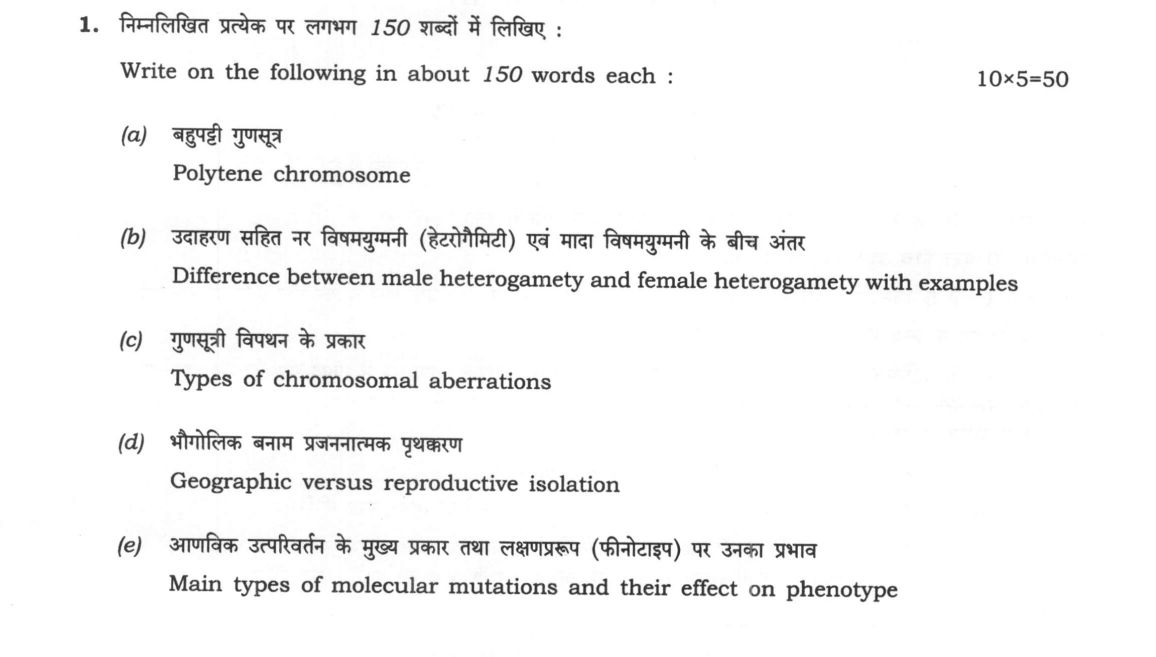
Write on the following in about 150 words each: (a) Polytene chromosome (10 marks) (b) Difference between male heterogamety and…
Write on the following in about 150 words each: Polytene chromosome 10 marks
Difference between male heterogamety and female heterogamety with examples 10 marks
Types of chromosomal aberrations 10 marks
Geographic versus reproductive isolation 10 marks
Main types of molecular mutations and their effect on phenotype 10 marks
हिंदी में प्रश्न पढ़ें
निम्नलिखित प्रत्येक पर लगभग 150 शब्दों में लिखिए : बहुपट्टी गुणसूत्र (10 अंक)
उदाहरण सहित नर विषमयुग्मनी (हेट्रोगैमिटी) एवं मादा विषमयुग्मनी के बीच अंतर (10 अंक)
गुणसूत्री विपथन के प्रकार (10 अंक)
भौगोलिक बनाम प्रजननात्मक पृथक्करण (10 अंक)
आणविक उत्परिवर्तन के मुख्य प्रकार तथा लक्षणप्ररूप (फीनोटाइप) पर उनका प्रभाव (10 अंक)
Model answer
Written by UPSC Answer Check against this question's marking rubric, to the 150-word length. UPSC does not publish answers for Mains — this is one way to score well, not an official key.
(a) Polytene Chromosome
Polytene chromosomes are giant, multistranded chromosomes formed by repeated cycles of endoreduplication (DNA replication without cell division or separation of sister chromatids). First described by E.G. Balbiani in Chironomus, they are characteristically observed in the larval salivary glands, gut, and Malpighian tubules of Dipteran insects such as Drosophila melanogaster. They exhibit a distinct pattern of transverse alternating dark bands (dense, transcriptionally inactive chromatin) and light interbands (less dense DNA).
During specific developmental stages, certain bands decondense and loosen into localized swellings called chromosomal puffs, which serve as sites of active gene transcription and RNA synthesis. Prominent, exceptionally large puffs are termed Balbiani rings. Because their reproducible banding patterns allow precise physical identification of loci, polytene chromosomes have historically provided an indispensable cytogenetic tool for gene mapping, analyzing structural rearrangements like inversions and deletions, and visualizing gene expression in situ.
(b) Male Heterogamety versus Female Heterogamety
Heterogamety refers to the condition where individuals of a particular sex produce two cytogenetically distinct types of gametes with respect to sex chromosomes, thereby determining the sex of the offspring at fertilization.
Male heterogamety occurs when the male produces two distinct types of gametes, while the female is homogametic and produces a single type:
- XX-XY System: Females possess two identical X chromosomes (XX) and produce only X-bearing eggs, whereas males possess one X and one Y chromosome (XY) and produce 50% X-bearing and 50% Y-bearing sperms (e.g., humans, mammals, and Drosophila melanogaster).
- XX-XO System: Males possess a single X chromosome (XO) and produce gametes with or without an X chromosome (e.g., grasshoppers).
Female heterogamety occurs when the female produces two distinct types of gametes, while the male is homogametic:
- ZZ-ZW System: Males are homogametic (ZZ) producing identical Z-bearing sperm, whereas females are heterogametic (ZW) producing Z-bearing and W-bearing ova. This mechanism is standard in birds (Gallus gallus), reptiles, and lepidopteran insects such as the mulberry silkworm (Bombyx mori).
- ZZ-ZO System: Females possess a single Z chromosome (ZO) and males possess two (ZZ) (e.g., certain primitive moths).
(c) Types of Chromosomal Aberrations
Chromosomal aberrations represent modifications in standard chromosome structure or number, classified into structural and numerical aberrations.
Structural Aberrations involve changes in gene arrangement or content:
- Deletion (Deficiency): Loss of a chromosome segment. In humans, terminal deletion of the short arm of chromosome 5 (5p-) causes Cri-du-chat syndrome.
- Duplication: Presence of an extra chromosomal segment, increasing gene dosage (e.g., the Bar eye duplication in Drosophila).
- Inversion: A 180-degree rotation of an internal segment. It is termed paracentric if it excludes the centromere and pericentric if the centromere is included.
- Translocation: Exchange of segments between non-homologous chromosomes, such as reciprocal translocations or centric fusions (Robertsonian translocations).
Numerical Aberrations involve variations in chromosome count:
- Aneuploidy: Gain or loss of one or more individual chromosomes due to non-disjunction during meiosis. Examples include monosomy (2n-1, as in Turner syndrome, 45,XO) and trisomy (2n+1, as in Down syndrome / Trisomy 21).
- Euploidy (Polyploidy): Variation involving complete haploid chromosome sets (e.g., 3n triploidy, 4n tetraploidy), categorized as autopolyploidy or allopolyploidy.
(d) Geographic versus Reproductive Isolation
Isolation mechanisms halt gene flow between populations, serving as the prerequisite for divergent evolution and speciation.
Geographic Isolation represents an extrinsic, spatial separation of populations by physical environmental barriers such as mountain ranges, rivers, deserts, or marine expanses. By preventing panmixia, it allows separated populations to diverge genetically through differential natural selection and genetic drift, driving allopatric speciation. A prominent Indian example is the speciation of the Lion-tailed Macaque (Macaca silenus) and the Nilgiri Tahr (Nilgiritragus hylocrius), isolated within fragmented high-altitude biomes of the Western Ghats following geological and climatic shifts.
Reproductive Isolation comprises intrinsic biological properties of organisms that prevent interbreeding between co-occurring populations:
- Prezygotic barriers prevent mating or fertilization (ecological, temporal, ethological/behavioral, mechanical, and gametic isolation).
- Postzygotic barriers reduce the viability or fertility of hybrid offspring (hybrid inviability, hybrid sterility as in the sterile mule produced from horse and donkey, and hybrid breakdown).
Geographic isolation typically acts as the initial physical precursor that allows reproductive isolation to evolve secondarily.
(e) Main Types of Molecular Mutations and Their Effect on Phenotype
Molecular (point) mutations are alterations in the specific nucleotide sequence of DNA, classified by their structural nature and their functional consequences on the encoded polypeptide.
Base Substitutions:
- Silent (Synonymous) Mutations: A base change that, owing to the degeneracy of the genetic code, alters a codon to another coding for the same amino acid. These generally exert no phenotypic effect.
- Missense Mutations: A nucleotide replacement that alters a codon to encode a different amino acid. The phenotypic consequence ranges from neutral to severe; for example, a single transversion in the β-globin gene (GAG to GTG) substitutes glutamic acid with valine at position 6, altering protein conformation and causing Sickle Cell Anemia.
- Nonsense Mutations: A substitution that converts an amino acid codon into a premature translation termination codon (UAA, UAG, or UGA), resulting in truncated, non-functional polypeptides.
Frameshift Mutations:
- Insertions and Deletions (Indels): The addition or loss of nucleotide numbers not divisible by three shifts the triplet reading frame downstream of the mutation site. This radically alters the entire subsequent amino acid sequence and frequently generates premature stop codons, typically yielding a completely non-functional or degraded protein phenotype.
What "Write short notes" is asking you to do
Five or six self-contained answers, marked separately, typically 10 marks and about 150 words each. Each note must carry its own definition, its two or three defining features and a line on why it matters; a common introduction or conclusion across the notes earns nothing.
Structure that answers it
Per note: one-line definition or identification → two or three features, mechanisms or named examples → one line of significance or Indian application
Where marks are lost
Writing the first two notes at essay length and rationing the rest. Each note is marked on its own, so marks surrendered on a compressed or unattempted note cannot be won back by the long ones.
How this answer will be evaluated
Approach
Framework: Zoology Paper 2: Define > Structure/Mechanism > Diagram > Example. (a) describe: define > structure or process in order > labelled diagram > significance | (b) compare: paired headings or table > key differences > significance > conclusion | (c) enumerate: list the items in order > one line each > no commentary | (d) compare: paired headings or table > key differences > significance > conclusion | (e) describe: define > structure or process in order > labelled diagram > significance Full marks: Precise definitions, correct mechanisms, specific named taxa/species, clear distinctions, and accurate examples for all parts.
Key points expected
- Define polytene chromosome (giant chromosome)
- Explain endoreduplication mechanism (mitosis without cytokinesis)
- Describe banding pattern (light/dark bands)
- Name example taxon (Diptera, e.g., Drosophila)
- Define male heterogamety (XY system)
- Define female heterogamety (ZW system)
- Give example for male (Mammals, Drosophila)
- Give example for female (Birds, Lepidoptera)
Evaluation rubric
Each sub-part is marked on its own, against the marks and word limit printed on the paper.
- (a) Define polytene chromosome, explain formation mechanism, and describe structure with example. · 150 words
describe— define → structure or process in order → labelled diagram → significance
Must cover
- Define polytene chromosome (giant chromosome)
- Explain endoreduplication mechanism (mitosis without cytokinesis)
- Describe banding pattern (light/dark bands)
- Name example taxon (Diptera, e.g., Drosophila)
Loses marks
- Confusing with lampbrush chromosomes
- Omitting the mechanism of formation
- No specific taxon named
Earns more
- Mention larval salivary glands
- Note puffs as sites of transcription
- Mention specific species (Chironomus, Drosophila)
Extra mark
- Labelled diagram of polytene chromosome
- Mention specific banding nomenclature
- (b) Distinguish male and female heterogamety with specific examples for each. · 150 words
compare— paired headings or table → key differences → significance → conclusion
Must cover
- Define male heterogamety (XY system)
- Define female heterogamety (ZW system)
- Give example for male (Mammals, Drosophila)
- Give example for female (Birds, Lepidoptera)
Loses marks
- Confusing which sex is heterogametic in which group
- Failing to provide examples for both types
- Vague description without specific systems
Earns more
- Mention specific sex chromosomes (X, Y, Z, W)
- Note that male is heterogametic in mammals
- Note that female is heterogametic in birds
Extra mark
- Mention specific species (e.g., Gallus gallus, Mus musculus)
- Brief mention of haplodiploidy as contrast
- (c) List and briefly describe the main types of chromosomal aberrations. · 150 words
enumerate— list the items in order → one line each → no commentary
Must cover
- Distinguish structural vs numerical aberrations
- List structural types (deletion, duplication, inversion, translocation)
- List numerical types (aneuploidy, polyploidy)
- Briefly define each type
Loses marks
- Listing only structural or only numerical
- No distinction between structural and numerical
- Vague descriptions without specific types
Earns more
- Mention specific examples (e.g., Down syndrome for aneuploidy)
- Distinguish reciprocal vs Robertsonian translocation
- Mention monosomy vs trisomy
Extra mark
- Mention specific syndrome (e.g., Cri-du-chat for deletion)
- Mention specific plant example for polyploidy
- (d) Distinguish geographic from reproductive isolation with examples. · 150 words
compare— paired headings or table → key differences → significance → conclusion
Must cover
- Define geographic isolation (allopatric)
- Define reproductive isolation (pre/post-zygotic)
- Explain mechanism of geographic isolation
- Explain mechanism of reproductive isolation
Loses marks
- Confusing the two types of isolation
- No examples provided
- Vague definitions without mechanisms
Earns more
- Mention specific geographic barriers (mountains, rivers)
- List types of reproductive isolation (behavioral, temporal)
- Mention specific example (e.g., Darwin's finches)
Extra mark
- Mention specific species (e.g., Galapagos finches)
- Mention specific barrier (e.g., Himalayas)
- (e) List main types of molecular mutations and explain their phenotypic effects. · 150 words
describe— define → structure or process in order → labelled diagram → significance
Must cover
- List types (point, frameshift, insertion, deletion)
- Explain point mutations (silent, missense, nonsense)
- Explain frameshift mutations
- Link mutation type to phenotypic effect
Loses marks
- Listing types without explaining phenotypic effects
- Confusing point and frameshift mutations
- No specific examples of phenotypic effects
Earns more
- Mention specific example (e.g., sickle cell for missense)
- Explain codon degeneracy for silent mutations
- Mention specific disease (e.g., cystic fibrosis for deletion)
Extra mark
- Mention specific gene (e.g., HBB for sickle cell)
- Mention specific protein effect (e.g., hemoglobin S)
Practice this exact question
Write your answer and it is marked point by point against the model answer above — what you covered, what you missed, what you got wrong.
Evaluate my answer →More from Zoology 2024 Paper II
- Q1 Write on the following in about 150 words each: (a) Polytene chromosome (10 marks) (b) Di…
- Q2 (a) Give an account of ultrastructure of rough and smooth endoplasmic reticulum. Also dis…
- Q3 (a) What is sex-determination? Give an account of genic balance theory of sex-determinati…
- Q4 (a) Describe the stages of human evolution and mention the major hominid forms giving the…