Paper II — Q7
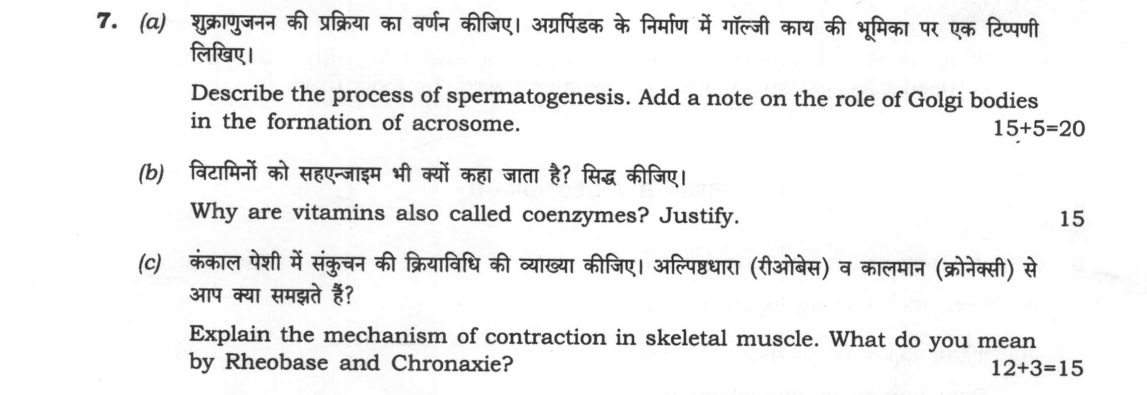
(a) Describe the process of spermatogenesis. Add a note on the role of Golgi bodies in the formation of acrosome. (15+5=20…
Describe the process of spermatogenesis. Add a note on the role of Golgi bodies in the formation of acrosome. (15+5=20 marks)
Why are vitamins also called coenzymes? Justify. 15 marks
Explain the mechanism of contraction in skeletal muscle. What do you mean by Rheobase and Chronaxie? (12+3=15 marks)
हिंदी में प्रश्न पढ़ें
शुक्राणुजनन की प्रक्रिया का वर्णन कीजिए। अग्रपिंडक के निर्माण में गॉल्जी काय की भूमिका पर एक टिप्पणी लिखिए। (15+5=20 अंक)
विटामिनों को सह-एंजाइम भी क्यों कहा जाता है? सिद्ध कीजिए। (15 अंक)
कंकाल पेशी में संकुचन की क्रियाविधि की व्याख्या कीजिए। अलिबंधारा (रियोबेस) व कालमान (क्रोनेक्सी) से आप क्या समझते हैं? (12+3=15 अंक)
Model answer
Written by UPSC Answer Check against this question's marking rubric, to the expected length. UPSC does not publish answers for Mains — this is one way to score well, not an official key.
Spermatogenesis and Acrosome Formation
Spermatogenesis is the continuous process occurring within the seminiferous tubules of testes, wherein diploid spermatogonia transform into haploid spermatozoa. It proceeds through three major phases: the proliferative phase, meiotic phase, and spermiogenesis.
Type A spermatogonia undergo mitotic divisions to maintain the stem cell pool and yield Type B spermatogonia, which enlarge into primary spermatocytes (46, XY). Under the influence of follicle-stimulating hormone (FSH) acting on Sertoli cells and luteinizing hormone (LH) stimulating Leydig cells to secrete testosterone, primary spermatocytes undergo Meiosis I to form two haploid secondary spermatocytes (23, X or 23, Y). These rapidly enter Meiosis II, producing four non-motile, spherical spermatids.
During spermiogenesis, spermatids differentiate into specialized spermatozoa. The Golgi apparatus plays a central role in generating the acrosome, an apical cap acting as a specialized lysosome. Ultrastructurally, the Golgi cisternae produce multiple electron-dense proacrosomal vesicles that coalesce into a single large acrosomal vesicle containing an acrosomal granule. This vesicle adheres to the nuclear membrane at the anterior pole of the condensing nucleus, spreading over its anterior two-thirds to form the acrosomal cap. The remnant Golgi apparatus moves away as the Golgi remnant. The completed acrosome contains hydrolytic enzymes, notably hyaluronidase, corona penetrating enzyme, and acrosin, which are essential for penetrating the cumulus oophorus and zona pellucida during fertilization.
Vitamins as Coenzymes: Justification
Vitamins, specifically water-soluble B-complex vitamins, are designated as coenzymes because they serve as essential, non-protein organic precursors that bind with apoenzymes to form catalytically active holoenzymes. Unlike macronutrients, vitamins function catalytically in micro-quantities rather than stoichiometrically as substrates.
The biochemical justification rests on their obligate transformation into reactive prosthetic groups or co-substrates: Thiamine (Vitamin B1) is phosphorylated to Thiamine Pyrophosphate (TPP) for oxidative decarboxylation; Riboflavin (Vitamin B2) forms Flavin Mononucleotide (FMN) and Flavin Adenine Dinucleotide (FAD) for cellular redox reactions; Niacin (Vitamin B3) yields NAD+ and NADP+, serving as universal hydride-ion carriers; Pantothenic acid (Vitamin B5) forms the functional core of Coenzyme A for acyl transfers; Pyridoxine (Vitamin B6) converts to Pyridoxal Phosphate (PLP) for transamination and amino acid metabolism; Biotin (Vitamin B7) acts as a covalently bound coenzyme in carboxylation reactions; Folic acid (Vitamin B9) converts to Tetrahydrofolate (THF) for one-carbon unit transfer; and Cobalamin (Vitamin B12) forms Methylcobalamin and Adenosylcobalamin for isomerase and methyltransferase reactions.
Unlike fat-soluble vitamins (A, D, E), which primarily function as nuclear receptor ligands, visual pigments, or lipid-soluble antioxidants, water-soluble vitamins undergo limited tissue storage and function directly in intermediary metabolic enzymatic complexes.
Mechanism of Skeletal Muscle Contraction, Rheobase, and Chronaxie
Skeletal muscle contraction operates via the sliding filament mechanism coupled with excitation-contraction coupling. An action potential arriving at the neuromuscular junction propagates across the sarcolemma and down the transverse (T) tubules. This depolarizes dihydropyridine receptors, opening ryanodine receptors on the sarcoplasmic reticulum to release Ca²⁺ into the sarcoplasm.
Elevated Ca²⁺ binds to troponin C, producing a conformational shift in troponin I and troponin T that pulls tropomyosin away from actin active sites. Myosin heads, energized by hydrolyzed ATP (bound to ADP and Pi), bind to exposed actin to form cross-bridges. The release of Pi and ADP triggers the power stroke, tilting the myosin head by 45 degrees and pulling the thin actin filament toward the center of the sarcomere (H-zone narrowing). Binding of a new ATP molecule causes myosin detachment; ATP hydrolysis re-cocks the head for subsequent cycling until Ca²⁺ is actively pumped back by SERCA pumps.
Neuromuscular excitability is evaluated using the strength-duration curve. Rheobase is defined as the minimum galvanic electrical stimulus intensity (current or voltage) of infinite duration required to elicit a threshold muscle contraction. Chronaxie is the minimum stimulus duration required to excite the tissue when using a current twice the strength of the rheobase. Chronaxie provides a precise index of excitability: tissues with shorter chronaxie values, such as myelinated nerves and fast skeletal muscle fibers, exhibit higher excitability.
Thus, reproductive gametogenesis, coenzyme-mediated cellular bioenergetics, and neuromuscular excitation-contraction mechanisms collectively integrate cellular differentiation, metabolic catalysis, and somatic mechanical function to sustain physiological homeostasis.
What "Describe" is asking you to do
Give a full, ordered account of the thing named — its parts, stages or mechanism — in the sequence in which it actually exists or occurs. Most describe questions come from the science optionals, where the marks sit in correct technical detail and, where the stem says so, a labelled diagram.
Structure that answers it
One-line identification of the subject → the parts or stages in their real order, each with its defining detail → labelled diagram where the subject is structural → closing line on function or significance
Where marks are lost
Loose general prose where the examiner is ticking named parts, correct terminology and their sequence; and in the General Studies papers, turning to evaluation before the description is finished.
How this answer will be evaluated
Approach
Framework: Spermatogenesis, Coenzyme theory, Sliding Filament theory. (a) describe: define > structure or process in order > labelled diagram > significance | (b) justify: definition/context > points in order > small example > short close | (c) explain: definition/context > points in order > small example > short close Full marks: Precise mechanisms, correct definitions, and labelled diagrams
Key points expected
- Spermatogenesis stages
- Golgi-acrosome link
- Vitamin as coenzyme precursor
- Sliding filament theory
- Rheobase definition
- Chronaxie definition
Evaluation rubric
Each sub-part is marked on its own, against the marks and word limit printed on the paper.
- (a) Sequential stages of spermatogenesis and Golgi-acrosome link 20 marks
describe— define → structure or process in order → labelled diagram → significance
Must cover
- Spermatocytogenesis (mitosis) to spermiogenesis (differentiation)
- Meiosis I and II stages (primary/secondary spermatocytes)
- Golgi bodies form the acrosomal vesicle
- Labelled diagram of spermatogenesis stages
Loses marks
- Confusing spermatogenesis with oogenesis
- Missing the specific Golgi-acrosome link
Earns more
- Sertoli cell support and nutrition
- Role of Leydig cells in testosterone
- Spermiogenesis details (flagellum, midpiece)
Extra mark
- Specific taxon example (e.g., human or rat)
- (b) Link between vitamin structure and coenzyme function 15 marks
justify— definition/context → points in order → small example → short close
Must cover
- Definition of coenzyme (non-protein organic helper)
- Vitamins act as precursors to coenzymes
- Example: Niacin to NAD+ or Riboflavin to FAD
- Role in enzyme active site binding
Loses marks
- Listing vitamins without explaining the 'why'
- Confusing vitamins with hormones
Earns more
- Distinction between prosthetic group and coenzyme
- Specific metabolic pathway example (e.g., Krebs cycle)
Extra mark
- Mention of specific vitamin deficiency disease
- (c) Sliding filament mechanism and definitions of Rheobase/Chronaxie 15 marks
explain— definition/context → points in order → small example → short close
Must cover
- Sliding filament theory (actin-myosin interaction)
- Role of Ca2+ and troponin-tropomyosin
- Definition of Rheobase (minimum stimulus intensity)
- Definition of Chronaxie (half rheobase time)
Loses marks
- Confusing rheobase with threshold
- Missing the specific definitions of the terms
Earns more
- Cross-bridge cycle steps (power stroke)
- ATP role in contraction and relaxation
Extra mark
- Diagram of sarcomere contraction
Practice this exact question
Write your answer and it is marked point by point against the model answer above — what you covered, what you missed, what you got wrong.
Evaluate my answer →More from Zoology 2024 Paper II
- Q4 (a) Describe the stages of human evolution and mention the major hominid forms giving the…
- Q5 Write on the following in about 150 words each: (a) Functions of immunoglobulins (10 mark…
- Q6 (a) Explain the structure of nephron and its role in urine formation. Add a note on hormo…
- Q7 (a) Describe the process of spermatogenesis. Add a note on the role of Golgi bodies in th…
- Q8 (a) Write about the role of liver and pancreas in digestion. Add a note on neural and hor…