Paper II — Q6
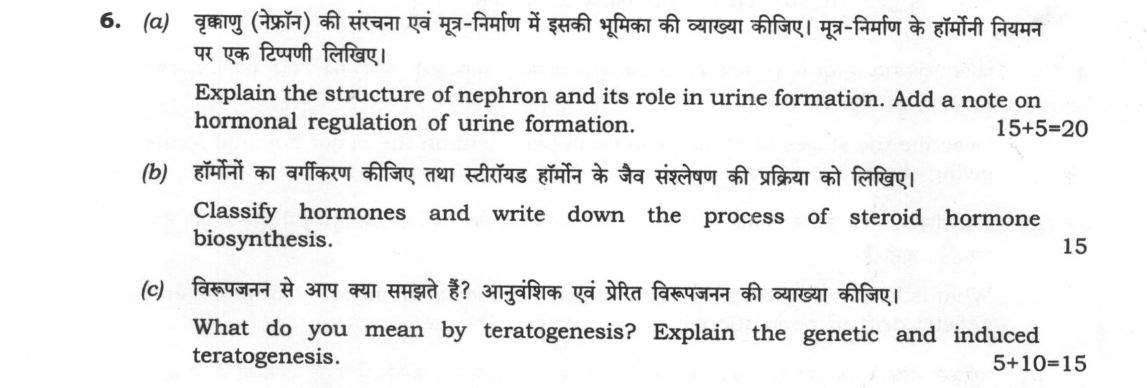
(a) Explain the structure of nephron and its role in urine formation. Add a note on hormonal regulation of urine formation…
Explain the structure of nephron and its role in urine formation. Add a note on hormonal regulation of urine formation. (15+5=20 marks)
Classify hormones and write down the process of steroid hormone biosynthesis. 15 marks
What do you mean by teratogenesis? Explain the genetic and induced teratogenesis. (5+10=15 marks)
हिंदी में प्रश्न पढ़ें
वृक्काणु (नेफ्रॉन) की संरचना एवं मूत्र-निर्माण में इसकी भूमिका की व्याख्या कीजिए। मूत्र-निर्माण के हार्मोनी नियमन पर एक टिप्पणी लिखिए। (15+5=20 अंक)
हार्मोनों का वर्गीकरण कीजिए तथा स्टेरॉयड हार्मोन के जैव संश्लेषण की प्रक्रिया को लिखिए। (15 अंक)
विकृजनन से आप क्या समझते हैं? आनुवंशिक एवं प्रेरित विकृजनन की व्याख्या कीजिए। (5+10=15 अंक)
Model answer
Written by UPSC Answer Check against this question's marking rubric, to the expected length. UPSC does not publish answers for Mains — this is one way to score well, not an official key.
(a) Nephron and urine formation The kidney forms urine through the nephron proper—renal corpuscle, proximal convoluted tubule (PCT), loop of Henle and distal convoluted tubule (DCT); the collecting duct system, though not part of the nephron, receives DCT output and completes final modification. The renal corpuscle contains a glomerular capillary tuft enclosed by Bowman’s capsule. Blood pressure forces plasma water and small solutes into Bowman’s space, forming an ultrafiltrate free of cells and most proteins. The juxtaglomerular apparatus senses tubular NaCl and helps regulate glomerular filtration rate. In the PCT, epithelial cells reabsorb about 65% of filtered water passively/osmotically, while glucose, amino acids, bicarbonate and most sodium are recovered by active or secondary-active transport; tubular epithelial cells also secrete H+, K+, NH4+, creatinine and many xenobiotics into the lumen. The descending limb is permeable to water, concentrating tubular fluid, whereas the thick ascending limb actively reabsorbs NaCl without water, diluting the fluid and generating the medullary osmotic gradient. The DCT fine-tunes Na+ and Ca2+ reabsorption. In the collecting duct, principal and intercalated cells adjust water, Na+, K+ and acid-base balance, producing concentrated or dilute urine. Hormonal regulation is central: ADH/vasopressin increases aquaporin-2 channels in collecting ducts, enhancing water reabsorption and concentrating urine; aldosterone acts on DCT and collecting ducts to increase ENaC-mediated Na+ reabsorption and K+/H+ secretion, conserving sodium and controlling potassium; ANP opposes this by promoting natriuresis, inhibiting renin-angiotensin-aldosterone and reducing ADH release, thereby lowering blood volume and pressure. In India, CKD hotspots in Andhra Pradesh/Telangana make this physiology clinically important; loss of nephrons reduces concentrating ability and GFR.
(b) Hormones and steroidogenesis Hormones are classified by chemical nature as peptide/protein hormones (insulin, growth hormone), steroid hormones (cortisol, testosterone, oestradiol) and amino-acid derivatives (catecholamines, thyroid hormones). By source, they include hypothalamic releasing/inhibiting hormones, anterior and posterior pituitary hormones, and peripheral hormones from adrenal cortex, gonads, thyroid, pancreas, kidney and others. Steroid biosynthesis begins with cholesterol, derived from LDL or de novo synthesis, which is transferred by StAR protein from the outer to the inner mitochondrial membrane. CYP11A1 then cleaves the side chain to form pregnenolone, the rate-limiting step. 3β-hydroxysteroid dehydrogenase converts pregnenolone to progesterone. For cortisol, CYP17A1 first 17α-hydroxylates progesterone to 17-hydroxyprogesterone; 21-hydroxylase then forms 11-deoxycortisol, and 11β-hydroxylase produces cortisol. Without 17α-hydroxylation, the pathway yields corticosterone. CYP17A1 also has 17,20-lyase activity, converting 17-hydroxyprogesterone to dehydroepiandrosterone and androstenedione; 5α-reductase then forms testosterone. Aromatase (CYP19A1) converts androgens to oestrone and oestradiol. Tissue-specific enzymes determine which steroid is made, explaining steroid therapeutics and enzyme-defect diseases such as congenital adrenal hyperplasia.
(c) Teratogenesis Teratogenesis is the induction of structural or functional defects during prenatal development, when an insult disrupts normal cell division, migration, differentiation or organ formation. Genetic teratogenesis arises from inherited or de novo chromosomal and single-gene abnormalities. Chromosomal aberrations include trisomy 21 (Down syndrome), trisomy 18 (Edwards syndrome), trisomy 13 (Patau syndrome) and monosomy X (Turner syndrome), usually due to meiotic nondisjunction; single-gene mutations can cause cleft palate, neural-tube defects, thalassaemia or metabolic disorders. Induced teratogenesis results from environmental teratogens acting during critical periods, especially organogenesis in the first trimester, with effects depending on dose, timing and susceptibility. Thalidomide causes phocomelia by disrupting limb-bud angiogenesis; isotretinoin causes craniofacial, cardiac and CNS defects; alcohol causes fetal alcohol syndrome; rubella and radiation can cause microcephaly, cataracts, cardiac defects and growth restriction. Endocrine disruptors are a special class: diethylstilbestrol (DES) causes vaginal adenosis, and maternal thyroid deficiency can cause cretinism. Prevention therefore combines folic acid supplementation, genetic counselling, infection control, and avoidance of teratogens such as alcohol, smoking and unregulated drugs. Thus, renal, endocrine and developmental physiology are linked by precise transport, enzymatic and hormonal controls.
What "Explain" is asking you to do
Make the working of something clear — what sets it off, what follows from what, and what it produces. Explain is the Commission's mechanism word: it dominates the technical papers and the “explain why” stems, where the marks sit in the causal chain and not in the label.
Structure that answers it
State what it is → the initiating condition → the chain of cause, step by step → an instance where it plays out → what the chain produces
Where marks are lost
Describing what something looks like instead of why it works that way. Naming the stages without linking them reads as description too.
How this answer will be evaluated
Approach
Framework: Zoology Paper 2: Define > Structure/Mechanism > Diagram > Example. (a) explain: definition/context > points in order > small example > short close | (b) describe: define > structure or process in order > labelled diagram > significance | (c) explain: definition/context > points in order > small example > short close Full marks: Precise mechanisms, labelled diagrams, named examples, and clear distinctions.
Key points expected
- Labelled diagram of nephron (Bowman's capsule, tubules)
- Mechanism of filtration, reabsorption, and secretion
- Role of ADH and Aldosterone in regulation
- Link between structure and specific function
- Classification by chemical nature (peptide, steroid, amine)
- Stepwise process of steroid biosynthesis
- Mention of cholesterol as precursor
- Identification of key enzymes (e.g., CYP11A1)
Evaluation rubric
Each sub-part is marked on its own, against the marks and word limit printed on the paper.
- (a) Nephron structure, urine formation role, and hormonal regulation. 20 marks
explain— definition/context → points in order → small example → short close
Must cover
- Labelled diagram of nephron (Bowman's capsule, tubules)
- Mechanism of filtration, reabsorption, and secretion
- Role of ADH and Aldosterone in regulation
- Link between structure and specific function
Loses marks
- Diagrams without labels
- Description without mechanism
- Omission of hormonal regulation
Earns more
- Mention of counter-current multiplier system
- Specific reference to juxtaglomerular apparatus
- Distinction between cortical and juxtamedullary nephrons
Extra mark
- Reference to specific species (e.g., human vs. rat)
- (b) Hormone classification and steroid biosynthesis process. 15 marks
describe— define → structure or process in order → labelled diagram → significance
Must cover
- Classification by chemical nature (peptide, steroid, amine)
- Stepwise process of steroid biosynthesis
- Mention of cholesterol as precursor
- Identification of key enzymes (e.g., CYP11A1)
Loses marks
- Listing classes without examples
- Omission of biosynthetic steps
- Confusing steroid with peptide synthesis
Earns more
- Mention of specific pathways (e.g., 17-hydroxylase)
- Comparison of steroid vs. peptide synthesis
Extra mark
- Reference to specific gland (e.g., adrenal cortex)
- (c) Definition of teratogenesis and genetic vs. induced types. 15 marks
explain— definition/context → points in order → small example → short close
Must cover
- Precise definition of teratogenesis
- Explanation of genetic teratogenesis (mutations)
- Explanation of induced teratogenesis (environmental)
- Examples of teratogens (e.g., thalidomide, rubella)
Loses marks
- Confusing teratogenesis with carcinogenesis
- Lack of distinction between genetic and induced
- No examples provided
Earns more
- Mention of critical periods of development
- Distinction between mutagen and teratogen
Extra mark
- Reference to specific case study (e.g., DES)
Practice this exact question
Write your answer and it is marked point by point against the model answer above — what you covered, what you missed, what you got wrong.
Evaluate my answer →More from Zoology 2024 Paper II
- Q3 (a) What is sex-determination? Give an account of genic balance theory of sex-determinati…
- Q4 (a) Describe the stages of human evolution and mention the major hominid forms giving the…
- Q5 Write on the following in about 150 words each: (a) Functions of immunoglobulins (10 mark…
- Q6 (a) Explain the structure of nephron and its role in urine formation. Add a note on hormo…
- Q7 (a) Describe the process of spermatogenesis. Add a note on the role of Golgi bodies in th…
- Q8 (a) Write about the role of liver and pancreas in digestion. Add a note on neural and hor…