Paper II — Q5
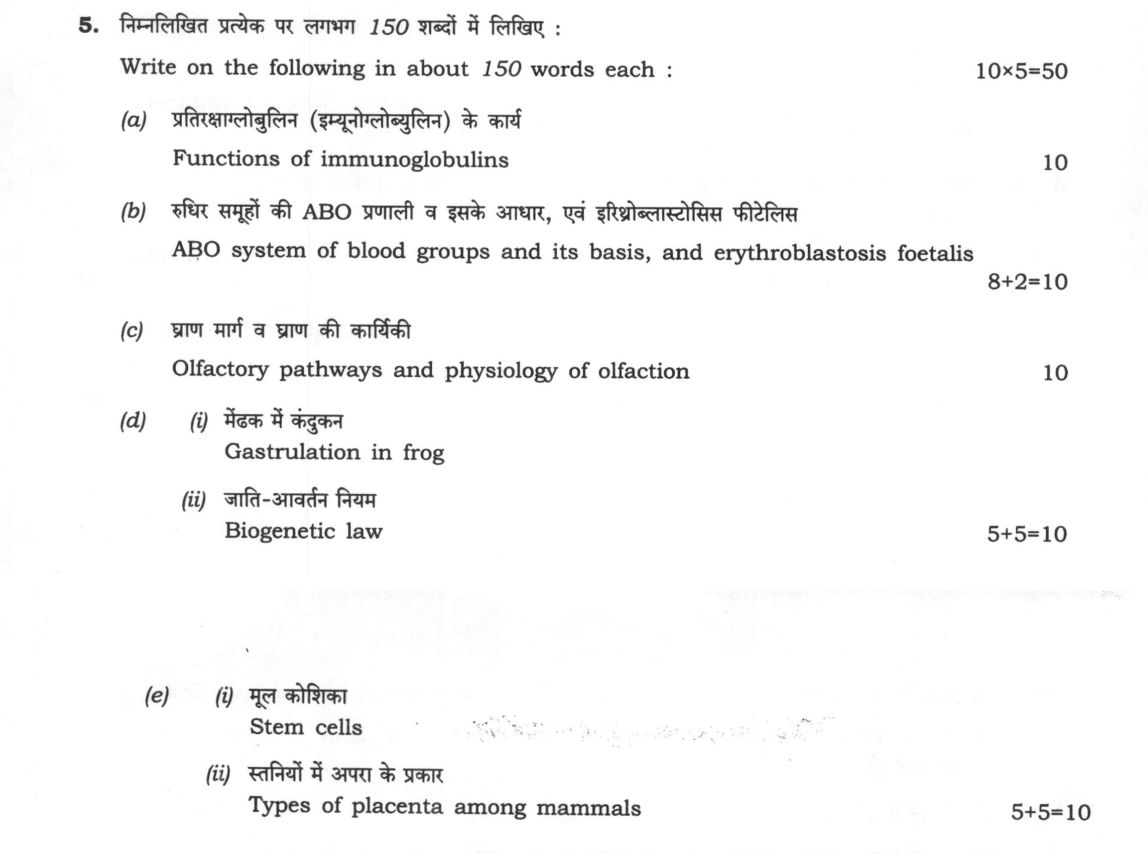
Write on the following in about 150 words each: (a) Functions of immunoglobulins (10 marks) (b) ABO system of blood groups and…
Write on the following in about 150 words each: Functions of immunoglobulins 10 marks
ABO system of blood groups and its basis, and erythroblastosis foetalis (8+2=10 marks)
Olfactory pathways and physiology of olfaction 10 marks
Gastrulation in frog 5 marks
Biogenetic law 5 marks
Stem cells 5 marks
Types of placenta among mammals 5 marks
हिंदी में प्रश्न पढ़ें
निम्नलिखित प्रत्येक पर लगभग 150 शब्दों में लिखिए : प्रतिरक्षाल्बुलिन (इम्युनोग्लोब्युलिन) के कार्य (10 अंक)
श्वेतर समूहों की ABO प्रणाली व इसके आधार, एवं इरिथ्रोब्लास्टोसिस फोटेलिस (8+2=10 अंक)
घ्राण मार्ग व घ्राण की कार्यिकी (10 अंक)
मेंढक में कंडुकन (5 अंक)
जाति-आवर्तन नियम (5 अंक)
मूल कोशिका (5 अंक)
स्तनियों में अपरा के प्रकार (5 अंक)
Model answer
Written by UPSC Answer Check against this question's marking rubric, to the 150-word length. UPSC does not publish answers for Mains — this is one way to score well, not an official key.
(a) Functions of immunoglobulins Immunoglobulins are heterotetrameric glycoproteins, each with two identical heavy chains and two light chains, forming Fab antigen-binding and Fc effector regions. The Fab region determines antigen specificity, while the Fc region determines effector functions such as complement binding and Fc-receptor interaction. IgG is the major serum antibody; it opsonizes microbes, neutralizes toxins, activates complement, and crosses the placenta via FcRn to give passive neonatal immunity. IgM is a pentamer, appears in the primary response, and is a potent complement activator. IgA, especially secretory IgA, protects mucosal surfaces in saliva, tears, milk and gut. IgE binds mast cells and basophils, mediating immediate hypersensitivity and defence against helminths through eosinophils and mast-cell degranulation. IgD mainly serves as a membrane-bound B-cell receptor, participating in B-cell maturation and activation.
(b) ABO system and erythroblastosis foetalis The ABO system is based on carbohydrate antigens on red-cell membranes. The H antigen, made by FUT1, is modified by A or B glycosyltransferases; type A has A antigen, type B has B antigen, type AB both, type O only H. Naturally occurring IgM anti-A or anti-B antibodies occur in plasma of individuals lacking the corresponding antigen. The Bombay phenotype (hh) lacks H antigen, so A/B antigens cannot be expressed and such persons make anti-H, making transfusion special. Erythroblastosis foetalis mainly follows Rh incompatibility: an Rh-negative mother sensitized by Rh-positive fetal cells makes IgG anti-D, which crosses the placenta in later pregnancies and haemolyses fetal Rh-positive erythrocytes. Anti-D immunoglobulin (RhoGAM) given prophylactically prevents maternal sensitization.
(c) Olfactory pathways and physiology Olfaction begins in the olfactory epithelium of the nasal cavity, where bipolar olfactory receptor neurons bear cilia in mucus and Bowman’s glands secrete mucus. Odorant molecules bind G-protein-coupled receptors on cilia; Gs activates adenylyl cyclase, raising cAMP, opening cyclic-nucleotide-gated channels, depolarizing the neuron. Axons form fila olfactoria, pass through the cribriform plate, and synapse in glomeruli of the olfactory bulb. Mitral and tufted cells project via the lateral olfactory tract to the piriform cortex, amygdala and hippocampus, linking smell with emotion and memory. Adaptation occurs when Ca2+ entering through CNG channels activates calmodulin, which inhibits further channel opening and stimulates phosphodiesterase to lower cAMP, reducing sensitivity.
(d)(i) Gastrulation in frog In the frog blastula, the dorsal lip of the blastopore forms first. Involution begins as prospective endoderm and mesoderm roll over the lip and move inward, forming the archenteron. The process converts a two-layered blastula into a three-layered gastrula. The dorsal lip is the Spemann-Mangold organizer; when transplanted it can induce a secondary axis, showing organizer activity. Cells migrating through the blastopore include presumptive notochord, somites, neural tube and other mesodermal tissues. As the blastopore closes, the archenteron becomes the gut, and the body axes are established.
(d)(ii) Biogenetic law Haeckel’s biogenetic law stated that ontogeny recapitulates phylogeny: embryonic development briefly repeats ancestral adult forms. Its evolutionary significance was to show that embryos of related vertebrates share common features, such as pharyngeal pouches and tails, supporting descent with modification. In vertebrate embryos, early stages of fish, amphibian, reptile, bird and mammal show similar pharyngeal arches. Modern embryology rejects strict recapitulation because development is not a simple replay of adult stages. Heterochrony, changes in timing and rate of developmental events, and paedomorphosis, retention of juvenile traits in adults, explain similarities and differences. Thus the law is a historical insight, not a literal rule.
(e)(i) Stem cells Stem cells are cells that self-renew and give rise to differentiated progeny. Potency defines their capacity: totipotent cells form all embryonic and extra-embryonic tissues; pluripotent cells form all three germ layers; multipotent cells form limited lineages; unipotent cells produce one cell type. Sources include embryonic stem cells, adult tissue stem cells such as haematopoietic and neural stem cells, and induced pluripotent stem cells reprogrammed from somatic cells. Their potency makes them central to developmental biology. They are important in regenerative medicine for tissue repair, disease modelling and potential cell therapies.
(e)(ii) Types of placenta Mammalian placentas are classified by the histological barrier between maternal blood and fetal trophoblast. In epitheliochorial placentas, maternal epithelium remains, as in pig and cow; in syndesmochorial placentas, maternal connective tissue remains; in endotheliochorial placentas, maternal endothelium remains, as in horse; in hemochorial placentas, maternal blood directly contacts trophoblast, as in cat and human. The barrier type affects exchange of gases, nutrients and waste. A thinner barrier generally increases exchange efficiency, while a thicker barrier offers more maternal-fetal separation. Human placenta is hemochorial and supports efficient nutrient, gas and waste exchange, with IgG transfer by receptor-mediated FcRn rather than simple diffusion.
Thus, immunoglobulins, blood-group compatibility, olfactory signalling, gastrulation, stem-cell potency and placental barriers together describe the molecular, developmental and physiological mechanisms that maintain immunity, reproduction and organismal form.
What "Describe" is asking you to do
Give a full, ordered account of the thing named — its parts, stages or mechanism — in the sequence in which it actually exists or occurs. Most describe questions come from the science optionals, where the marks sit in correct technical detail and, where the stem says so, a labelled diagram.
Structure that answers it
One-line identification of the subject → the parts or stages in their real order, each with its defining detail → labelled diagram where the subject is structural → closing line on function or significance
Where marks are lost
Loose general prose where the examiner is ticking named parts, correct terminology and their sequence; and in the General Studies papers, turning to evaluation before the description is finished.
How this answer will be evaluated
Approach
Framework: Zoology Paper 2: Define > Structure/Mechanism > Diagram > Example. (a) write short notes: define > 3-4 key features > one example > one-line significance | (b) write short notes: define > 3-4 key features > one example > one-line significance | (c) write short notes: define > 3-4 key features > one example > one-line significance | (d(i)) write short notes: define > 3-4 key features > one example > one-line significance | (d(ii)) write short notes: define > 3-4 key features > one example > one-line significance | (e(i)) write short notes: define > 3-4 key features > one example > one-line significance | (e(ii)) write short notes: define > 3-4 key features > one example > one-line significance Full marks: Precise definitions, clear mechanisms, labelled diagrams, and specific examples.
Key points expected
- Neutralization of toxins and pathogens
- Opsonization and phagocytosis
- Activation of complement system
- Agglutination of antigens
- Antigen-antibody basis of ABO groups
- Inheritance of blood groups
- Mechanism of Rh incompatibility
- Consequences for the fetus
Evaluation rubric
Each sub-part is marked on its own, against the marks and word limit printed on the paper.
- (a) Define immunoglobulins and list their key physiological functions. 10 marks · 150 words
write short notes— define → 3-4 key features → one example → one-line significance
Must cover
- Neutralization of toxins and pathogens
- Opsonization and phagocytosis
- Activation of complement system
- Agglutination of antigens
Loses marks
- Listing functions without mechanism
- Confusing with cytokines
Earns more
- Mention of IgG, IgM, IgA classes
- Role in passive immunity
Extra mark
- Diagram of antibody structure
- (b) Explain ABO blood group basis and the mechanism of erythroblastosis foetalis. 10 marks · 150 words
write short notes— define → 3-4 key features → one example → one-line significance
Must cover
- Antigen-antibody basis of ABO groups
- Inheritance of blood groups
- Mechanism of Rh incompatibility
- Consequences for the fetus
Loses marks
- Confusing ABO with Rh system
- Omitting the basis of grouping
Earns more
- Mention of anti-D immunoglobulin
- Specificity of A and B antigens
Extra mark
- Diagram of blood group inheritance
- (c) Describe the olfactory pathway and the physiology of smell perception. 10 marks · 150 words
write short notes— define → 3-4 key features → one example → one-line significance
Must cover
- Olfactory receptor neurons
- Pathway to olfactory bulb
- Projection to olfactory cortex
- Mechanism of odorant binding
Loses marks
- Confusing with gustatory pathway
- Omitting the central pathway
Earns more
- Mention of glomeruli
- Role of mucus in olfaction
Extra mark
- Labelled diagram of olfactory pathway
- (d(i)) Describe the process of gastrulation in a frog embryo. 5 marks · 150 words
write short notes— define → 3-4 key features → one example → one-line significance
Must cover
- Involution of blastula cells
- Formation of archenteron
- Formation of germ layers
- Role of blastopore
Loses marks
- Confusing with mammalian gastrulation
- Omitting the archenteron
Earns more
- Mention of specific frog species
- Timing of gastrulation
Extra mark
- Labelled diagram of frog gastrulation
- (d(ii)) Explain the biogenetic law and its significance in evolution. 5 marks · 150 words
write short notes— define → 3-4 key features → one example → one-line significance
Must cover
- Definition of biogenetic law
- Ontogeny recapitulates phylogeny
- Examples of embryonic stages
- Significance in evolutionary biology
Loses marks
- Overstating the law's validity
- Omitting the evolutionary context
Earns more
- Mention of Haeckel
- Critiques of the law
Extra mark
- Diagram of embryonic stages
- (e(i)) Define stem cells and describe their types and functions. 5 marks · 150 words
write short notes— define → 3-4 key features → one example → one-line significance
Must cover
- Definition of stem cells
- Types: embryonic and adult
- Self-renewal and differentiation
- Applications in medicine
Loses marks
- Confusing with progenitor cells
- Omitting the self-renewal property
Earns more
- Mention of pluripotency
- Ethical considerations
Extra mark
- Diagram of stem cell differentiation
- (e(ii)) Describe the types of placenta found among mammals. 5 marks · 150 words
write short notes— define → 3-4 key features → one example → one-line significance
Must cover
- Epitheliochorial placenta
- Syndesmochorial placenta
- Hemochorial placenta
- Examples of mammals for each type
Loses marks
- Confusing with non-mammalian placentas
- Omitting the examples
Earns more
- Mention of specific mammal species
- Functional differences between types
Extra mark
- Diagram of placental types
Practice this exact question
Write your answer and it is marked point by point against the model answer above — what you covered, what you missed, what you got wrong.
Evaluate my answer →More from Zoology 2024 Paper II
- Q2 (a) Give an account of ultrastructure of rough and smooth endoplasmic reticulum. Also dis…
- Q3 (a) What is sex-determination? Give an account of genic balance theory of sex-determinati…
- Q4 (a) Describe the stages of human evolution and mention the major hominid forms giving the…
- Q5 Write on the following in about 150 words each: (a) Functions of immunoglobulins (10 mark…
- Q6 (a) Explain the structure of nephron and its role in urine formation. Add a note on hormo…
- Q7 (a) Describe the process of spermatogenesis. Add a note on the role of Golgi bodies in th…
- Q8 (a) Write about the role of liver and pancreas in digestion. Add a note on neural and hor…