Paper II — Q4
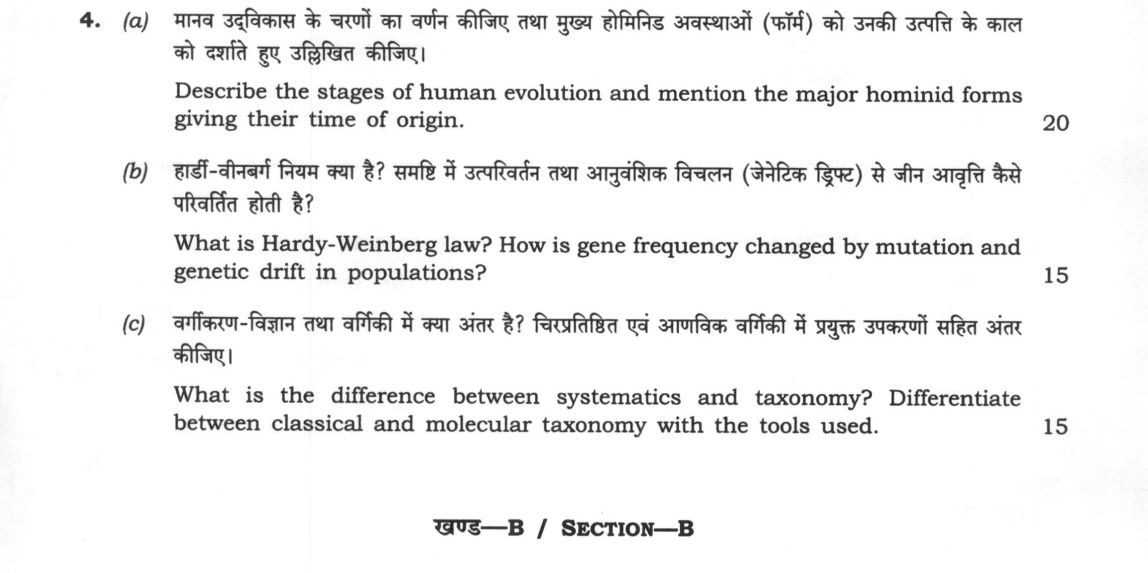
(a) Describe the stages of human evolution and mention the major hominid forms giving their time of origin. (20 marks) (b) What…
Describe the stages of human evolution and mention the major hominid forms giving their time of origin. 20 marks
What is Hardy-Weinberg law? How is gene frequency changed by mutation and genetic drift in populations? 15 marks
What is the difference between systematics and taxonomy? Differentiate between classical and molecular taxonomy with the tools used. 15 marks
हिंदी में प्रश्न पढ़ें
मानव उद्विकास के चरणों का वर्णन कीजिए तथा मुख्य होमिनिड अवस्थाओं (फॉर्म) को उनकी उत्पत्ति के काल को दर्शाते हुए उल्लिखित कीजिए। (20 अंक)
हार्डी-वीनबर्ग नियम क्या है? समष्टि में उत्परिवर्तन तथा आनुवंशिक विचलन (जेनेटिक ड्रिफ्ट) से जीन आवृत्ति कैसे परिवर्तित होती है? (15 अंक)
वर्गीकरण-विज्ञान तथा वर्गिकी में क्या अंतर है? चिरप्रतिष्ठित एवं आणविक वर्गिकी में प्रयुक्त उपकरणों सहित अंतर कीजिए। (15 अंक)
Model answer
Written by UPSC Answer Check against this question's marking rubric, to the expected length. UPSC does not publish answers for Mains — this is one way to score well, not an official key.
Human evolution is best described as a sequential record of hominid forms in which bipedalism, brain enlargement, dental reduction and tool use became progressively linked. Stages and hominid forms. In the Miocene, early apes such as Dryopithecus (~12–9 Mya) and Ramapithecus (~14–8 Mya) provide the background for hominid origins; Ramapithecus was historically debated as a hominid relative but is not accepted as a bipedal ancestor. In the Pliocene and early Pleistocene, Australopithecus appears: A. anamensis (~4.2–3.9 Mya), A. afarensis (~3.9–2.9 Mya, represented by Lucy), and A. africanus (~3.3–2.1 Mya, represented by the Taung Child). These forms show habitual bipedalism, cranial capacities of about 400–550 cc, reduced canines and jaws, and little consistent tool use. Homo habilis (~2.4–1.4 Mya) marks the first clear association of larger brains (~500–700 cc) with Oldowan stone tools and further dental reduction. Homo erectus (~1.9–0.3 Mya) shows cranial capacity rising to about 800–1200 cc, Acheulean tools, probable control of fire, and wider dispersal. Homo neanderthalensis (~0.4–0.04 Mya) in Europe and western Asia had a large brain (~1200–1700 cc), robust body, and advanced stone-tool behaviour. Homo sapiens (~0.3 Mya to present) originated in Africa, with cranial capacity around 1300–1500 cc, symbolic behaviour, complex tools and global expansion. Across these stages, the post-cranial skeleton indicates bipedalism before major brain expansion, while the dentition and skull show reduction of jaw and tooth size as diet and tool use changed.
Hardy-Weinberg law. The Hardy-Weinberg law states that allele and genotype frequencies in a population remain constant from generation to generation when the population is large, mating is random, and there is no mutation, selection, migration or genetic drift. For two alleles A and a, with frequencies p and q, p + q = 1 and the genotype frequencies are p² + 2pq + q² = 1, where p² is homozygous dominant, 2pq heterozygous and q² homozygous recessive. The law is a null model: if observed genotype frequencies deviate from p², 2pq and q², one or more assumptions are being violated. Mutation changes gene frequency by converting one allele into another and by introducing new alleles; it is the raw material of evolution. Mutation pressure may be directional, when one allele changes into another more often, or non-directional/balanced when back mutation occurs. Mutation rates are usually low, so mutation alone changes frequencies slowly, but it continually supplies variation on which selection and drift act. Genetic drift changes gene frequency by random sampling error, especially in small populations. It can fix or eliminate alleles regardless of fitness. Drift is stochastic; its effect is inversely related to population size, so isolated or fragmented populations may diverge rapidly. Bottleneck effects, where a population is sharply reduced, and founder effects, where a small group colonises a new area, are special cases of drift.
Systematics and taxonomy. Systematics is the broader science of biological diversity, including description, identification, nomenclature, classification and evolutionary relationships. Taxonomy is the practical discipline of naming, describing and classifying organisms. Classical taxonomy relies on morphology, anatomy, embryology and comparative anatomy, using herbarium sheets, museum specimens and dichotomous keys. Classical taxonomy can be constrained by convergent morphology and incomplete fossils, whereas molecular taxonomy can detect cryptic species and clarify deep relationships. Molecular taxonomy uses DNA and RNA sequences, PCR, RFLP, DNA barcoding and phylogenomics to infer relationships. Its tools include BLAST for sequence comparison, ClustalW for multiple sequence alignment, mitochondrial DNA for maternal lineages and ribosomal RNA sequencing for deep phylogenies. Thus, modern evolutionary biology integrates fossil hominid morphology, population-genetic principles and molecular systematics to explain how forms, gene frequencies and classifications change over time.
What "Describe" is asking you to do
Give a full, ordered account of the thing named — its parts, stages or mechanism — in the sequence in which it actually exists or occurs. Most describe questions come from the science optionals, where the marks sit in correct technical detail and, where the stem says so, a labelled diagram.
Structure that answers it
One-line identification of the subject → the parts or stages in their real order, each with its defining detail → labelled diagram where the subject is structural → closing line on function or significance
Where marks are lost
Loose general prose where the examiner is ticking named parts, correct terminology and their sequence; and in the General Studies papers, turning to evaluation before the description is finished.
How this answer will be evaluated
Approach
Framework: null. (a) describe: define > structure or process in order > labelled diagram > significance | (b) explain: definition/context > points in order > small example > short close | (c) compare: paired headings or table > key differences > significance > conclusion Full marks: Comprehensive, chronologically accurate, with precise terminology and clear differentiation of concepts.
Key points expected
- Define human evolution and its stages
- List major hominid forms in chronological order
- Provide time of origin for each form
- Describe key morphological/behavioral changes
- State Hardy-Weinberg equilibrium conditions
- Define gene frequency change mechanism
- Explain mutation's role in introducing variation
- Explain genetic drift's random sampling effect
Evaluation rubric
Each sub-part is marked on its own, against the marks and word limit printed on the paper.
- (a) Chronological account of human evolution stages with specific hominid forms and their time of origin. 20 marks
describe— define → structure or process in order → labelled diagram → significance
Must cover
- Define human evolution and its stages
- List major hominid forms in chronological order
- Provide time of origin for each form
- Describe key morphological/behavioral changes
Loses marks
- Omitting time of origin for forms
- Listing forms without chronological order
- Confusing hominid with non-hominid primates
Earns more
- Mention Australopithecus, Homo habilis, Homo erectus
- Include Homo sapiens and Neanderthals
- Reference specific geological epochs
- Mention fossil evidence locations
Extra mark
- Include a simple evolutionary tree diagram
- Mention specific fossil sites like Olduvai Gorge
- (b) Definition of Hardy-Weinberg law and explanation of how mutation and genetic drift alter gene frequency. 15 marks
explain— definition/context → points in order → small example → short close
Must cover
- State Hardy-Weinberg equilibrium conditions
- Define gene frequency change mechanism
- Explain mutation's role in introducing variation
- Explain genetic drift's random sampling effect
Loses marks
- Confusing drift with natural selection
- Omitting equilibrium conditions
- Failing to link mutation to new alleles
Earns more
- Use p + q = 1 notation
- Distinguish directional vs neutral mutations
- Mention bottleneck and founder effects
- Link drift to small population size
Extra mark
- Provide a simple numerical example
- Mention specific population studies
- (c) Distinction between systematics and taxonomy, and differentiation of classical vs molecular taxonomy with tools. 15 marks
compare— paired headings or table → key differences → significance → conclusion
Must cover
- Define systematics and taxonomy separately
- Differentiate classical taxonomy methods
- Differentiate molecular taxonomy methods
- List specific tools for each approach
Loses marks
- Treating systematics and taxonomy as identical
- Omitting tools for molecular taxonomy
- Failing to distinguish classical from molecular
Earns more
- Mention morphological vs DNA sequencing
- Reference phylogenetic trees
- Mention electrophoresis or PCR
- Discuss evolutionary relationships
Extra mark
- Mention specific software for molecular analysis
- Reference a specific taxonomic revision
Practice this exact question
Write your answer and it is marked point by point against the model answer above — what you covered, what you missed, what you got wrong.
Evaluate my answer →More from Zoology 2024 Paper II
- Q1 Write on the following in about 150 words each: (a) Polytene chromosome (10 marks) (b) Di…
- Q2 (a) Give an account of ultrastructure of rough and smooth endoplasmic reticulum. Also dis…
- Q3 (a) What is sex-determination? Give an account of genic balance theory of sex-determinati…
- Q4 (a) Describe the stages of human evolution and mention the major hominid forms giving the…
- Q5 Write on the following in about 150 words each: (a) Functions of immunoglobulins (10 mark…
- Q6 (a) Explain the structure of nephron and its role in urine formation. Add a note on hormo…
- Q7 (a) Describe the process of spermatogenesis. Add a note on the role of Golgi bodies in th…