Paper II — Q3
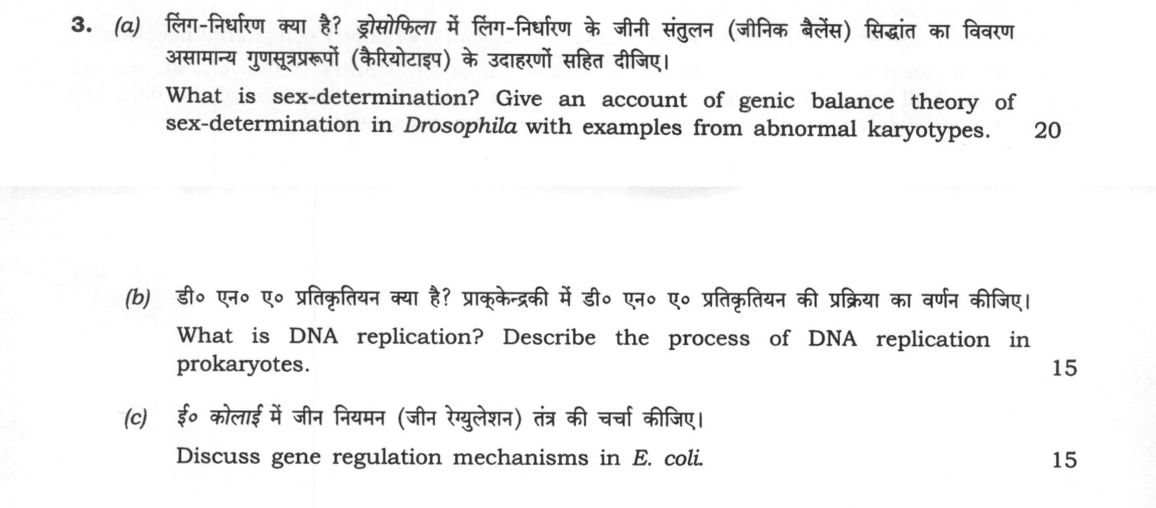
(a) What is sex-determination? Give an account of genic balance theory of sex-determination in Drosophila with examples from…
What is sex-determination? Give an account of genic balance theory of sex-determination in Drosophila with examples from abnormal karyotypes. 20 marks
What is DNA replication? Describe the process of DNA replication in prokaryotes. 15 marks
Discuss gene regulation mechanisms in E. coli. 15 marks
हिंदी में प्रश्न पढ़ें
लिंग-निर्धारण क्या है? ड्रोसोफिला में लिंग-निर्धारण के जीनी संतुलन (जीनिक बैलेंस) सिद्धांत का विवरण असामान्य गुणसूत्रप्ररूपों (कैरियोटाइप) के उदाहरणों सहित दीजिए। (20 अंक)
डी० एन० ए० प्रतिकृतियन क्या है? प्राक्केंद्रकी में डी० एन० ए० प्रतिकृतियन की प्रक्रिया का वर्णन कीजिए। (15 अंक)
ई० कोलाई में जीन नियमन (जीन रेगुलेशन) तंत्र की चर्चा कीजिए। (15 अंक)
Model answer
Written by UPSC Answer Check against this question's marking rubric, to the expected length. UPSC does not publish answers for Mains — this is one way to score well, not an official key.
(a) Sex Determination and Genic Balance Theory in Drosophila
Sex-determination is the genetic mechanism establishing the sexual phenotype of an organism, distinct from sex differentiation, which is the downstream morphological and physiological development of sex characteristics. In Drosophila melanogaster, C.B. Bridges formulated the Genic Balance Theory, postulating that sex is determined by the numerical ratio between X chromosomes (carrying female-determining factors) and sets of autosomes (A, carrying male-determining factors), expressed as the X:A ratio.
An X:A ratio of 1.0 produces a female, while a ratio of 0.5 produces a male. Ratios between 0.5 and 1.0 result in intersex individuals, while ratios exceeding 1.0 or falling below 0.5 result in inviable or sterile metafemales and metamales, respectively. The Y chromosome plays no role in sex determination, although it is required for male fertility.
Abnormal karyotypes substantiate this theory. Individuals with 2X:2A (ratio 1.0) or XXY:2A (ratio 1.0) develop as fertile females despite the presence of a Y chromosome. Individuals with XY:2A (ratio 0.5) develop as normal males, whereas XO:2A (ratio 0.5) develops into a morphologically normal but sterile male due to the absence of the Y-borne fertility factors. Flies with 3X:2A (ratio 1.5) develop as metafemales (superfemales), which are sterile and weakly viable. A 2X:3A karyotype (ratio 0.67) produces an intersex fly displaying a mosaic of intermediate male and female traits. A 1X:3A karyotype (ratio 0.33) yields a sterile, inviable metamale (supermale).
(b) DNA Replication in Prokaryotes
DNA replication is the biological process of duplicating a double-stranded DNA molecule into two identical copies through a semiconservative mechanism, wherein each daughter duplex retains one parental and one newly synthesized strand.
In E. coli, replication initiates at a unique locus, oriC. DnaA initiator proteins bind to specific 9-mer repeats, causing localized denaturation at 13-mer AT-rich regions. DnaB helicase unwinds the double helix bidirectionally, while single-stranded DNA-binding (SSB) proteins stabilize the exposed templates and DNA gyrase (topoisomerase II) relieves positive supercoiling ahead of the fork.
DnaG primase synthesizes short RNA primers complementary to the DNA template. The replisome core, DNA polymerase III, extends these primers in the 5' to 3' direction. On the leading strand, synthesis is continuous toward the replication fork. On the lagging strand, synthesis occurs discontinuously away from the fork, generating short Okazaki fragments. DNA polymerase I removes the RNA primers utilizing its 5' to 3' exonuclease activity and fills the resulting gaps via its 5' to 3' polymerase activity. Finally, DNA ligase catalyzes the formation of phosphodiester bonds to seal the remaining nicks.
(c) Gene Regulation Mechanisms in E. coli
Gene regulation in E. coli coordinates metabolic adaptation primarily at the level of transcription through multi-cistronic operons containing regulatory genes, promoters, operators, and structural genes.
The lac operon exemplifies negative inducible control. In the absence of lactose, the *lacI*-encoded repressor binds the operator, physically blocking RNA polymerase. When lactose is present, its isomer allolactose acts as an inducer, binding the repressor and causing an allosteric shift that releases it from the operator to allow transcription of lacZ, lacY, and lacA. The operon is further regulated by positive control via catabolite repression; low glucose levels elevate cyclic AMP (cAMP), which complexes with the Catabolite Activator Protein (CRP/CAP) to bind the promoter and enhance RNA polymerase recruitment.
The trp operon operates under negative repressible control for tryptophan biosynthesis. The active corepressor, tryptophan, binds the inactive TrpR aporepressor, enabling it to attach to the operator and repress transcription when end-product levels are sufficient. Fine-tuning occurs via transcriptional attenuation, where translation of a leader peptide responds to charged tRNA^Trp levels; excess tryptophan causes the ribosome to advance rapidly, allowing the formation of an intrinsic 3-4 transcription terminator hairpin that prematurely aborts transcription.
What "Describe" is asking you to do
Give a full, ordered account of the thing named — its parts, stages or mechanism — in the sequence in which it actually exists or occurs. Most describe questions come from the science optionals, where the marks sit in correct technical detail and, where the stem says so, a labelled diagram.
Structure that answers it
One-line identification of the subject → the parts or stages in their real order, each with its defining detail → labelled diagram where the subject is structural → closing line on function or significance
Where marks are lost
Loose general prose where the examiner is ticking named parts, correct terminology and their sequence; and in the General Studies papers, turning to evaluation before the description is finished.
How this answer will be evaluated
Approach
Framework: Zoology, Paper 2. (a) account for: state the phenomenon > the causes in order of weight > conclusion | (b) describe: define > structure or process in order > labelled diagram > significance | (c) discuss: intro > 3-4 dimensions > example > balanced close Full marks: Comprehensive, accurate, and well-structured answers with clear diagrams and examples.
Key points expected
- Define sex-determination as the mechanism of sex development
- State the X:A ratio (X chromosome to Autosome ratio)
- Explain the mechanism of genic balance theory
- Provide examples of abnormal karyotypes (e.g., XXY, XO, XXX)
- Define DNA replication as the synthesis of DNA
- Identify the origin of replication (oriC)
- Describe the semi-conservative nature of replication
- Explain the roles of key enzymes (helicase, primase, DNA pol III)
Evaluation rubric
Each sub-part is marked on its own, against the marks and word limit printed on the paper.
- (a) Define sex-determination and explain the genic balance theory in Drosophila using abnormal karyotypes. 20 marks
account for— state the phenomenon → the causes in order of weight → conclusion
Must cover
- Define sex-determination as the mechanism of sex development
- State the X:A ratio (X chromosome to Autosome ratio)
- Explain the mechanism of genic balance theory
- Provide examples of abnormal karyotypes (e.g., XXY, XO, XXX)
Loses marks
- Confusing genic balance with haplodiploidy
- Failing to link karyotype to phenotype
- Omitting the definition of sex-determination
Earns more
- Mention the role of the Sxl gene
- Discuss the concept of intersexes
- Reference the work of Calvin Bridges
- Include a table of karyotypes and phenotypes
Extra mark
- Mention the specific gene 'transformer'
- Reference the 'double sex' gene
- (b) Define DNA replication and describe the process in prokaryotes. 15 marks
describe— define → structure or process in order → labelled diagram → significance
Must cover
- Define DNA replication as the synthesis of DNA
- Identify the origin of replication (oriC)
- Describe the semi-conservative nature of replication
- Explain the roles of key enzymes (helicase, primase, DNA pol III)
Loses marks
- Confusing prokaryotic with eukaryotic replication
- Omitting the semi-conservative nature
- Failing to name the key enzymes
Earns more
- Mention the role of DNA ligase
- Describe the formation of the replication fork
- Explain the role of SSB proteins
- Mention the role of topoisomerase
Extra mark
- Mention the specific prokaryotic organism (e.g., E. coli)
- Include a diagram of the replication fork
- (c) Discuss gene regulation mechanisms in E. coli. 15 marks
discuss— intro → 3-4 dimensions → example → balanced close
Must cover
- Define gene regulation as the control of gene expression
- Explain the lac operon as a model system
- Describe the role of the repressor protein
- Explain the role of the inducer (lactose/allolactose)
Loses marks
- Confusing gene regulation with gene expression
- Failing to explain the mechanism of the lac operon
- Omitting the role of the repressor protein
Earns more
- Mention the trp operon as an example of repression
- Explain the concept of positive regulation (CAP-cAMP)
- Describe the role of the operator sequence
- Mention the role of the promoter sequence
Extra mark
- Mention the specific gene 'lacI'
- Reference the work of Jacob and Monod
Practice this exact question
Write your answer and it is marked point by point against the model answer above — what you covered, what you missed, what you got wrong.
Evaluate my answer →More from Zoology 2024 Paper II
- Q1 Write on the following in about 150 words each: (a) Polytene chromosome (10 marks) (b) Di…
- Q2 (a) Give an account of ultrastructure of rough and smooth endoplasmic reticulum. Also dis…
- Q3 (a) What is sex-determination? Give an account of genic balance theory of sex-determinati…
- Q4 (a) Describe the stages of human evolution and mention the major hominid forms giving the…
- Q5 Write on the following in about 150 words each: (a) Functions of immunoglobulins (10 mark…
- Q6 (a) Explain the structure of nephron and its role in urine formation. Add a note on hormo…