Paper I — Q8
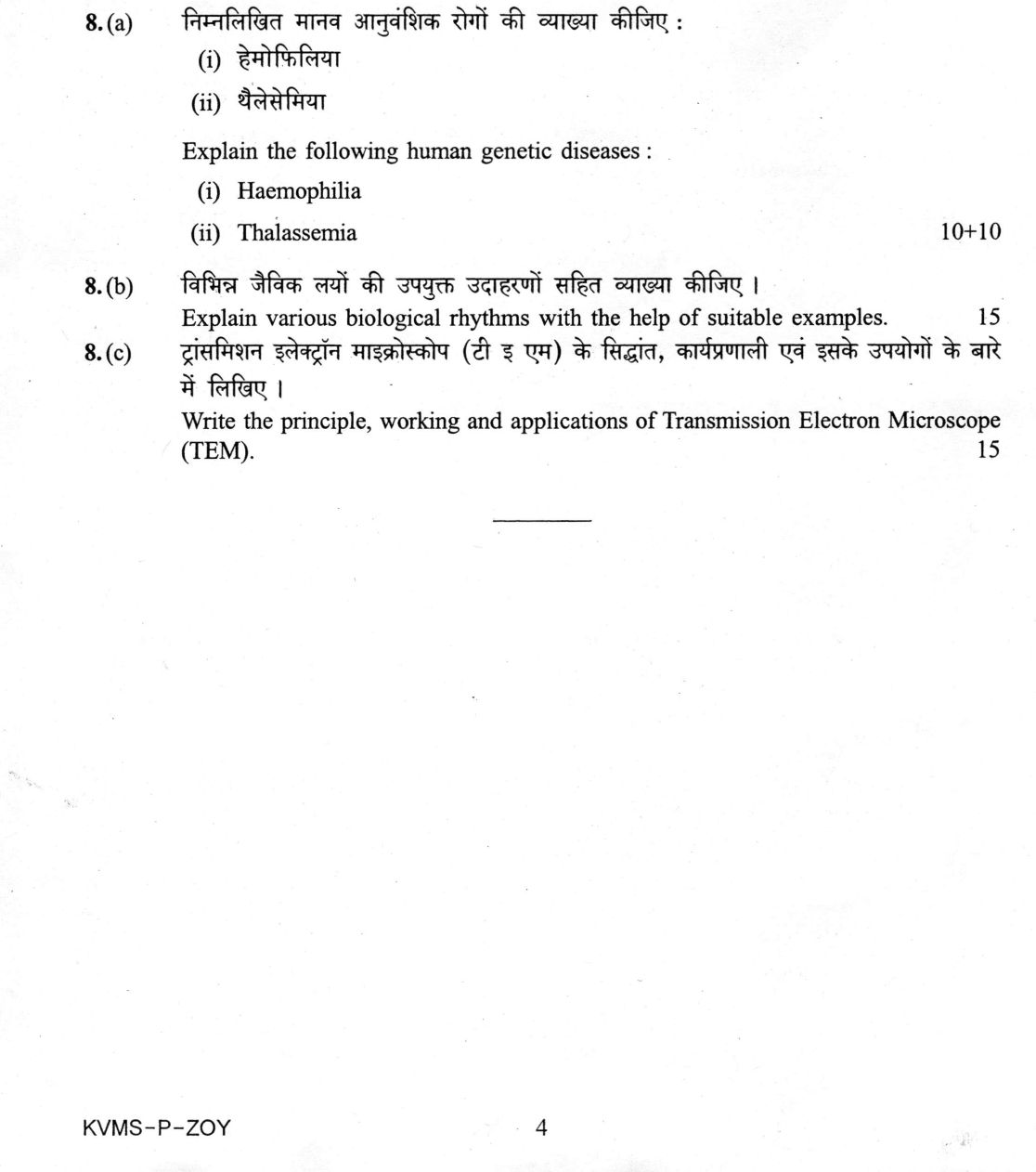
(a) Explain the following human genetic diseases : (i) Haemophilia (ii) Thalassemia (20 marks) (b) Explain various biological…
Explain the following human genetic diseases : Haemophilia
Thalassemia 20 marks
Explain various biological rhythms with the help of suitable examples. 15 marks
Write the principle, working and applications of Transmission Electron Microscope (TEM). 15 marks
हिंदी में प्रश्न पढ़ें
निम्नलिखित मानव आनुवंशिक रोगों की व्याख्या कीजिए : हेमोफिलिया
थैलेसीमिया (20 अंक)
विभिन्न जैविक लयों की उपयुक्त उदाहरणों सहित व्याख्या कीजिए । (15 अंक)
ट्रांसमिशन इलेक्ट्रॉन माइक्रोस्कोप (टी इ एम) के सिद्धांत, कार्यप्रणाली एवं इसके उपयोगों के बारे में लिखिए । (15 अंक)
Model answer
Drafted with AI by UPSC Answer Check against this question's marking rubric, to the expected length. UPSC does not publish answers for Mains — this is one way to score well, not an official key. How we build rubrics and answers.
(a)(i) Haemophilia (10 marks)
Haemophilia is an X-linked recessive bleeding disorder caused by a deficiency of a clotting factor.
Types. Haemophilia A (classical), from factor VIII deficiency (gene F8, Xq28), accounts for about 80–85% of cases. Haemophilia B (Christmas disease) is from factor IX deficiency (gene F9). Haemophilia C is a milder, autosomal deficiency of factor XI.
Inheritance. Males with one X chromosome are affected, and carrier females are usually healthy. An affected father passes the gene to all his daughters (carriers) and to none of his sons, and a carrier mother passes it to half of her sons (affected) and half of her daughters (carriers). Females are affected only if the father is affected and the mother is a carrier. The disease in the descendants of Queen Victoria is a classic example.
Defect and features. The intrinsic clotting pathway fails, so the clotting time and aPTT are prolonged but the bleeding time and prothrombin time are normal. The features are prolonged bleeding after injury, bleeding into joints (haemarthrosis), muscle haematomas and, at times, intracranial bleeding. Severity depends on factor level: below 1% is severe.
Management. Replacement of factor VIII or IX (recombinant), desmopressin for mild type A, and emicizumab for type A. Gene therapy is now available. Avoid aspirin and injury, and provide physiotherapy and genetic counselling.
(a)(ii) Thalassaemia (10 marks)
Thalassaemias are autosomal recessive disorders of haemoglobin caused by reduced or absent synthesis of the α- or β-globin chains. The unbalanced excess of the normal chain damages the red cells, leading to ineffective erythropoiesis and haemolysis, and a microcytic, hypochromic anaemia.
Alpha thalassaemia. Deletion of the α-globin genes (four genes on chromosome 16). One gene deleted gives a silent carrier, two the trait, three HbH disease (β₄ tetramers), and four Hb Bart's hydrops fetalis, which is fatal before or at birth.
Beta thalassaemia. Mutation in the HBB gene on chromosome 11. The heterozygous carrier (minor) has mild anaemia with raised HbA₂. The homozygous form (major, Cooley's anaemia) presents after six months, when foetal haemoglobin falls, with severe anaemia, enlarged liver and spleen, bone deformity (thalassaemic facies), poor growth and iron overload.
Diagnosis. Blood smear (target cells), HPLC or haemoglobin electrophoresis.
Management. Regular blood transfusion with iron chelation (deferasirox), splenectomy in some, bone-marrow (stem-cell) transplantation, and gene therapy.
Prevention in India. About 3–4% of Indians are beta-thalassaemia carriers, so premarital and antenatal carrier screening, genetic counselling and prenatal diagnosis (chorionic villus sampling at 10–12 weeks) are used.
(b) Biological rhythms (15 marks)
Biological rhythms are regular, repeating cycles in the physiology or behaviour of organisms. They are endogenous, driven by an internal biological clock, and persist under constant conditions with a free-running period close to, but not exactly, that of the environmental cycle. They are entrained, or synchronised, to the environment by zeitgebers ("time-givers") such as light and temperature.
Types by period.
- Circadian (about 24 hours): the sleep–wake cycle, body temperature and cortisol in humans, leaf movements in Phaseolus, and emergence of adult Drosophila.
- Ultradian (shorter than 24 hours): the heartbeat, breathing, and the 90-minute sleep cycle.
- Infradian (longer than 24 hours): the menstrual cycle (about 28 days) and hibernation.
- Circatidal (about 12.4 hours): the activity of the fiddler crab and other intertidal animals.
- Circalunar (about 29.5 days): the spawning of the palolo worm (Eunice viridis) and the midge Clunio.
- Circannual (about a year): bird migration, moulting and reproduction, and hibernation in ground squirrels.
Mechanism of the circadian clock. In mammals the master clock is the suprachiasmatic nucleus of the hypothalamus, which is reset by light through the retina and controls the pineal hormone melatonin. In cells, clock genes (Clock, Bmal1, Period, Cryptochrome, and Timeless in Drosophila) form a feedback loop of about 24 hours: CLOCK–BMAL1 turn on Period and Cryptochrome, whose proteins accumulate and inhibit CLOCK–BMAL1, are then degraded, and the cycle restarts.
Significance. Rhythms let organisms anticipate daily and seasonal change, time reproduction and migration, and support navigation with the sun compass. Their disruption causes jet lag and shift-work disorders.
(c) Transmission electron microscope (15 marks)
Principle. The TEM uses a beam of electrons in place of light. The wavelength of the electron, λ = h/√(2meV), is only about 0.004 nm at 100 kV, so the resolving power is about 0.1–0.2 nm, far better than the 200 nm of the light microscope, and magnification reaches about a million times. The beam passes through an ultrathin specimen, and dense or heavy-metal-stained regions scatter electrons more, producing contrast in the image.
Working.
- The electron gun (a heated tungsten filament, LaB₆ or field-emission source) produces electrons, which are accelerated by 60–120 kV.
- Electromagnetic condenser lenses focus the beam on the specimen.
- The objective lens forms the first magnified image, and the intermediate and projector lenses enlarge it further onto a fluorescent screen or a CCD camera.
- The whole column is kept under a high vacuum, so that the electrons are not scattered by air.
Specimen preparation. Fixation (glutaraldehyde and osmium tetroxide), dehydration, embedding in resin, cutting sections 50–100 nm thick with an ultramicrotome, and staining with uranyl acetate and lead citrate, then mounting on a copper grid. Viruses are prepared by negative staining.
Applications. Ultrastructure of cells and organelles, identification of viruses, diagnosis in pathology (kidney biopsy), structure of macromolecules by cryo-EM, immunogold labelling and study of nanomaterials. It cannot examine living specimens and may show artefacts.
How this answer will be evaluated
Evaluation rubric
Each sub-part is marked on its own, against the marks and word limit printed on the paper.
- (a) Explain (i) haemophilia and (ii) thalassaemia (10 + 10 = 20 marks). 20 marks
Must cover
- Haemophilia: X-linked recessive, types A, B and C, defect of factor VIII or IX, clinical features
- Haemophilia inheritance pattern with carrier females and management by factor replacement
- Thalassaemia: autosomal recessive, alpha and beta forms, major and trait, clinical picture
- Thalassaemia management and prevention: transfusion and chelation, screening and prenatal diagnosis in India
Loses marks
- Treating only one disease.
- Calling haemophilia autosomal or thalassaemia X-linked.
Earns more
- Roughly equal depth for both diseases.
- Correct gene and chromosome for each type.
Extra mark
- Gene therapy for either disease
- (b) Explain various biological rhythms with the help of suitable examples (15 marks). 15 marks
Must cover
- Definition with endogenous clock, zeitgeber, free-running period and entrainment
- Types: circadian, ultradian, infradian, circatidal, circalunar, circannual
- A named example for each type
- Mechanism of the circadian clock and its significance
Loses marks
- Listing rhythms without examples.
- Confusing circadian with circannual rhythms.
Earns more
- Suprachiasmatic nucleus and clock genes named.
- Adaptive value of rhythms.
Extra mark
- Melatonin and jet lag
- (c) Write the principle, working and applications of Transmission Electron Microscope (TEM) (15 marks). 15 marks
Must cover
- Principle: electron beam of short wavelength, high resolving power and scattering contrast
- Working: electron gun, condenser, objective and projector lenses, screen, high vacuum
- Specimen preparation: fixation, embedding, ultrathin sectioning, heavy-metal staining
- Applications and limitations
Loses marks
- Confusing TEM with SEM.
- No mention of vacuum or thin sections.
Earns more
- Numerical values of wavelength and resolution.
- Comparison with the light microscope.
Extra mark
- Cryo-EM and negative staining
What "Explain" is asking you to do
Make the working of something clear — what sets it off, what follows from what, and what it produces. Explain is the Commission's mechanism word: it dominates the technical papers and the “explain why” stems, where the marks sit in the causal chain and not in the label.
Structure that answers it
State what it is → the initiating condition → the chain of cause, step by step → an instance where it plays out → what the chain produces
Where marks are lost
Describing what something looks like instead of why it works that way. Naming the stages without linking them reads as description too.
Practice this exact question
Write your answer and it is marked point by point against the model answer above — what you covered, what you missed, what you got wrong.
Evaluate my answer →More from Zoology 2026 Paper I
- Q5 Write short notes on the following in about 150 words each : (a) Green house effect. (10…
- Q6 (a) Enumerate various population characteristics. Explain the following characteristics i…
- Q7 (a) Differentiate among alpha, beta and gamma diversity. Explain various factors which th…
- Q8 (a) Explain the following human genetic diseases : (i) Haemophilia (ii) Thalassemia (20 m…