Paper I — Q7
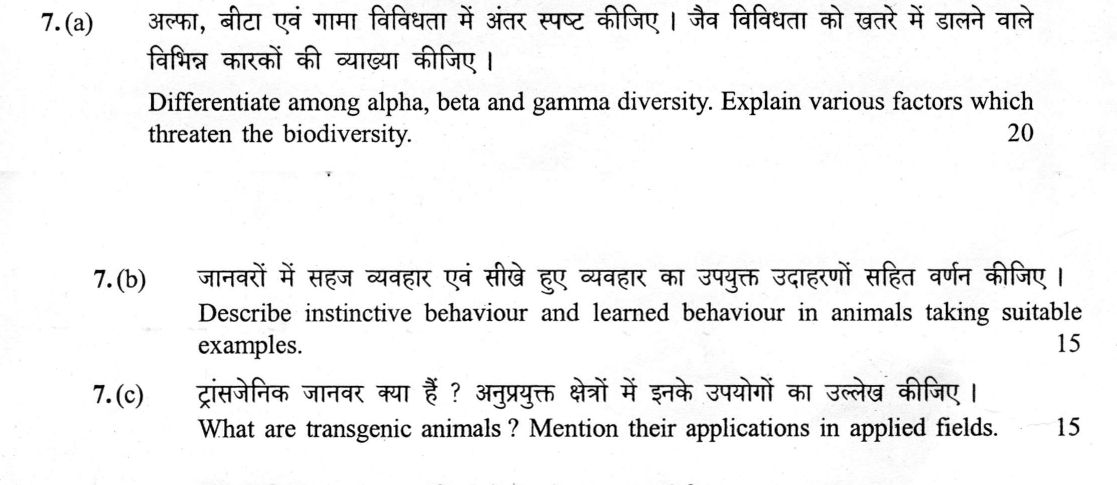
(a) Differentiate among alpha, beta and gamma diversity. Explain various factors which threaten the biodiversity. (20 marks) (b)…
Differentiate among alpha, beta and gamma diversity. Explain various factors which threaten the biodiversity. 20 marks
Describe instinctive behaviour and learned behaviour in animals taking suitable examples. 15 marks
What are transgenic animals ? Mention their applications in applied fields. 15 marks
हिंदी में प्रश्न पढ़ें
अल्फा, बीटा एवं गामा विविधता में अंतर स्पष्ट कीजिए । जैव विविधता को खतरे में डालने वाले विभिन्न कारकों की व्याख्या कीजिए । (20 अंक)
जानवरों में सहज व्यवहार एवं सीखे हुए व्यवहार का उपयुक्त उदाहरणों सहित वर्णन कीजिए । (15 अंक)
ट्रांसजेनिक जानवर क्या हैं ? अनुप्रयुक्त क्षेत्रों में इनके उपयोगों का उल्लेख कीजिए । (15 अंक)
Model answer
Drafted with AI by UPSC Answer Check against this question's marking rubric, to the expected length. UPSC does not publish answers for Mains — this is one way to score well, not an official key. How we build rubrics and answers.
(a) Alpha, beta and gamma diversity and threats to biodiversity (20 marks)
Alpha, beta and gamma diversity. Whittaker (1960, 1972) recognised three levels.
- Alpha (α) diversity is the diversity within a single community or habitat, measured as species richness or by indices such as Shannon's and Simpson's. A tropical forest patch has a high alpha diversity.
- Beta (β) diversity is the change in species composition between habitats or along a gradient (altitude, moisture), or the extent of species turnover. It is measured as β = γ/α, or by similarity indices (Jaccard, Sørensen). It is high when habitats share few species.
- Gamma (γ) diversity is the total diversity of a whole region or landscape made up of several habitats, the product of alpha and beta (γ = α × β), such as the whole of the Western Ghats.
Alpha is local, beta compares habitats, and gamma is regional.
Factors threatening biodiversity.
- Habitat loss, fragmentation and degradation: the greatest threat, from deforestation, agriculture, dams, mining and urbanisation, as in the loss of rainforest and wetlands.
- Overexploitation: hunting, poaching and overfishing, as in the tiger, one-horned rhinoceros, and the extinct passenger pigeon.
- Invasive alien species: Lantana, water hyacinth and Parthenium in India, and the Nile perch in Lake Victoria, which displaced native species.
- Pollution: pesticides such as DDT, which thinned bird eggshells, and diclofenac, which killed vultures in India, with plastics and eutrophication.
- Climate change: coral bleaching, shifts in species ranges and loss of glacier-fed habitats.
- Co-extinction: the loss of a species that depends on another, such as a parasite or a pollinator.
These are often called the "evil quartet" (habitat loss, overexploitation, introduced species and co-extinction), and diseases and human–wildlife conflict add to them.
(b) Instinctive and learned behaviour in animals (15 marks)
Instinctive (innate) behaviour is inherited, stereotyped, species-specific and performed correctly the first time without practice. It is triggered by sign stimuli. Its categories are:
- Taxes, such as the phototaxis of Euglena and fly maggots.
- Kineses, such as the random movement of woodlice that slows in damp air.
- Reflexes, such as withdrawal from a pin prick.
- Fixed action patterns, such as egg-rolling in the greylag goose, web spinning in spiders, and nest building.
Learned behaviour is a change in behaviour with experience. Its types are:
- Habituation: a fading response to a harmless repeated stimulus, as in gill withdrawal in Aplysia.
- Classical conditioning: Pavlov's dogs salivating at a bell.
- Operant conditioning (trial and error): a rat learns to press a lever for food in a Skinner box.
- Imprinting: young animals follow the first moving object in a critical period, as in Lorenz's goslings.
- Latent learning: rats learn a maze without reward and use it later (Tolman).
- Insight learning: Köhler's chimpanzee stacked boxes to reach bananas.
- Observational learning: macaques on Koshima Island learning to wash sweet potatoes.
Interaction. Most behaviour combines both. Instinct gives the basic pattern and learning refines it, as in the bird song of white-crowned sparrows, which have an inherited template but need to hear the adult song. Innate predispositions guide what is learned.
(c) Transgenic animals and their applications (15 marks)
Transgenic animals carry a foreign gene (transgene) stably integrated in their genome and passed through the germ line.
Methods.
- Microinjection of DNA into the male pronucleus of a fertilised egg, which is then implanted in a foster mother (as in the giant mouse with rat growth hormone gene).
- Retrovirus-mediated gene transfer into early embryos.
- Embryonic stem-cell transfer, in which modified cells are injected into a blastocyst, used for knockouts.
- Sperm-mediated transfer, nuclear transfer (cloning) and genome editing by CRISPR–Cas9.
Applications.
- Biomedicine: disease models such as the oncomouse and knockout mice, and testing of vaccines and drugs.
- Pharming: human proteins in the milk of animals, as human α1-antitrypsin in sheep and antithrombin in goats.
- Xenotransplantation: genetically modified pigs to supply organs.
- Livestock: faster growth, leaner meat, disease resistance and improved milk.
- Aquaculture: fast-growing transgenic salmon and fluorescent zebrafish.
- Pest control: transgenic sterile mosquitoes.
- Industry: spider silk protein from goat milk.
Concerns. Animal welfare, ecological risk from escape, biosafety and ethics, so their use is regulated, in India through the GEAC and internationally under the Cartagena Protocol.
How this answer will be evaluated
Evaluation rubric
Each sub-part is marked on its own, against the marks and word limit printed on the paper.
- (a) Differentiate among alpha, beta and gamma diversity. Explain various factors which threaten the biodiversity (20 marks). 20 marks
Must cover
- Alpha diversity as within-habitat, beta as between-habitat turnover, gamma as regional, with γ = α × β and their measures
- Habitat loss, fragmentation and degradation as the main threat
- Overexploitation, invasive alien species, pollution, climate change and co-extinction
- Indian and global examples
Loses marks
- Explaining only the threats.
- Confusing alpha with gamma diversity.
Earns more
- Whittaker named and the indices of each level given.
- Indian examples such as vultures and diclofenac, Lantana, tiger.
Extra mark
- The evil quartet
- (b) Describe instinctive behaviour and learned behaviour in animals taking suitable examples (15 marks). 15 marks
Must cover
- Instinct defined as inherited, stereotyped behaviour, with taxes, kineses, reflexes and fixed action patterns
- Learned behaviour defined, with habituation, conditioning, imprinting, latent, insight and observational learning
- Named examples and workers for each
- Interaction of instinct and learning
Loses marks
- Treating all behaviour as either innate or learned.
- No examples.
Earns more
- Named worker such as Pavlov, Lorenz, Köhler or Tolman.
- Bird song as a mixed case.
Extra mark
- Innate learning predisposition
- (c) What are transgenic animals? Mention their applications in applied fields (15 marks). 15 marks
Must cover
- Definition: animals with a foreign gene stably integrated and inherited
- Methods: pronuclear microinjection, retroviral vectors, embryonic stem cells, genome editing
- Applications: disease models, pharming, xenotransplantation, livestock, aquaculture, pest control
- Concerns and regulation
Loses marks
- Confusing with cloned animals.
- No named example.
Earns more
- Named transgenic animals such as human α1-antitrypsin sheep or AquAdvantage salmon.
- Both methods and applications.
Extra mark
- Regulation by GEAC and the Cartagena Protocol
What "Differentiate" is asking you to do
Fix the criteria on which the two differ and apply each criterion to both, so the pair can no longer be mixed up. Differentiate stems usually carry a further task attached — describe the mechanism, set out the principles, discuss the applications — and that task carries its own marks.
Structure that answers it
Criterion 1 applied to both → criterion 2 → criterion 3 → summary line or table → the attached second demand answered in full
Where marks are lost
Two standalone definitions placed side by side, leaving the reader to extract the difference. The second common loss is running out of space before the attached task, which is often worth as much as the differentiation.
Practice this exact question
Write your answer and it is marked point by point against the model answer above — what you covered, what you missed, what you got wrong.
Evaluate my answer →More from Zoology 2026 Paper I
- Q4 (a) Explain types of fins in fishes and their role in locomotion. (20 marks) (b) Describe…
- Q5 Write short notes on the following in about 150 words each : (a) Green house effect. (10…
- Q6 (a) Enumerate various population characteristics. Explain the following characteristics i…
- Q7 (a) Differentiate among alpha, beta and gamma diversity. Explain various factors which th…
- Q8 (a) Explain the following human genetic diseases : (i) Haemophilia (ii) Thalassemia (20 m…