Paper I — Q5
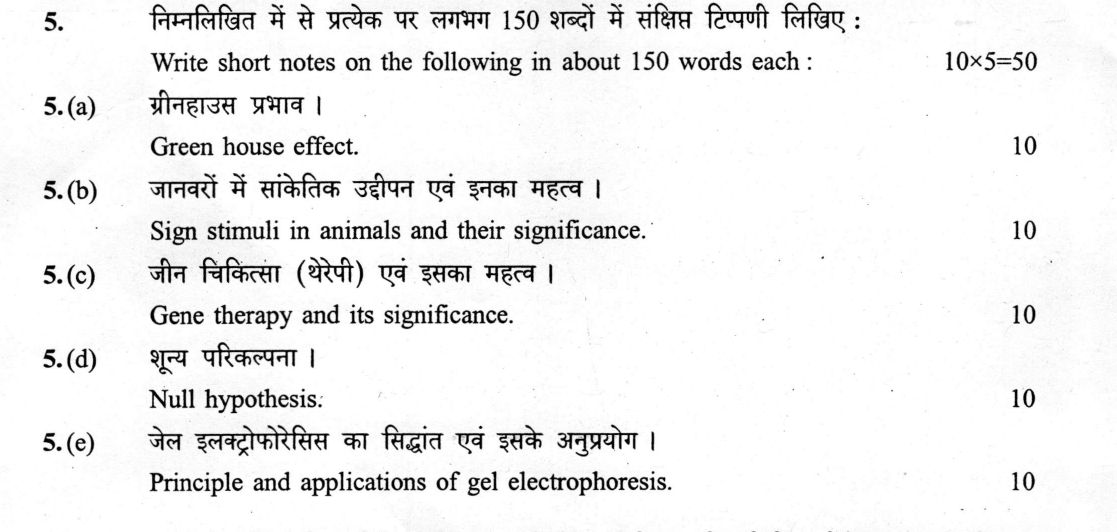
(a) Green house effect. (10 marks) (b) Sign stimuli in animals and their significance. (10 marks) (c) Gene therapy and its…
Write short notes on the following in about 150 words each :
Green house effect. 10 marks
Sign stimuli in animals and their significance. 10 marks
Gene therapy and its significance. 10 marks
Null hypothesis. 10 marks
Principle and applications of gel electrophoresis. 10 marks
हिंदी में प्रश्न पढ़ें
निम्नलिखित में से प्रत्येक पर लगभग 150 शब्दों में संक्षिप्त टिप्पणी लिखिए :
ग्रीनहाउस प्रभाव । (10 अंक)
जानवरों में सांकेतिक उद्दीपन एवं इनका महत्व । (10 अंक)
जीन चिकित्सा (थेरेपी) एवं इसका महत्व । (10 अंक)
शून्य परिकल्पना । (10 अंक)
जेल इलक्ट्रोफोरेसिस का सिद्धांत एवं इसके अनुप्रयोग । (10 अंक)
Model answer
Drafted with AI by UPSC Answer Check against this question's marking rubric, to the 150-word length. UPSC does not publish answers for Mains — this is one way to score well, not an official key. How we build rubrics and answers.
(a) Greenhouse effect (10 marks)
The greenhouse effect is the warming of the lower atmosphere because gases such as water vapour, CO₂, CH₄, N₂O and ozone absorb the infrared radiation emitted by the Earth and re-radiate part of it downward.
Natural effect. It keeps the average surface temperature at about 15°C instead of about −18°C, and so makes life possible.
Enhanced effect. Human activity adds gases and traps more heat.
- CO₂: fossil fuels and deforestation.
- CH₄: rice fields, cattle and landfills; about 28 times the warming potential of CO₂ over 100 years.
- N₂O: fertilisers; about 265 times.
- CFCs, HFCs and SF₆: industry.
Consequences. Global warming, glacier melt, sea-level rise, altered rainfall, floods, droughts, coral bleaching and lower crop yields.
Mitigation. The Kyoto Protocol (1997) and the Paris Agreement (2015), with renewable energy and afforestation.
(b) Sign stimuli in animals and their significance (10 marks)
A sign (key) stimulus is a simple feature of an object or situation that triggers an innate fixed action pattern through an innate releasing mechanism, without learning (Lorenz and Tinbergen).
Examples.
- The red belly of a male three-spined stickleback releases attack by rival males, even on a crude red model.
- The red spot on a herring gull's beak releases begging and pecking in the chick.
- A greylag goose rolls back an egg lying outside its nest.
Supernormal stimulus. An exaggerated artificial stimulus, such as a larger or more speckled egg, is preferred to the natural one, showing that a particular feature releases the response.
Significance.
- It gives quick, correct responses in feeding, mating, defence and parental care without experience.
- It helps species recognition and reproductive isolation.
- It explains mimicry and deception.
(c) Gene therapy and its significance (10 marks)
Gene therapy treats disease by introducing a functional gene, or correcting or silencing a faulty one, in the patient's cells.
Types.
- Somatic therapy affects body cells and is not inherited; germline therapy would be heritable and is prohibited in most countries.
- Ex vivo: cells are modified outside the body and returned, as in ADA-SCID. In vivo: the vector is given directly, as in Luxturna for retinal dystrophy.
Vectors. Retroviruses, lentiviruses, adenoviruses, adeno-associated virus, and liposomes. CRISPR–Cas9 editing is used for sickle-cell disease and β-thalassaemia.
Significance. It offers cure for single-gene disorders such as SCID, haemophilia and sickle-cell disease, and treatment for cancer (CAR-T cells).
Limitations. Immune reactions, insertional mutagenesis (leukaemia in early SCID-X1 trials), delivery, high cost and ethical concerns.
(d) Null hypothesis (10 marks)
The null hypothesis (H₀) states that there is no effect or difference, for example that two means are equal or that counts fit an expected ratio. The alternative hypothesis (H₁) states that there is an effect. A test asks whether the data are consistent with H₀.
Logic.
- A test statistic (t, χ² or F) is calculated.
- The P-value is the probability of a result at least as extreme as that observed if H₀ is true.
- With a significance level α (usually 0.05), H₀ is rejected if P < α; otherwise we fail to reject it.
Errors. Type I error: rejecting a true H₀ (probability α). Type II error: failing to reject a false H₀ (probability β); power = 1 − β.
Example. H₀: a drug does not change the mean weight of mice. In genetics, H₀: the F₂ ratio fits 3:1, tested by χ².
(e) Principle and applications of gel electrophoresis (10 marks)
Principle. Charged molecules migrate in an electric field through a gel that acts as a molecular sieve: agarose for DNA, polyacrylamide for proteins.
- DNA is uniformly negatively charged, so it moves to the anode, and small fragments run faster; distance travelled is inversely related to log size.
- Proteins differ in charge, so SDS-PAGE coats them with SDS and they separate by mass.
- Bands are seen with ethidium bromide under UV, or with Coomassie stain.
Applications.
- Research: PCR products, restriction mapping, sequencing, and Southern and Western blots.
- Diagnosis: haemoglobin variants in sickle-cell disease and thalassaemia.
- Forensics: DNA fingerprinting and paternity testing.
How this answer will be evaluated
Evaluation rubric
Each sub-part is marked on its own, against the marks and word limit printed on the paper.
- (a) Write a short note on the greenhouse effect (10 marks, about 150 words). 10 marks · 150 words
Must cover
- Definition: absorption and re-radiation of infrared radiation by greenhouse gases
- Natural effect (about 15°C against −18°C) against the enhanced human-caused effect
- Gases with sources: CO₂, CH₄, N₂O, CFCs, with relative warming potential
- Consequences and mitigation such as the Kyoto Protocol and the Paris Agreement
Loses marks
- Confusing the greenhouse effect with ozone depletion.
- Describing only global warming.
Earns more
- Numerical temperature contrast.
- Both consequences and mitigation.
Extra mark
- Global warming potentials
- (b) Write a short note on sign stimuli in animals and their significance (10 marks, about 150 words). 10 marks · 150 words
Must cover
- Definition: simple stimulus releasing a fixed action pattern through the innate releasing mechanism
- Examples: stickleback red belly, gull chick pecking, goose egg rolling
- Supernormal stimulus
- Significance: quick innate response, species recognition
Loses marks
- Confusing with conditioned stimuli.
- No significance given.
Earns more
- Names of Tinbergen and Lorenz.
- Significance stated as required.
Extra mark
- Mimicry as a use of sign stimuli
- (c) Write a short note on gene therapy and its significance (10 marks, about 150 words). 10 marks · 150 words
Must cover
- Definition: introducing or editing genes to treat disease
- Types: somatic against germline, ex vivo against in vivo
- Vectors and named cases such as ADA-SCID, Luxturna and CRISPR therapy
- Significance and limitations
Loses marks
- Confusing gene therapy with GM crops.
- Omitting limitations.
Earns more
- Vector named and matched to a therapy.
- Ethical position on germline therapy.
Extra mark
- CAR-T therapy for cancer
- (d) Write a short note on the null hypothesis (10 marks, about 150 words). 10 marks · 150 words
Must cover
- Definition of H₀ as no effect and H₁ as alternative
- Test statistic, P-value and significance level
- Reject or fail to reject, with Type I and Type II errors
- A biological example
Loses marks
- Saying H₀ is accepted as true.
- Confusing Type I and Type II errors.
Earns more
- Statement that H₀ is not proved.
- Correct definition of α and β.
Extra mark
- Power of a test
- (e) Write a short note on the principle and applications of gel electrophoresis (10 marks, about 150 words). 10 marks · 150 words
Must cover
- Principle: charged molecules migrating in a gel in an electric field
- DNA separates by size on agarose
- Proteins by SDS-PAGE, with SDS giving uniform charge
- Applications in research, diagnosis and forensics
Loses marks
- Confusing with paper chromatography.
- No applications given.
Earns more
- Visualisation by ethidium bromide or Coomassie.
- Named applications such as blotting and DNA fingerprinting.
Extra mark
- Native PAGE and isoelectric focusing
What "Write short notes" is asking you to do
Five or six self-contained answers, marked separately, typically 10 marks and about 150 words each. Each note must carry its own definition, its two or three defining features and a line on why it matters; a common introduction or conclusion across the notes earns nothing.
Structure that answers it
Per note: one-line definition or identification → two or three features, mechanisms or named examples → one line of significance or Indian application
Where marks are lost
Writing the first two notes at essay length and rationing the rest. Each note is marked on its own, so marks surrendered on a compressed or unattempted note cannot be won back by the long ones.
Practice this exact question
Write your answer and it is marked point by point against the model answer above — what you covered, what you missed, what you got wrong.
Evaluate my answer →More from Zoology 2026 Paper I
- Q2 (a) Write peculiar characters of phylum Annelida. Classify this phylum into different cla…
- Q3 (a) Give a comparative account of aortic arches in vertebrates. (20 marks) (b) Explain di…
- Q4 (a) Explain types of fins in fishes and their role in locomotion. (20 marks) (b) Describe…
- Q5 Write short notes on the following in about 150 words each : (a) Green house effect. (10…
- Q6 (a) Enumerate various population characteristics. Explain the following characteristics i…
- Q7 (a) Differentiate among alpha, beta and gamma diversity. Explain various factors which th…
- Q8 (a) Explain the following human genetic diseases : (i) Haemophilia (ii) Thalassemia (20 m…