Paper I — Q2
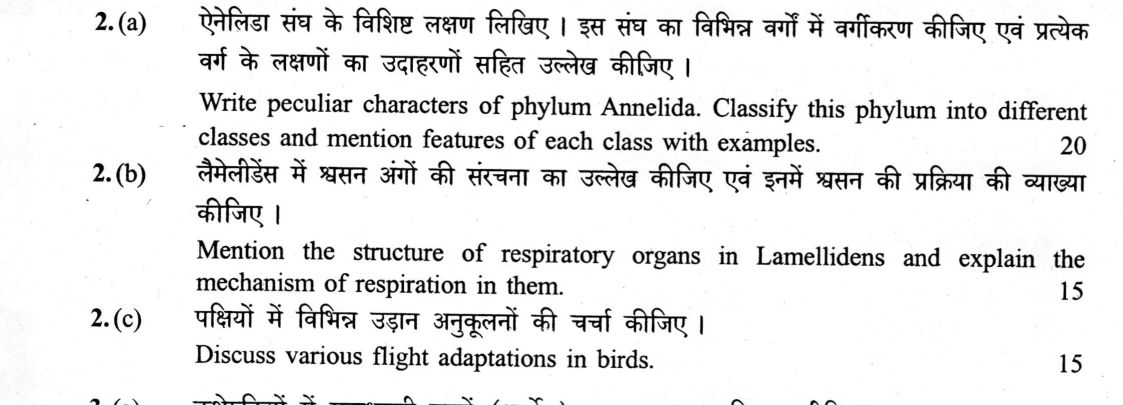
(a) Write peculiar characters of phylum Annelida. Classify this phylum into different classes and mention features of each class…
Write peculiar characters of phylum Annelida. Classify this phylum into different classes and mention features of each class with examples. 20 marks
Mention the structure of respiratory organs in Lamellidens and explain the mechanism of respiration in them. 15 marks
Discuss various flight adaptations in birds. 15 marks
हिंदी में प्रश्न पढ़ें
ऐनेलिडा संघ के विशिष्ट लक्षण लिखिए । इस संघ का विभिन्न वर्गों में वर्गीकरण कीजिए एवं प्रत्येक वर्ग के लक्षणों का उदाहरणों सहित उल्लेख कीजिए । (20 अंक)
लैमेलीडेंस में श्वसन अंगों की संरचना का उल्लेख कीजिए एवं इनमें श्वसन की प्रक्रिया की व्याख्या कीजिए । (15 अंक)
पक्षियों में विभिन्न उड़ान अनुकूलनों की चर्चा कीजिए । (15 अंक)
Model answer
Drafted with AI by UPSC Answer Check against this question's marking rubric, to the expected length. UPSC does not publish answers for Mains — this is one way to score well, not an official key. How we build rubrics and answers.
(a) Annelida: peculiar characters and classification (20 marks)
Peculiar characters.
- Bilaterally symmetrical, triploblastic and coelomate (a true coelom of schizocoelic origin) with organ-system organisation.
- Metameric segmentation, both external (rings) and internal, in which most organs repeat in each segment.
- Body wall with a thin cuticle, epidermis, and circular and longitudinal muscles; locomotor chaetae (setae) in most.
- Closed blood-vascular system with respiratory pigment (haemoglobin) dissolved in the plasma.
- Excretion by paired segmental nephridia.
- Nervous system with a dorsal cerebral (supra-pharyngeal) ganglion, a nerve ring and a double ventral nerve cord.
- Complete alimentary canal; sexes separate or hermaphrodite; development direct or through a trochophore larva.
Classification and features of the classes.
- Class Polychaeta: mostly marine, with a distinct head bearing eyes, tentacles and palps, parapodia bearing many setae, no clitellum, sexes separate, external fertilisation and a trochophore larva. Examples: Nereis, Aphrodite, Arenicola, Chaetopterus.
- Class Oligochaeta: mostly terrestrial or freshwater, with no distinct head, no parapodia, few setae, a clitellum in the reproductive season, hermaphrodite with cross-fertilisation, cocoons and direct development. Examples: Pheretima, Lumbricus, Tubifex.
- Class Hirudinea: leeches, with a fixed number of segments (34), no setae or parapodia, anterior and posterior suckers, coelom reduced to sinuses, hermaphrodite, mostly blood-sucking. Examples: Hirudinaria, Hirudo.
- Class Archiannelida: small, simple marine worms with no parapodia or setae, and little external segmentation. Examples: Polygordius, Protodrilus.
(b) Respiratory organs of Lamellidens and mechanism of respiration (15 marks)
Structure. Lamellidens, the freshwater mussel, breathes with a pair of gills (ctenidia), one on each side of the foot in the mantle cavity, and with the mantle.
- Each ctenidium is of the eulamellibranch type, made of two demibranchs (outer and inner). Each demibranch has a descending lamella and an ascending lamella, joined at the lower margin to form a V or W.
- The lamellae are made of vertical gill filaments, united by tissue junctions, and the two lamellae are connected by interlamellar junctions, which divide the space between them into vertical water tubes.
- The lamellae are perforated by small openings, the ostia, that lead into the water tubes, which open above into the suprabranchial chamber.
- The filaments carry frontal, latero-frontal and lateral cilia, and are rich in blood vessels.
Mechanism.
- The lateral cilia beat and create a current in which water enters through the ventral inhalant siphon into the mantle cavity.
- The water passes through the ostia into the water tubes, moves up into the suprabranchial chamber and leaves by the dorsal exhalant siphon.
- Blood in the filaments, brought by the afferent branchial vessel, takes up oxygen from the water and gives off carbon dioxide, and it leaves by the efferent vessel to the heart. The vascular mantle also exchanges gases.
- The same current brings food particles, which are trapped in mucus on the gills and carried by cilia to the mouth.
(c) Flight adaptations in birds (15 marks)
- External form: a spindle-shaped, streamlined body; forelimbs modified into wings; feathers, with light contour and flight feathers (remiges, rectrices) that give lift and control, and down for insulation; no teeth, a light horny beak and no tail bones (a short pygostyle).
- Skeleton: light, pneumatic bones, with air sacs and hollow cavities; fusion of the vertebrae (synsacrum), pelvic bones and the wrist and hand bones (carpometacarpus), which gives rigidity; a keeled sternum (carina) for flight muscles; a furcula (wishbone) that acts as a spring; and uncinate processes that stiffen the ribs.
- Muscles: very large pectoralis (downstroke) and supracoracoideus (upstroke) muscles, the latter working through a pulley, both attached to the keel and held low to keep the centre of gravity low.
- Respiration: compact lungs with air sacs and one-way airflow through the parabronchi, so that oxygen is taken up in both inspiration and expiration (double respiration), meeting the high demand.
- Circulation: a four-chambered heart, with complete separation of oxygenated and deoxygenated blood, a fast heart rate and high blood pressure.
- Metabolism: warm-blooded, with a high metabolic rate.
- Excretion and reproduction: uric acid excreted with no urinary bladder, a single functional ovary, and eggs laid outside, all of which reduce weight.
- Nervous and sense organs: a large cerebellum for balance and coordination, large optic lobes and keen eyesight.
How this answer will be evaluated
Evaluation rubric
Each sub-part is marked on its own, against the marks and word limit printed on the paper.
- (a) Write peculiar characters of phylum Annelida. Classify this phylum into different classes and mention features of each class with examples (20 marks). 20 marks
Must cover
- Peculiar characters: metameric segmentation, true coelom, closed circulation, nephridia, chaetae, ventral nerve cord
- Four classes: Polychaeta, Oligochaeta, Hirudinea, Archiannelida
- Distinguishing features of each class, such as parapodia, clitellum, suckers
- Examples for each class
Loses marks
- A general essay on earthworms.
- Classes without examples.
- Omitting metamerism.
Earns more
- Contrast between the classes in head, parapodia, setae and sexes.
- Trochophore larva in polychaetes.
Extra mark
- Modern grouping of oligochaetes and leeches as Clitellata
- (b) Mention the structure of respiratory organs in Lamellidens and explain the mechanism of respiration in them (15 marks). 15 marks
Must cover
- Eulamellibranch ctenidia: two demibranchs, descending and ascending lamellae, filaments
- Interlamellar junctions, water tubes and ostia
- Ciliary water current: inhalant siphon, ostia, water tubes, suprabranchial chamber, exhalant siphon
- Gas exchange in the gill blood and the role of the mantle
Loses marks
- Describing the gills of a fish.
- Omitting the water tubes.
Earns more
- Types of cilia named.
- Blood route through afferent and efferent vessels.
Extra mark
- Food collection by the gills
- (c) Discuss various flight adaptations in birds (15 marks). 15 marks
Must cover
- External form: streamlined body, wings and feathers
- Skeleton: pneumatic bones, fusion, keeled sternum, furcula
- Muscles: pectoralis and supracoracoideus
- Respiration with air sacs, four-chambered heart, high metabolism, uric acid excretion
Loses marks
- A bare list of features with no explanation.
- Describing the anatomy of a pigeon with no link to flight.
Earns more
- Each feature linked to how it aids flight.
- Sense organs and nervous system covered.
Extra mark
- Double respiration and parabronchi
What "Classify" is asking you to do
Sort into categories on a stated basis, and make the basis explicit before you sort. A classification is judged on whether the categories are exhaustive, mutually exclusive and drawn on a single consistent principle.
Structure that answers it
State the basis of classification → category one with its members → category two → category three → note the overlaps and borderline cases
Where marks are lost
Categories that are not mutually exclusive, or a basis of division left unstated.
Practice this exact question
Write your answer and it is marked point by point against the model answer above — what you covered, what you missed, what you got wrong.
Evaluate my answer →More from Zoology 2026 Paper I
- Q1 Write short notes on the following in about 150 words each : (a) Structure of gemmules in…
- Q2 (a) Write peculiar characters of phylum Annelida. Classify this phylum into different cla…
- Q3 (a) Give a comparative account of aortic arches in vertebrates. (20 marks) (b) Explain di…
- Q4 (a) Explain types of fins in fishes and their role in locomotion. (20 marks) (b) Describe…
- Q5 Write short notes on the following in about 150 words each : (a) Green house effect. (10…