Paper I — Q3
(a) Give a comparative account of aortic arches in vertebrates. (20 marks) (b) Explain different ways of locomotion in Protozoa…
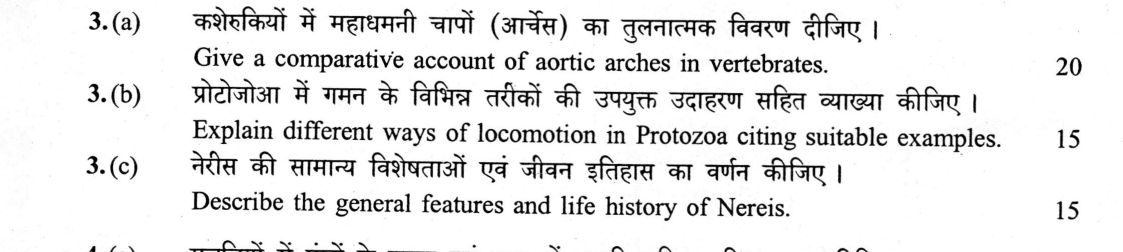
Give a comparative account of aortic arches in vertebrates. 20 marks
Explain different ways of locomotion in Protozoa citing suitable examples. 15 marks
Describe the general features and life history of Nereis. 15 marks
हिंदी में प्रश्न पढ़ें
कशेरुकियों में महाधमनी चापों (आर्चेस) का तुलनात्मक विवरण दीजिए । (20 अंक)
प्रोटोजोआ में गमन के विभिन्न तरीकों की उपयुक्त उदाहरण सहित व्याख्या कीजिए । (15 अंक)
नेरीस की सामान्य विशेषताओं एवं जीवन इतिहास का वर्णन कीजिए । (15 अंक)
Model answer
Drafted with AI by UPSC Answer Check against this question's marking rubric, to the expected length. UPSC does not publish answers for Mains — this is one way to score well, not an official key. How we build rubrics and answers.
(a) Comparative account of the aortic arches in vertebrates (20 marks)
The embryonic vertebrate has six pairs of aortic arches (I–VI), which connect the ventral aorta to the paired dorsal aortae through the pharyngeal (visceral) arches. The ancestral pattern, in which each arch is broken by gill capillaries into afferent and efferent parts, is modified in each class.
- Cyclostomes: arches supply the gill pouches, in more numerous pairs, and each arch is divided into afferent and efferent vessels.
- Fishes: arches I and II are lost or reduced, while arches III to VI (four pairs in bony fishes; five pairs in sharks such as Scoliodon) persist as gill arches. Each breaks up into an afferent branchial artery from the ventral aorta and an efferent branchial artery to the dorsal aorta. Blood flows in a single circuit.
- Amphibians: in the tadpole arches III–VI serve the gills. In the adult arch III becomes the carotid arch (common carotid, external and internal carotid), arch IV the systemic arch to the dorsal aorta, arch V is lost, and arch VI becomes the pulmocutaneous arch to the lungs and skin.
- Reptiles: arch III forms the carotid arches, arch IV persists as paired systemic arches (right and left), arch V is lost and arch VI forms the pulmonary arches. In crocodiles the left systemic arch arises from the right ventricle.
- Birds: arch III forms the carotid, arch IV persists on the right side only as the right systemic arch, the left one being lost, and arch VI forms the pulmonary arches.
- Mammals: arch III forms the carotid, arch IV persists on the left side only as the left systemic (aortic) arch, the right forming the root of the right subclavian, and arch VI forms the pulmonary arch. In the foetus a duct (ductus arteriosus) joins the left pulmonary arch to the aorta, and it closes after birth into the ligamentum arteriosum.
Trend. From fish to mammals the number of arches falls, the gill function disappears, and the arches are remodelled to separate the pulmonary and systemic circulations with a single systemic arch in the higher forms.
(b) Modes of locomotion in Protozoa (15 marks)
- Amoeboid (pseudopodial): the cytoplasm flows in a sol–gel cycle, with actin and myosin, to form pseudopodia. There are lobopodia in Amoeba, filopodia in Euglypha, reticulopodia in foraminifera such as Elphidium, and axopodia in Actinophrys.
- Flagellar: one or more flagella, each with a 9 + 2 axoneme, beat in waves and pull or push the cell forward, as in Euglena, Trypanosoma and Noctiluca.
- Ciliary: numerous short cilia beat in an effective stroke and a recovery stroke, and the coordinated metachronal waves move the cell, as in Paramecium.
- Metabolic (euglenoid): the flexible pellicle allows the body to contract and elongate in waves, as in Euglena.
- Gliding: the cell glides over a surface without visible organelles, by a secreted film of mucilage and the movement of the cortex, as in gregarines, and in the sporozoites of Plasmodium.
- Contractile: contractile fibres called myonemes shorten the body or stalk, as in the stalk of Vorticella and in Stentor.
- Passive floating: some planktonic forms, such as radiolarians, float, aided by oil droplets and vacuoles.
(c) General features and life history of Nereis (15 marks)
General features. Nereis (the clamworm) is a marine annelid that lives in burrows in sand and mud in coastal waters and is a predator or omnivore.
- The body is elongated, segmented and up to 200 segments long, with a head made of the prostomium, with two pairs of eyes, two tentacles and two palps, and a peristomium with four pairs of tentacular cirri.
- Each trunk segment bears a pair of biramous parapodia, with acicula, setae and dorsal and ventral cirri, used for swimming, crawling and respiration.
- The gut has a muscular pharynx (proboscis) with a pair of jaws. The coelom is schizocoelic, and the blood-vascular system is closed with haemoglobin in the plasma. Nephridia excrete, and the nervous system consists of a brain and a ventral ganglionated cord.
- Sexes are separate, with no permanent gonads.
Life history.
- At maturity the worm becomes the heteronereis (epitoky): the eyes enlarge and the parapodia are flattened into paddles, so the worm can swim to the surface.
- It swarms, often in relation to the moon, and eggs and sperm are shed into the sea, where fertilisation is external. The adults die after spawning.
- Cleavage is spiral and holoblastic, giving a blastula and gastrula, and a free-swimming trochophore larva, then a metatrochophore and a nectochaete, which settles as the young worm.
How this answer will be evaluated
Evaluation rubric
Each sub-part is marked on its own, against the marks and word limit printed on the paper.
- (a) Give a comparative account of aortic arches in vertebrates (20 marks). 20 marks
Must cover
- Basic six pairs of embryonic arches between ventral and dorsal aortae
- Fishes: arches III–VI persist as gill arches with afferent and efferent parts
- Amphibians and reptiles: arch III carotid, IV systemic, VI pulmonary, and V lost
- Birds (right systemic arch) and mammals (left systemic arch), with the evolutionary trend
Loses marks
- Stating the wrong side of the systemic arch in birds or mammals.
- Description of the adult heart instead of the arches.
Earns more
- Correct fate of each arch in each class.
- Ductus arteriosus in the mammal.
Extra mark
- Comparison with cyclostomes
- (b) Explain different ways of locomotion in Protozoa citing suitable examples (15 marks). 15 marks
Must cover
- Amoeboid movement with the types of pseudopodia and sol–gel mechanism
- Flagellar and ciliary movement with the mechanism
- Metabolic, gliding and contractile movement
- A named genus for each mode
Loses marks
- Modes listed without mechanism.
- Wrong genus for a mode.
Earns more
- Types of pseudopodia with examples.
- Effective and recovery strokes of cilia.
Extra mark
- Passive floating in radiolarians
- (c) Describe the general features and life history of Nereis (15 marks). 15 marks
Must cover
- General features: habitat, head with eyes, tentacles and palps, parapodia, proboscis with jaws
- Organ systems in brief: closed blood system, nephridia, ventral nerve cord, separate sexes
- Epitoky and heteronereis formation, and swarming
- External fertilisation, spiral cleavage, trochophore and the young worm
Loses marks
- Describing an earthworm.
- Omitting the trochophore larva.
Earns more
- Function of the parapodia.
- Adults die after spawning.
Extra mark
- Lunar periodicity of swarming
What "Discuss" is asking you to do
Lay the issue out from more than one side — how it arose, what is claimed for it, what is held against it, and where it now stands. UPSC attaches discuss to broad topics with several live dimensions, so coverage of the dimensions earns more than the strength of your opinion.
Structure that answers it
Set the issue up → the case as it is made → the case against → the dimension both sides leave out → where the balance now lies
Where marks are lost
Listing facts with no thread between them, or arguing one side throughout and calling it a discussion.
Practice this exact question
Write your answer and it is marked point by point against the model answer above — what you covered, what you missed, what you got wrong.
Evaluate my answer →More from Zoology 2026 Paper I
- Q1 Write short notes on the following in about 150 words each : (a) Structure of gemmules in…
- Q2 (a) Write peculiar characters of phylum Annelida. Classify this phylum into different cla…
- Q3 (a) Give a comparative account of aortic arches in vertebrates. (20 marks) (b) Explain di…
- Q4 (a) Explain types of fins in fishes and their role in locomotion. (20 marks) (b) Describe…
- Q5 Write short notes on the following in about 150 words each : (a) Green house effect. (10…
- Q6 (a) Enumerate various population characteristics. Explain the following characteristics i…