Paper I — Q6
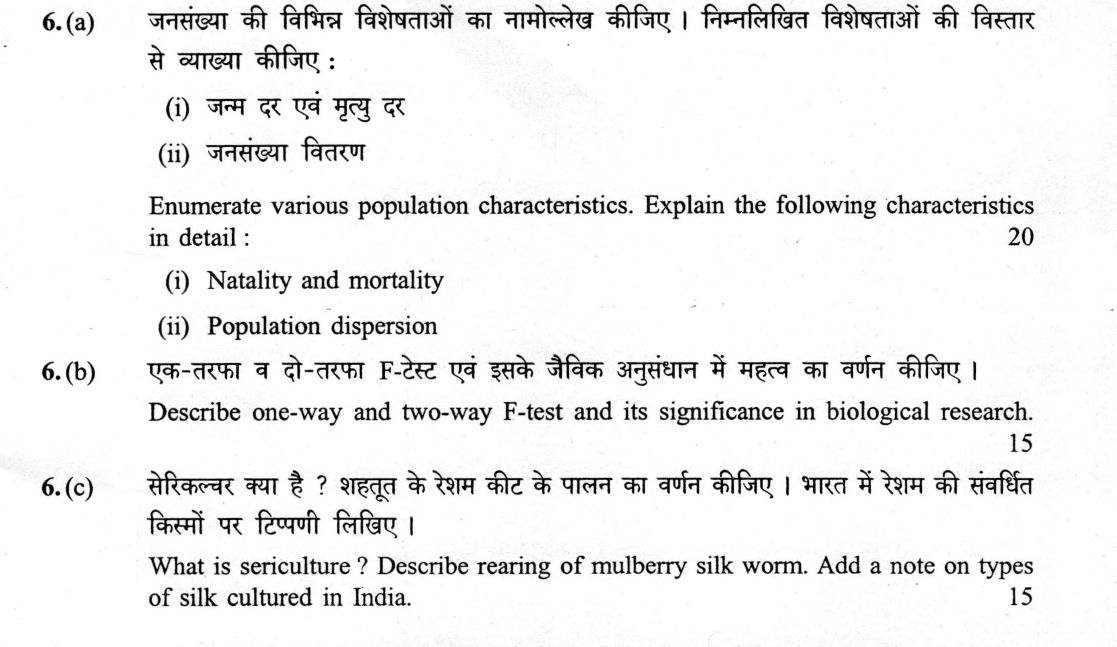
(a) Enumerate various population characteristics. Explain the following characteristics in detail : (i) Natality and…
Enumerate various population characteristics. Explain the following characteristics in detail : Natality and mortality
Population dispersion 20 marks
Describe one-way and two-way F-test and its significance in biological research. 15 marks
What is sericulture ? Describe rearing of mulberry silk worm. Add a note on types of silk cultured in India. 15 marks
हिंदी में प्रश्न पढ़ें
जनसंख्या की विभिन्न विशेषताओं का नामोल्लेख कीजिए । निम्नलिखित विशेषताओं की विस्तार से व्याख्या कीजिए : जन्म दर एवं मृत्यु दर
जनसंख्या वितरण (20 अंक)
एक-तरफा व दो-तरफा F-टेस्ट एवं इसके जैविक अनुसंधान में महत्व का वर्णन कीजिए । (15 अंक)
सेरिकल्चर क्या है ? शहतूत के रेशम कीट के पालन का वर्णन कीजिए । भारत में रेशम की संवर्धित किस्मों पर टिप्पणी लिखिए । (15 अंक)
Model answer
Drafted with AI by UPSC Answer Check against this question's marking rubric, to the expected length. UPSC does not publish answers for Mains — this is one way to score well, not an official key. How we build rubrics and answers.
(a) Population characteristics: natality, mortality and dispersion (20 marks)
Characteristics. A population has group properties that no individual has: density, natality (birth rate), mortality (death rate), age distribution, sex ratio, dispersion, dispersal, biotic potential, growth form and carrying capacity.
(a)(i) Natality and mortality
Natality is the birth rate, the number of new individuals added per unit time.
- Maximum (absolute or physiological) natality is the theoretical maximum under ideal conditions, limited only by reproductive physiology. Realised (ecological) natality is the actual rate under the real environment, and is usually much lower.
- The crude birth rate is B/N per unit time. Specific rates are for age classes or sexes (age-specific fecundity).
Mortality is the death rate.
- Minimum (physiological) mortality is the death rate under ideal conditions, when death is due only to old age, so it equals the physiological longevity. Realised (ecological) mortality is the actual rate in the field, from predation, disease, starvation and weather.
- The crude death rate is D/N per unit time, and specific rates are for age classes.
Life table. It records for each age class x the number surviving (nₓ), the survivorship (lₓ), the number dying (dₓ), the mortality rate (qₓ) and the life expectancy (eₓ).
Survivorship curves. Plotting log lₓ against age gives three types.
- Type I (convex): most individuals survive to old age, then die quickly, as in humans and large mammals.
- Type II (diagonal): a constant mortality at all ages, as in Hydra and many birds.
- Type III (concave): very high early mortality among the young, as in oysters, fishes and many insects.
(a)(ii) Population dispersion
Dispersion is the spatial pattern of individuals within the area they occupy.
- Random: the position of each individual is independent of others, which occurs in uniform habitats without attraction or repulsion, as with spiders on a forest floor. It is rare.
- Uniform (regular): individuals are evenly spaced because of competition or territoriality, as in nesting penguins and creosote bush.
- Clumped (aggregated): the commonest pattern, arising from patchy resources, social behaviour or vegetative reproduction, as in herds, fish schools and plant clumps.
Measurement. The variance-to-mean ratio of counts in quadrats is 1 for random, less than 1 for uniform and more than 1 for clumped dispersion, and other indices are Morisita's index and nearest-neighbour distance.
(b) F-test: one-way and two-way, and its significance in biological research (15 marks)
The F-test compares two variances. F = s₁²/s₂², the larger variance over the smaller, with degrees of freedom for each, and it is the basis of analysis of variance (ANOVA). The null hypothesis is that the variances, or the group means, are equal.
One-way ANOVA. It tests whether the means of k groups differ under a single factor.
- The total sum of squares is divided into between-group (SSB) and within-group (SSW) parts.
- Mean squares are SS divided by df, so F = MSB/MSW, with (k − 1) and (N − k) degrees of freedom.
- If F exceeds the critical value, H₀ is rejected. Then post-hoc tests such as Tukey's find which groups differ.
Two-way ANOVA. It tests two factors, A and B, together.
- The total sum of squares is divided into A, B, the A × B interaction and error, each with its own F.
- Its special value is that it shows interaction, where the effect of one factor depends on the level of the other, which one-way tests cannot detect.
Assumptions. Independent samples, normal distributions and equal variances.
Significance. It compares many treatments at once, avoiding the rise in Type I error from repeated t-tests, tests the equality of variances, and finds sources of variation in experiments, such as fertiliser and variety in crops, dose and sex in drug trials, or habitat and season in ecology.
(c) Sericulture and rearing of mulberry silkworm (15 marks)
Sericulture is the rearing of silkworms for the production of raw silk, and includes growing the food plant, rearing and reeling.
Rearing of Bombyx mori.
- Grainage: production of disease-free layings (DFLs). Moths mate, and the eggs are laid, examined for pébrine (Nosema) and treated.
- Incubation: eggs are held at about 25°C and 80% humidity for 10–12 days until they hatch.
- Brushing: newly hatched larvae are moved onto chopped tender mulberry leaves.
- Rearing: the larvae grow through five instars and four moults in about 25–28 days, in trays with clean, ventilated beds, fed several times a day with leaves of increasing maturity, at 25–28°C, and the beds are cleaned and spaced.
- Mounting: when the larva is ripe, it stops feeding, becomes translucent and is placed on mountages, where it spins the cocoon from a single filament of 1,000–1,500 m in 2–3 days.
- Harvest, stifling and reeling: cocoons are harvested after 5–6 days, the pupae are killed by hot air or steam, and the cocoons are cooked to soften sericin and reeled into raw silk. Diseases (pébrine, flacherie, grasserie and muscardine) are controlled by hygiene.
Types of silk in India.
- Mulberry silk: Bombyx mori on mulberry, in Karnataka, Andhra Pradesh, Tamil Nadu, West Bengal and Jammu & Kashmir.
- Tasar (tropical): Antheraea mylitta on Terminalia arjuna and sal, in Jharkhand, Chhattisgarh and Odisha; oak tasar from Antheraea proylei on oak in the Himalayan states.
- Eri: Samia ricini on castor, in Assam and the north-east.
- Muga: Antheraea assamensis on som (Persea bombycina), in Assam.
How this answer will be evaluated
Evaluation rubric
Each sub-part is marked on its own, against the marks and word limit printed on the paper.
- (a) Enumerate various population characteristics. Explain in detail (i) natality and mortality and (ii) population dispersion (20 marks). 20 marks
Must cover
- Enumeration of characteristics: density, natality, mortality, age structure, sex ratio, dispersion, biotic potential, growth form
- Natality and mortality: maximum against realised natality, minimum against realised mortality, specific rates
- Life table and survivorship curves of types I, II and III with examples
- Dispersion: random, uniform and clumped with causes, examples and the variance-to-mean ratio
Loses marks
- Explaining only natality or only dispersion.
- Wrong description of the survivorship curves.
Earns more
- Both halves (i) and (ii) explained in detail.
- Named example for each survivorship curve and dispersion pattern.
Extra mark
- Morisita index and nearest-neighbour method
- (b) Describe one-way and two-way F-test and its significance in biological research (15 marks). 15 marks
Must cover
- F as the ratio of variances with degrees of freedom and decision rule
- One-way ANOVA: partition into between and within sums of squares, F = MSB/MSW
- Two-way ANOVA: two factors and the interaction term
- Significance in biological research, with assumptions
Loses marks
- Confusing F-test with t-test only.
- Omitting interaction in the two-way test.
Earns more
- Degrees of freedom for each F.
- Biological example such as fertiliser and variety.
Extra mark
- Post-hoc tests such as Tukey
- (c) What is sericulture? Describe rearing of mulberry silkworm. Add a note on types of silk cultured in India (15 marks). 15 marks
Must cover
- Definition of sericulture
- Rearing steps: grainage, incubation, brushing, feeding through five instars, mounting, harvesting, stifling and reeling
- Types of silk: mulberry, tasar, eri and muga with silkworm species
- Host plants and states for each type
Loses marks
- Describing honey bees.
- Missing the types of silk.
Earns more
- Temperature and duration details.
- Diseases such as pébrine named.
Extra mark
- India's rank among silk producers
What "Enumerate" is asking you to do
Produce the complete set of items asked for, countable and correctly named. The examiner marks against a checklist, so a missing item costs and an elaborated one gains nothing — where discussion is wanted the stem asks for it as a separate sub-part.
Structure that answers it
One line naming the basis on which the set is drawn → items numbered, each in a phrase or a single line → the discussion sub-part taken up separately, after the list is complete
Where marks are lost
Treating it as an essay. Six items named in six lines score better than three items explained at length.
Practice this exact question
Write your answer and it is marked point by point against the model answer above — what you covered, what you missed, what you got wrong.
Evaluate my answer →More from Zoology 2026 Paper I
- Q3 (a) Give a comparative account of aortic arches in vertebrates. (20 marks) (b) Explain di…
- Q4 (a) Explain types of fins in fishes and their role in locomotion. (20 marks) (b) Describe…
- Q5 Write short notes on the following in about 150 words each : (a) Green house effect. (10…
- Q6 (a) Enumerate various population characteristics. Explain the following characteristics i…
- Q7 (a) Differentiate among alpha, beta and gamma diversity. Explain various factors which th…
- Q8 (a) Explain the following human genetic diseases : (i) Haemophilia (ii) Thalassemia (20 m…