Paper I — Q4
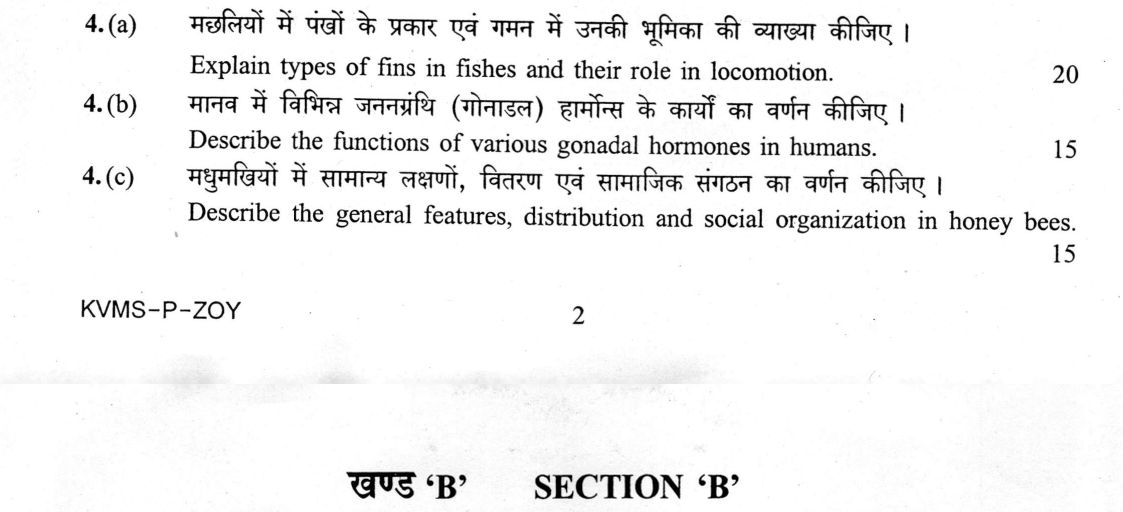
(a) Explain types of fins in fishes and their role in locomotion. (20 marks) (b) Describe the functions of various gonadal…
Explain types of fins in fishes and their role in locomotion. 20 marks
Describe the functions of various gonadal hormones in humans. 15 marks
Describe the general features, distribution and social organization in honey bees. 15 marks
हिंदी में प्रश्न पढ़ें
मछलियों में पंखों के प्रकार एवं गमन में उनकी भूमिका की व्याख्या कीजिए । (20 अंक)
मानव में विभिन्न जननग्रंथि (गोनाडल) हार्मोन्स के कार्यों का वर्णन कीजिए । (15 अंक)
मधुमक्खियों में सामान्य लक्षणों, वितरण एवं सामाजिक संगठन का वर्णन कीजिए । (15 अंक)
Model answer
Drafted with AI by UPSC Answer Check against this question's marking rubric, to the expected length. UPSC does not publish answers for Mains — this is one way to score well, not an official key. How we build rubrics and answers.
(a) Types of fins in fishes and their role in locomotion (20 marks)
Types of fins. Fins are of two kinds.
- Median (unpaired) fins: dorsal (one to three), caudal (tail) and anal fins, and in some teleosts a small fleshy adipose fin (salmon, catfish).
- Paired fins: the pectoral and pelvic fins, homologous with the limbs of tetrapods, supported by the pectoral and pelvic girdles.
Support. The fin is supported by basal cartilages or bones (basals and radials) and by dermal fin rays: horny ceratotrichia in sharks and bony lepidotrichia in bony fishes, and spiny rays in some.
Types of caudal fin.
- Protocercal: symmetrical with the notochord straight to the tip, as in lampreys and larvae.
- Heterocercal: the vertebral column turns into a larger upper lobe, as in sharks.
- Homocercal: apparently symmetrical, but the column ends in the urostyle at the base, as in teleosts (Labeo).
- Diphycercal: symmetrical, with the column straight to the tip, as in lungfishes.
Role in locomotion.
- The caudal fin gives the main propulsive thrust, and the body is thrown into waves, in which the caudal peduncle pushes water backward. The shape of the caudal fin fits the speed and habit; the heterocercal tail of a shark gives lift.
- The dorsal and anal fins act as keels that prevent rolling and yawing and give stability.
- The pectoral fins steer, brake, control depth and pitch, and give lift. The pelvic fins keep the body balanced and brake, and both paired fins act as hydroplanes.
- The adipose fin gives stability.
Special functions. The pectoral fins of flying fishes act as wings for gliding, and those of rays are used for propulsion. Anglerfish and mudskippers use them to crawl, and pelvic fins form a sucker in gobies and a clasper in male sharks. The anal fin forms the gonopodium in Gambusia and Poecilia.
(b) Gonadal hormones in humans (15 marks)
Testis.
- Testosterone, from the Leydig cells under LH, develops the male reproductive tract, maintains spermatogenesis (with FSH) and the secondary sexual characters, such as beard, deep voice and muscle, and promotes libido and protein synthesis.
- Sertoli cells secrete inhibin, which suppresses FSH, androgen-binding protein, which concentrates testosterone in the tubules, and anti-Müllerian hormone (AMH), which regresses the Müllerian ducts in the male foetus.
Ovary.
- Oestrogens (mainly oestradiol), from the granulosa and theca cells of the follicle, develop the female tract and secondary sexual characters, stimulate the proliferative phase of the endometrium, and produce the LH surge for ovulation by positive feedback. They also protect bone.
- Progesterone, from the corpus luteum, causes the secretory phase of the endometrium, maintains pregnancy, suppresses uterine contractions and prepares the mammary gland.
- Inhibin suppresses FSH, and relaxin, from the corpus luteum and placenta, relaxes the pelvic ligaments and cervix for birth. AMH from the granulosa cells regulates follicle growth.
Control. The hypothalamus releases GnRH, which stimulates the pituitary to release FSH and LH, and the gonadal steroids feed back to control them.
(c) Honey bees: general features, distribution and social organisation (15 marks)
General features. Honey bees (genus Apis, family Apidae, order Hymenoptera, class Insecta, phylum Arthropoda) are social insects that build wax combs and store honey.
- The body has a head, thorax and abdomen, with compound eyes and ocelli, antennae, and chewing and lapping mouthparts (a tongue, the proboscis).
- Hind legs carry a pollen basket (corbicula), the abdomen has wax glands, and the workers have a barbed sting (a modified ovipositor). Two pairs of wings are hooked together.
Distribution. Apis dorsata (the rock bee), A. cerana indica (the Indian bee, domesticated) and A. florea (the little bee) occur in India, and A. mellifera (the European bee) was introduced. Apis mellifera is kept worldwide. Beekeeping is done in Himachal Pradesh, Punjab, Kashmir, Kerala and Karnataka, among others.
Social organisation. A colony has three castes.
- Queen: the single fertile diploid female that lays up to 1,500 or more eggs a day, and lives 2–5 years. She is raised on royal jelly.
- Drones: haploid males from unfertilised eggs, whose only role is to mate with the queen.
- Workers: sterile diploid females from fertilised eggs, who work in order of age: cleaning, nursing, wax-building, guarding and foraging.
Caste determination. Sex is determined by ploidy (haplodiploidy), and queen or worker by the diet of the larva. Communication. Foragers dance a round dance for nearby food and a waggle dance for food far away, giving distance and direction (von Frisch), and pheromones, such as the queen substance, keep the colony together.
How this answer will be evaluated
Evaluation rubric
Each sub-part is marked on its own, against the marks and word limit printed on the paper.
- (a) Explain types of fins in fishes and their role in locomotion (20 marks). 20 marks
Must cover
- Median fins (dorsal, caudal, anal, adipose) and paired fins (pectoral, pelvic)
- Fin support: radials and fin rays, ceratotrichia and lepidotrichia
- Caudal fin types: protocercal, heterocercal, homocercal, diphycercal
- Role in propulsion, stability, steering and braking, with special modifications
Loses marks
- Only a list of fin names.
- Wrong association of a caudal type with a fish group.
Earns more
- Named example for each caudal type.
- Special functions such as flying fish, gonopodium and clasper.
Extra mark
- Homology of paired fins with tetrapod limbs
- (b) Describe the functions of various gonadal hormones in humans (15 marks). 15 marks
Must cover
- Testosterone: source Leydig cells under LH, male tract, spermatogenesis, secondary sexual characters
- Sertoli hormones: inhibin, androgen-binding protein and AMH
- Oestrogens and progesterone with their actions on the uterus and pregnancy
- Inhibin, relaxin and control by GnRH, FSH and LH with feedback
Loses marks
- Confusing testosterone with LH.
- Omitting the ovarian hormones.
Earns more
- Source cell named for each hormone.
- Positive feedback of oestrogen for the LH surge.
Extra mark
- AMH in the female
- (c) Describe the general features, distribution and social organisation in honey bees (15 marks). 15 marks
Must cover
- General features: systematic position, mouthparts, pollen basket, wax glands, sting
- Distribution: A. dorsata, A. cerana, A. florea, A. mellifera and beekeeping regions
- Three castes: queen, drone, worker, with origin and roles
- Caste determination, division of labour and communication by dances and pheromones
Loses marks
- Describing only the queen.
- Omitting distribution.
Earns more
- Haplodiploidy or the ploidy of each caste.
- Round and waggle dances distinguished.
Extra mark
- Royal jelly and swarming
What "Explain" is asking you to do
Make the working of something clear — what sets it off, what follows from what, and what it produces. Explain is the Commission's mechanism word: it dominates the technical papers and the “explain why” stems, where the marks sit in the causal chain and not in the label.
Structure that answers it
State what it is → the initiating condition → the chain of cause, step by step → an instance where it plays out → what the chain produces
Where marks are lost
Describing what something looks like instead of why it works that way. Naming the stages without linking them reads as description too.
Practice this exact question
Write your answer and it is marked point by point against the model answer above — what you covered, what you missed, what you got wrong.
Evaluate my answer →More from Zoology 2026 Paper I
- Q1 Write short notes on the following in about 150 words each : (a) Structure of gemmules in…
- Q2 (a) Write peculiar characters of phylum Annelida. Classify this phylum into different cla…
- Q3 (a) Give a comparative account of aortic arches in vertebrates. (20 marks) (b) Explain di…
- Q4 (a) Explain types of fins in fishes and their role in locomotion. (20 marks) (b) Describe…
- Q5 Write short notes on the following in about 150 words each : (a) Green house effect. (10…
- Q6 (a) Enumerate various population characteristics. Explain the following characteristics i…
- Q7 (a) Differentiate among alpha, beta and gamma diversity. Explain various factors which th…