Paper II — Q1
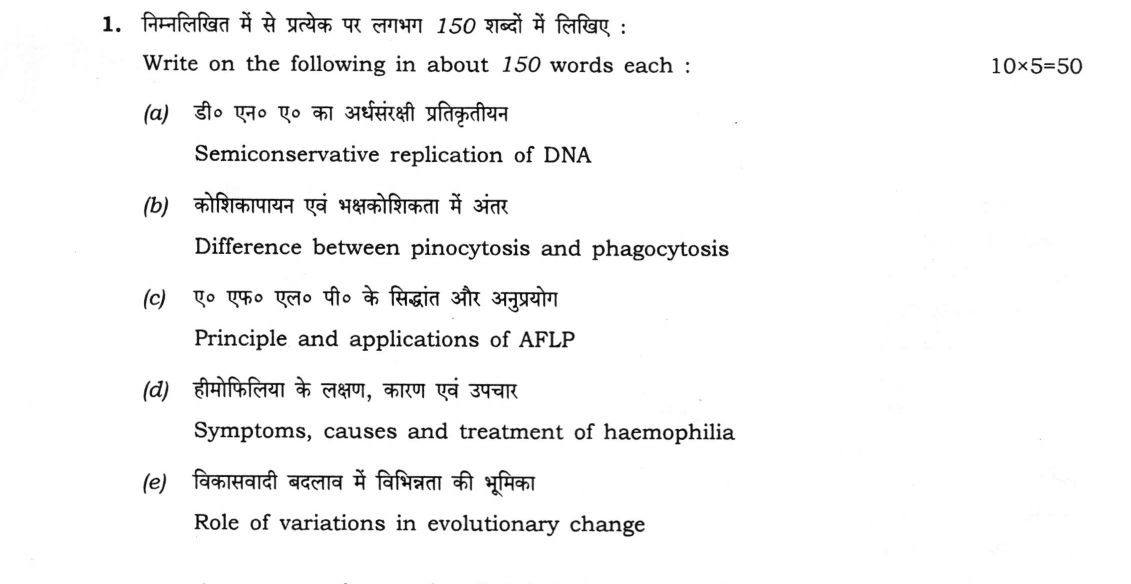
(a) Semiconservative replication of DNA (10 marks) (b) Difference between pinocytosis and phagocytosis (10 marks) (c) Principle…
Write on the following in about 150 words each :
Semiconservative replication of DNA 10 marks
Difference between pinocytosis and phagocytosis 10 marks
Principle and applications of AFLP 10 marks
Symptoms, causes and treatment of haemophilia 10 marks
Role of variations in evolutionary change 10 marks
हिंदी में प्रश्न पढ़ें
निम्नलिखित में से प्रत्येक पर लगभग 150 शब्दों में लिखिए :
डी० एन० ए० का अर्धसंरक्षी प्रतिकृतीयन (10 अंक)
कोशिकापायन एवं भक्षकोशिकता में अंतर (10 अंक)
ए० एफ० एल० पी० के सिद्धांत और अनुप्रयोग (10 अंक)
हीमोफिलिया के लक्षण, कारण एवं उपचार (10 अंक)
विकासवादी बदलाव में विभिन्नता की भूमिका (10 अंक)
Model answer
Drafted with AI by UPSC Answer Check against this question's marking rubric, to the 150-word length. UPSC does not publish answers for Mains — this is one way to score well, not an official key. How we build rubrics and answers.
(a) Semiconservative replication of DNA (10 marks)
Meaning. Each daughter DNA duplex has one old (parental) strand and one newly made strand, as Watson and Crick predicted in 1953 from complementary base pairing.
Proof: Meselson and Stahl (1958). E. coli grown for many generations in ¹⁵N (heavy) medium was shifted to ¹⁴N (light) medium, and DNA was analysed by CsCl density-gradient centrifugation.
- Parental DNA formed one heavy band.
- After one generation there was one band of intermediate density, which ruled out conservative replication (separate heavy and light bands).
- After two generations there were intermediate and light bands, which ruled out dispersive replication (a single band of falling density).
Machinery. Helicase unwinds the helix at oriC, single-strand binding proteins stabilise the strands and topoisomerase relieves supercoiling. Primase makes an RNA primer, and DNA polymerase III extends it 5′→3′, continuously on the leading strand and as Okazaki fragments on the lagging strand. Polymerase I replaces the primers and ligase seals the nicks.
(b) Pinocytosis and phagocytosis (10 marks)
Both are forms of endocytosis.
- Material: pinocytosis takes in fluid and dissolved solutes; phagocytosis takes in large solid particles such as bacteria and debris.
- Vesicle size: pinocytic vesicles are about 0.1–0.2 μm; phagosomes are above 0.5 μm.
- Cells: pinocytosis occurs in almost all cells; phagocytosis in specialised cells such as macrophages and neutrophils, and in Amoeba for feeding.
- Specificity: pinocytosis is usually non-specific (fluid phase), though clathrin-coated pits can be receptor-mediated; phagocytosis is triggered by receptors (Fc, complement) binding the particle.
- Machinery: pinocytosis uses clathrin or caveolin with dynamin; phagocytosis uses actin-driven pseudopodia.
- Fate: the pinocytic vesicle joins endosomes and lysosomes or is recycled; the phagosome fuses with a lysosome and digests its contents, leaving a residual body.
(c) AFLP: principle and applications (10 marks)
Principle. Amplified Fragment Length Polymorphism (Vos et al., 1995) is a PCR-based fingerprinting method that needs no prior sequence information.
- DNA is cut with a rare cutter (EcoRI) and a frequent cutter (MseI).
- Adapters of known sequence are ligated to the fragment ends.
- Pre-selective PCR uses primers matching the adapter plus one extra base; selective PCR uses primers with two or three extra bases, so only a subset is amplified, and the primers are labelled.
- The products are separated on a denaturing gel or by capillary electrophoresis, giving 50–100 bands. Band presence or absence differs between individuals because of mutations in restriction sites or selective bases, or insertions and deletions.
Applications. Genetic diversity and cultivar identification, linkage and QTL mapping, marker-assisted selection, phylogeny, and DNA fingerprinting. AFLP markers are dominant.
(d) Symptoms, causes and treatment of haemophilia (10 marks)
Symptoms. Prolonged bleeding after injury, easy bruising, nosebleeds, blood in urine, and spontaneous bleeding into joints (haemarthrosis) and muscles. Repeated joint bleeds cause arthropathy, and intracranial bleeding is dangerous.
Causes. Haemophilia is an X-linked recessive disease seen mainly in males. Mutation of the F8 gene (haemophilia A, factor VIII deficiency) or the F9 gene (haemophilia B, factor IX deficiency) blocks the intrinsic clotting pathway, so fibrin forms poorly. Carrier mothers pass it to half of their sons, and about one-third of cases are new mutations.
Treatment. Replacement of the missing factor (plasma-derived or recombinant) on demand or as prophylaxis; desmopressin for mild type A; tranexamic acid; emicizumab for type A; and gene therapy. Joint bleeds need rest, ice and compression, and aspirin and NSAIDs are avoided.
(e) Role of variation in evolutionary change (10 marks)
Heritable variation is the raw material of evolution: selection, drift and gene flow can only change the frequency of alleles that already exist, so a population with no genetic variance cannot evolve.
Kinds. Continuous (quantitative, polygenic, such as height) and discontinuous (such as blood groups); heritable (genetic) and non-heritable (environmental); somatic and germinal.
Sources. Mutation (the ultimate source), recombination by crossing over and independent assortment, random fertilisation, and gene flow.
Action on variation.
- Selection: dark forms of the peppered moth Biston betularia rose in polluted areas; beak size in Darwin's finches changed in the 1977 drought.
- Drift: the founder effect (Ellis–van Creveld syndrome in the Amish) and bottlenecks (northern elephant seals) change frequencies by chance and reduce variation.
- Gene flow introduces new alleles or homogenises populations.
- Balanced polymorphism: the sickle-cell allele persists in malarial regions through heterozygote advantage.
How this answer will be evaluated
Evaluation rubric
Each sub-part is marked on its own, against the marks and word limit printed on the paper.
- (a) Write on semiconservative replication of DNA (10 marks, about 150 words). 10 marks · 150 words
Must cover
- Meaning: each daughter duplex has one parental and one new strand
- Meselson–Stahl experiment with ¹⁵N and ¹⁴N and CsCl gradient, with the bands after each generation
- How it ruled out conservative and dispersive models
- Enzymes: helicase, primase, DNA polymerase III and I, ligase, topoisomerase
Loses marks
- Wrong band pattern after one or two generations.
- A full essay on replication without the proof.
Earns more
- Watson–Crick prediction stated.
- Leading and lagging strand synthesis.
Extra mark
- Origin oriC and single-strand binding proteins
- (b) Write on the difference between pinocytosis and phagocytosis (10 marks, about 150 words). 10 marks · 150 words
Must cover
- Nature of material: fluid against solid particles
- Vesicle size and the cells involved
- Specificity and receptors, and the machinery, clathrin against actin
- Fate of the vesicle, phagolysosome and residual body
Loses marks
- Two separate paragraphs with no comparison.
- Swapping the two processes.
Earns more
- Point-by-point contrast.
- Named cells such as macrophages and Amoeba.
Extra mark
- Receptor-mediated endocytosis
- (c) Write on the principle and applications of AFLP (10 marks, about 150 words). 10 marks · 150 words
Must cover
- Restriction digestion with two enzymes and ligation of adapters
- Pre-selective and selective PCR amplification
- Gel or capillary separation and scoring of bands
- Applications such as diversity, mapping, marker-assisted selection, fingerprinting
Loses marks
- Describing RFLP or RAPD instead.
- Principle without applications.
Earns more
- Names of the enzymes EcoRI and MseI.
- No prior sequence needed as an advantage.
Extra mark
- Dominant nature of the marker
- (d) Write on symptoms, causes and treatment of haemophilia (10 marks, about 150 words). 10 marks · 150 words
Must cover
- Symptoms: prolonged bleeding, haemarthrosis, bruising
- Causes: X-linked recessive, F8 or F9 mutation, factor VIII or IX deficiency
- Carrier inheritance
- Treatment: factor replacement, desmopressin, emicizumab, gene therapy
Loses marks
- Calling it autosomal.
- Omitting treatment.
Earns more
- Equal weight to symptoms, causes and treatment.
- Types A and B distinguished.
Extra mark
- Rest and avoidance of NSAIDs
- (e) Write on the role of variations in evolutionary change (10 marks, about 150 words). 10 marks · 150 words
Must cover
- Variation as the raw material on which selection acts
- Kinds of variation: continuous, discontinuous, heritable, non-heritable
- Sources: mutation, recombination, gene flow
- Named examples of selection, drift and gene flow
Loses marks
- A general account of Darwinism.
- Naming acquired characters as heritable variation.
Earns more
- Peppered moth or Darwin's finches example.
- Founder effect or bottleneck example.
Extra mark
- Balanced polymorphism of sickle-cell
What "Discuss" is asking you to do
Lay the issue out from more than one side — how it arose, what is claimed for it, what is held against it, and where it now stands. UPSC attaches discuss to broad topics with several live dimensions, so coverage of the dimensions earns more than the strength of your opinion.
Structure that answers it
Set the issue up → the case as it is made → the case against → the dimension both sides leave out → where the balance now lies
Where marks are lost
Listing facts with no thread between them, or arguing one side throughout and calling it a discussion.
Practice this exact question
Write your answer and it is marked point by point against the model answer above — what you covered, what you missed, what you got wrong.
Evaluate my answer →More from Zoology 2026 Paper II
- Q1 Write on the following in about 150 words each : (a) Semiconservative replication of DNA…
- Q2 (a) What is DNA transcription? Explain the process of DNA transcription in eukaryotes. (2…
- Q3 (a) What is recombinant DNA technology? Describe the different vectors used in DNA clonin…
- Q4 (a) What is Oparin concept? Comment on the chemical theory of origin of life. (20 marks)…