Paper II — Q4
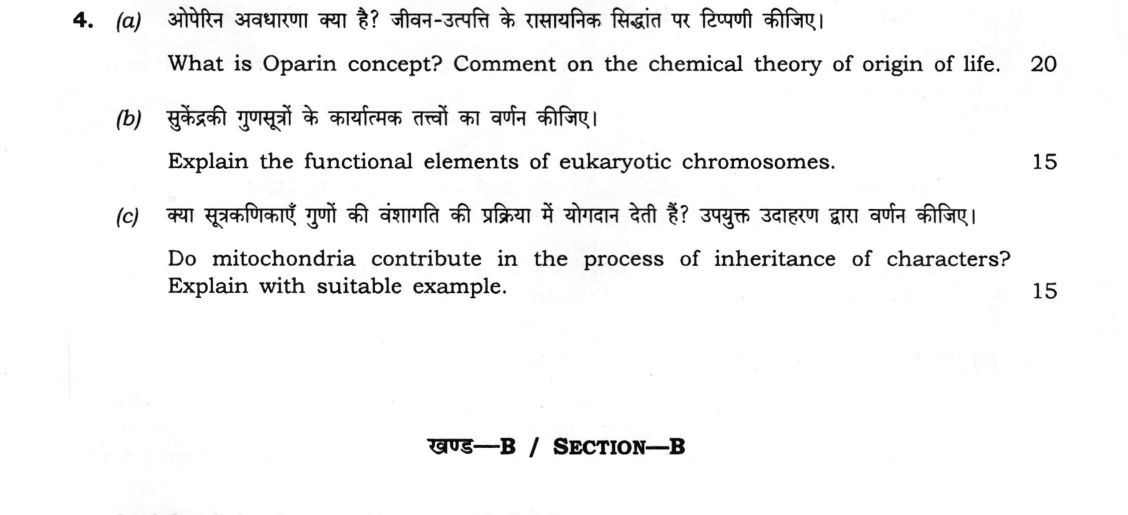
(a) What is Oparin concept? Comment on the chemical theory of origin of life. (20 marks) (b) Explain the functional elements of…
What is Oparin concept? Comment on the chemical theory of origin of life. 20 marks
Explain the functional elements of eukaryotic chromosomes. 15 marks
Do mitochondria contribute in the process of inheritance of characters? Explain with suitable example. 15 marks
हिंदी में प्रश्न पढ़ें
ओपेरिन अवधारणा क्या है? जीवन-उत्पत्ति के रासायनिक सिद्धांत पर टिप्पणी कीजिए। (20 अंक)
सुकेंद्रकी गुणसूत्रों के कार्यात्मक तत्वों का वर्णन कीजिए। (15 अंक)
क्या सूत्रकणिकाएँ गुणों की वंशागति की प्रक्रिया में योगदान देती हैं? उपयुक्त उदाहरण द्वारा वर्णन कीजिए। (15 अंक)
Model answer
Drafted with AI by UPSC Answer Check against this question's marking rubric, to the expected length. UPSC does not publish answers for Mains — this is one way to score well, not an official key. How we build rubrics and answers.
(a) Oparin's concept and the chemical theory of the origin of life (20 marks)
Oparin's concept. A. I. Oparin (1924), with J. B. S. Haldane (1929), proposed that life arose gradually from non-living matter by chemical evolution on the primitive Earth.
- The early atmosphere was reducing, with CH₄, NH₃, H₂ and water vapour and no free oxygen.
- Energy from ultraviolet light, lightning and volcanic heat converted these gases into simple organic molecules, which collected in the hot, dilute "primordial soup" of the oceans.
- The molecules polymerised, and Oparin proposed that they aggregated into coacervates (colloidal droplets bounded by a membrane-like layer), which absorbed substances and grew: the first protobionts, feeding on the soup, so they were heterotrophs. Autotrophs, photosynthesis and oxygen came later, followed by aerobes.
Chemical theory: stages. Formation of simple organic compounds, then of polymers, then of protobionts, and then of the first cell.
Experimental support.
- Miller and Urey (1953) sparked a mixture of CH₄, NH₃, H₂ and water and got amino acids (glycine, alanine and aspartic acid).
- Oró (1961) made adenine from HCN and ammonia. Fox heated amino acids to proteinoids, which formed microspheres.
- Amino acids have been found in the Murchison meteorite.
- Ribozymes (Cech and Altman) support an RNA world, in which RNA was both genetic material and catalyst before DNA and proteins.
Comment. The theory is testable and fits the heterotroph-first view. Its weaknesses are:
- The early atmosphere is now thought to have been less reducing (CO₂, N₂ and water), which gives lower yields.
- Products are racemic, and polymerisation in water is unfavourable.
- The origin of the genetic code and the leap from a protobiont to a cell are unexplained.
Alternatives. Hydrothermal-vent and iron–sulphur world hypotheses (Wächtershäuser), clay-mineral catalysis (Cairns-Smith) and panspermia. The RNA world hypothesis extends the theory.
(b) Functional elements of eukaryotic chromosomes (15 marks)
A chromosome needs three essential elements to replicate, segregate and stay stable. Murray and Szostak (1983) proved this by building an artificial yeast chromosome (YAC) from these three parts alone.
- Origins of replication (ARS): autonomously replicating sequences, about 100–150 bp in yeast, are bound by the origin recognition complex (ORC). Higher eukaryotes have many origins, which fire at different times in S phase, so that the long chromosome is copied in time.
- Centromere (CEN): the site of kinetochore assembly for attachment of spindle microtubules, and it is needed for segregation. Yeast has a point centromere of about 125 bp, and humans have alpha-satellite repeats and the histone variant CENP-A.
- Telomeres (TEL): repeats (TTAGGG in vertebrates) at the ends, added by telomerase, which protect the ends against degradation and fusion and solve the end-replication problem.
Organisational elements.
- Nucleosomes (146 bp of DNA on a histone octamer) fold into chromatin fibres.
- Chromatin loops are anchored on the scaffold at matrix attachment regions (MARs), which are AT-rich.
- The nucleolar organiser (NOR) carries rRNA genes and forms the nucleolus.
- Insulators (boundary elements, CTCF) block enhancers and separate chromatin domains.
- Heterochromatin, at centromeres and telomeres, is condensed and silenced, and euchromatin is active.
(c) Do mitochondria contribute to inheritance? (15 marks)
Yes. Mitochondria are semi-autonomous organelles with their own genome (mtDNA), so they show extranuclear (cytoplasmic) inheritance.
mtDNA. Human mtDNA is a circular molecule of 16,569 bp with 37 genes: 13 for proteins of oxidative phosphorylation, 22 for tRNAs and 2 for rRNAs. Each cell holds hundreds to thousands of copies.
Maternal transmission. The egg contributes almost all of the cytoplasm, and the sperm mitochondria are marked and destroyed after fertilisation. So mtDNA passes from mother to all offspring, and it does not follow Mendel's laws.
Heteroplasmy and threshold. A cell may hold a mixture of normal and mutant mtDNA (heteroplasmy). Mitochondria segregate at random in cell division, and disease appears only when the mutant fraction crosses a threshold (often 60–90%), which explains the variable expression within a family.
Example. Leber's hereditary optic neuropathy (LHON) is caused by mtDNA point mutations, such as m.11778G>A in the ND4 gene, and causes sudden loss of central vision.
- An affected mother passes it to all her children (with variable expression, and males are more often affected), and an affected father passes it to none.
- Other examples: MERRF and MELAS (mutations in mitochondrial tRNA genes), and cytoplasmic male sterility in maize, where the mitochondrial gene affects pollen.
How this answer will be evaluated
Evaluation rubric
Each sub-part is marked on its own, against the marks and word limit printed on the paper.
- (a) What is Oparin concept? Comment on the chemical theory of origin of life (20 marks). 20 marks
Must cover
- Oparin–Haldane concept: reducing atmosphere, primordial soup, coacervates, heterotrophs first
- Stages of chemical evolution from simple organics to polymers, protobionts and the first cell
- Experimental support: Miller–Urey, Oró, Fox, RNA world
- Critical comment: strengths, gaps and alternatives such as hydrothermal vents and panspermia
Loses marks
- Describing evolution of species instead.
- Stating Miller–Urey without the gases or products.
Earns more
- Composition of the primitive atmosphere and its energy sources.
- A balanced evaluation, not description alone.
Extra mark
- Recent view of a less reducing atmosphere
- (b) Explain the functional elements of eukaryotic chromosomes (15 marks). 15 marks
Must cover
- Three essential elements: origins of replication (ARS), centromere, telomere
- The YAC experiment of Murray and Szostak
- Roles of each: replication, segregation, protection of ends and telomerase
- Organisational elements: nucleosomes, MARs, NOR, insulators, heterochromatin
Loses marks
- Describing only the structure of chromatin.
- Omitting the telomere or centromere.
Earns more
- Sizes or repeat sequences such as TTAGGG and CENP-A.
- Link of each element to a function.
Extra mark
- End-replication problem
- (c) Do mitochondria contribute in the process of inheritance of characters? Explain with suitable example (15 marks). 15 marks
Must cover
- Clear answer yes, with mtDNA as a separate genome
- Human mtDNA features: 16,569 bp, 37 genes
- Maternal inheritance and non-Mendelian pattern
- Heteroplasmy and threshold effect, with a named example such as LHON, MERRF or MELAS
Loses marks
- Answering no or only Mendelian inheritance.
- No named example.
Earns more
- A worked transmission from an affected mother and father.
- Reason for maternal inheritance.
Extra mark
- Cytoplasmic male sterility in plants
What "Comment" is asking you to do
Take a position on the statement and support it. Comment usually attaches to a quoted line in the short slots, so the reasoning must be compressed — an opening view, a few load-bearing reasons, and the limit of the claim.
Structure that answers it
Unpack what the statement asserts → your stance → two or three supporting reasons → the qualification that limits it
Where marks are lost
Neutral summary; a comment without a stance has not answered. Equally costly is accepting the quoted line wholesale and never testing where it fails.
Practice this exact question
Write your answer and it is marked point by point against the model answer above — what you covered, what you missed, what you got wrong.
Evaluate my answer →More from Zoology 2026 Paper II
- Q1 Write on the following in about 150 words each : (a) Semiconservative replication of DNA…
- Q2 (a) What is DNA transcription? Explain the process of DNA transcription in eukaryotes. (2…
- Q3 (a) What is recombinant DNA technology? Describe the different vectors used in DNA clonin…
- Q4 (a) What is Oparin concept? Comment on the chemical theory of origin of life. (20 marks)…
- Q5 Write on the following in about 150 words each : (a) Role of calcium in muscle contractio…
- Q6 (a) Explain various levels of protein organization with suitable examples. (20 marks) (b)…
- Q7 (a) Name the proteins and their functions involved in skeletal muscle contraction. Unlike…