Paper II — Q5
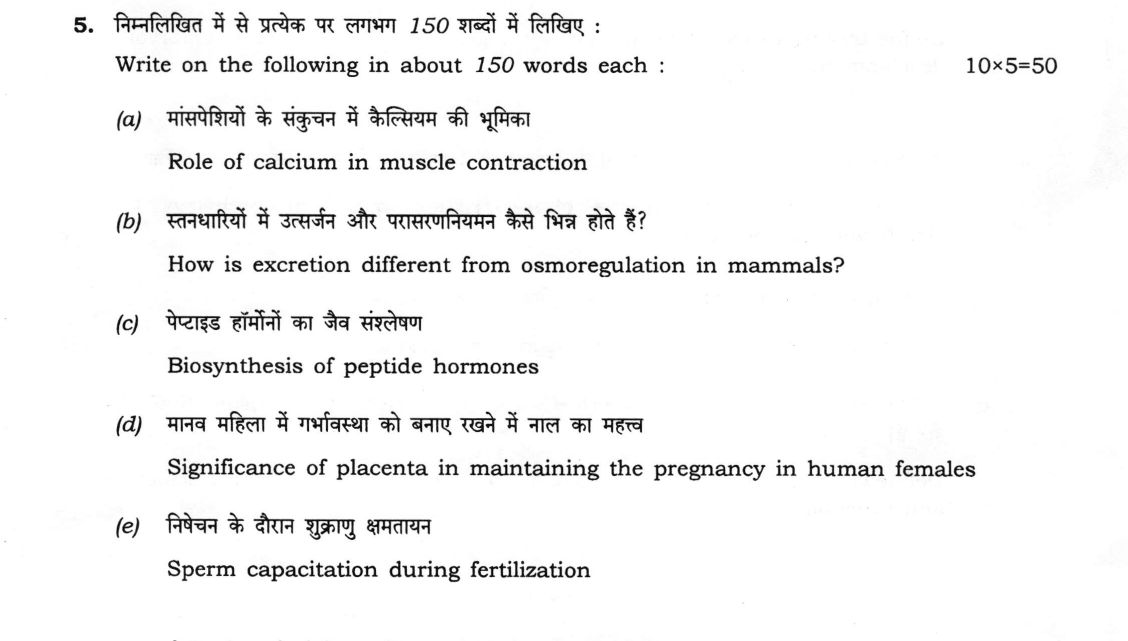
(a) Role of calcium in muscle contraction (10 marks) (b) How is excretion different from osmoregulation in mammals? (10…
Write on the following in about 150 words each :
Role of calcium in muscle contraction 10 marks
How is excretion different from osmoregulation in mammals? 10 marks
Biosynthesis of peptide hormones 10 marks
Significance of placenta in maintaining the pregnancy in human females 10 marks
Sperm capacitation during fertilization 10 marks
हिंदी में प्रश्न पढ़ें
निम्नलिखित में से प्रत्येक पर लगभग 150 शब्दों में लिखिए :
मांसपेशियों के संकुचन में कैल्सियम की भूमिका (10 अंक)
स्तनधारियों में उत्सर्जन और परासरणनियम कैसे भिन्न होते हैं? (10 अंक)
पेप्टाइड हार्मोनों का जैव संश्लेषण (10 अंक)
मानव महिला में गर्भावस्था को बनाए रखने में नाल का महत्व (10 अंक)
निषेचन के दौरान शुक्राणु क्षमतायन (10 अंक)
Model answer
Drafted with AI by UPSC Answer Check against this question's marking rubric, to the 150-word length. UPSC does not publish answers for Mains — this is one way to score well, not an official key. How we build rubrics and answers.
(a) Role of calcium in muscle contraction (10 marks)
Calcium is the trigger that turns contraction on and off.
- Release: an action potential spreads along the sarcolemma and down the T tubules. The voltage sensor (dihydropyridine receptor) opens the ryanodine receptor of the sarcoplasmic reticulum (SR), and Ca²⁺ floods the sarcoplasm.
- Switching on: Ca²⁺ binds troponin C, changing the shape of the troponin–tropomyosin complex and moving tropomyosin off the myosin-binding sites on actin. Myosin heads attach, and ATP-driven cross-bridge cycling follows.
- Relaxation: Ca²⁺ is pumped back into the SR by SERCA (Ca²⁺-ATPase), troponin loses its calcium, and tropomyosin again blocks actin.
- Variations: in smooth muscle, Ca²⁺ binds calmodulin, which activates myosin light-chain kinase; in cardiac muscle, Ca²⁺ entering through L-type channels triggers more release from the SR.
- Clinical: malignant hyperthermia comes from a defective ryanodine receptor, and rigor mortis develops when ATP runs out while calcium leaks in.
(b) Excretion and osmoregulation in mammals (10 marks)
Aim. Excretion removes nitrogenous metabolic wastes (urea, creatinine, uric acid) and foreign substances such as drugs. Osmoregulation keeps the water content, solute concentration (about 300 mOsm/L) and volume of body fluids constant.
Substances handled. Excretion deals with urea, creatinine, drugs and excess ions. Osmoregulation deals with water and electrolytes (Na⁺, K⁺, Cl⁻).
Mechanisms in the nephron.
- Excretion: glomerular filtration of wastes, and tubular secretion of H⁺, drugs and organic acids in the proximal tubule.
- Osmoregulation: the loop of Henle and the medullary gradient (countercurrent multiplier) make it possible to concentrate urine, and the collecting duct adjusts water reabsorption under ADH (aquaporin-2). Aldosterone controls Na⁺ and K⁺, atrial natriuretic peptide opposes it, and the renin–angiotensin system regulates volume.
The kidney performs both, and urea links them, since it is excreted but also recycled in the medulla to maintain the gradient. Skin and lungs also help.
(c) Biosynthesis of peptide hormones (10 marks)
Peptide hormones are made as larger precursors, illustrated by insulin.
- Transcription: the hormone gene (INS) is transcribed to mRNA, which is translated on ribosomes.
- Translation on the rough ER: an N-terminal signal peptide directs the ribosome to the ER through the signal recognition particle, and the chain enters the ER lumen as a preprohormone (preproinsulin).
- Signal cleavage: signal peptidase removes the signal peptide to give the prohormone (proinsulin), which folds and forms disulphide bonds.
- Golgi processing: vesicles carry it to the Golgi, and in the trans-Golgi network it is packaged into immature secretory granules.
- Maturation: prohormone convertases (PC1/3, PC2) and carboxypeptidase E cut out the C-peptide, giving mature insulin (A and B chains) stored with zinc in granules.
- Secretion: regulated exocytosis is triggered by Ca²⁺ entry after the stimulus (glucose).
POMC is processed differently in different tissues, to ACTH, MSH and β-endorphin.
(d) Significance of the placenta in maintaining pregnancy in human females (10 marks)
The placenta is formed from the chorion (trophoblast) and the decidua basalis, and is the endocrine, transport and immune organ of pregnancy.
- hCG: secreted by the syncytiotrophoblast from about day 8, it rescues the corpus luteum, so progesterone continues until about weeks 8–10. It is the basis of pregnancy tests.
- Luteo-placental shift: by weeks 10–12 the placenta itself makes progesterone and oestrogens.
- Progesterone maintains the endometrium and keeps the myometrium quiet, and it helps immune tolerance.
- Oestrogens (estriol) come from the fetoplacental unit, in which fetal adrenal precursors are converted by the placenta, and they grow the uterus and breasts.
- hPL changes the mother's metabolism to supply glucose to the foetus, and CRH helps to time birth.
- Transport and protection: the placenta exchanges O₂, nutrients, wastes and IgG, and protects the foetus, a semi-allograft, from rejection.
(e) Sperm capacitation during fertilisation (10 marks)
Capacitation is the final physiological maturation of ejaculated sperm in the female genital tract, by which they become able to fertilise an egg (Austin and Chang, 1951).
Site and time. It occurs in the uterus and the oviduct, over several hours in humans.
Changes.
- Seminal decapacitating factors are removed, and cholesterol is lost from the sperm membrane (to albumin), which increases its fluidity.
- Bicarbonate and calcium enter, the latter through CatSper channels. Bicarbonate activates soluble adenylyl cyclase, and the raised cAMP activates PKA, leading to protein tyrosine phosphorylation.
- Sperm motility becomes hyperactivated, with a stronger, asymmetrical whip-like beat.
Significance. Capacitated sperm can bind the zona pellucida, undergo the acrosome reaction (triggered by ZP3) and fuse with the egg. In IVF, sperm are capacitated in a medium with albumin, bicarbonate and calcium before insemination.
How this answer will be evaluated
Evaluation rubric
Each sub-part is marked on its own, against the marks and word limit printed on the paper.
- (a) Write on the role of calcium in muscle contraction (10 marks, about 150 words). 10 marks · 150 words
Must cover
- Release of Ca²⁺ from the sarcoplasmic reticulum after the action potential via T tubules and the ryanodine receptor
- Ca²⁺ binding troponin C and tropomyosin moving off actin sites
- Removal of Ca²⁺ by SERCA for relaxation
- Variations in smooth and cardiac muscle
Loses marks
- Saying calcium binds actin or myosin directly.
- Omitting relaxation.
Earns more
- Excitation–contraction coupling described.
- Clinical illustration such as rigor mortis or malignant hyperthermia.
Extra mark
- Concentration change of Ca²⁺
- (b) Write on how excretion is different from osmoregulation in mammals (10 marks, about 150 words). 10 marks · 150 words
Must cover
- Excretion as removal of nitrogenous wastes and foreign solutes, and osmoregulation as regulating water and solute concentration
- Substances handled by each
- Nephron mechanisms: filtration and secretion against loop of Henle, gradient and collecting duct
- Hormones ADH, aldosterone, ANP, and the urea link
Loses marks
- Treating the terms as synonyms.
- Omitting hormones.
Earns more
- Contrast in a point-by-point way.
- Recognition that the kidney does both.
Extra mark
- Skin and lungs as accessory organs
- (c) Write on the biosynthesis of peptide hormones (10 marks, about 150 words). 10 marks · 150 words
Must cover
- Transcription and translation on rough ER with a signal peptide
- Preprohormone to prohormone by signal peptidase
- Golgi processing and packaging into secretory granules
- Cleavage by prohormone convertases and regulated exocytosis, with a named example such as insulin or POMC
Loses marks
- Describing steroid hormone synthesis.
- No named hormone.
Earns more
- Signal recognition particle named.
- C-peptide as a product for insulin.
Extra mark
- Tissue-specific processing of POMC
- (d) Write on the significance of placenta in maintaining the pregnancy in human females (10 marks, about 150 words). 10 marks · 150 words
Must cover
- hCG rescuing the corpus luteum
- Luteo-placental shift with progesterone and oestrogens
- Roles of progesterone, oestrogens, hPL and CRH
- Transport and immune tolerance
Loses marks
- Describing only the anatomy of the placenta.
- Confusing hCG with LH.
Earns more
- Fetoplacental unit for estriol.
- Timing in weeks.
Extra mark
- hCG as the basis of pregnancy tests
- (e) Write on sperm capacitation during fertilisation (10 marks, about 150 words). 10 marks · 150 words
Must cover
- Definition and the discoverers, with site and duration
- Membrane changes: cholesterol efflux, bicarbonate, calcium, cAMP and PKA, tyrosine phosphorylation
- Hyperactivated motility
- Significance for the acrosome reaction and for IVF
Loses marks
- Confusing capacitation with the acrosome reaction.
- Describing spermatogenesis.
Earns more
- CatSper channels named.
- Role of zona pellucida binding.
Extra mark
- Decapacitation factors in seminal plasma
What "Discuss" is asking you to do
Lay the issue out from more than one side — how it arose, what is claimed for it, what is held against it, and where it now stands. UPSC attaches discuss to broad topics with several live dimensions, so coverage of the dimensions earns more than the strength of your opinion.
Structure that answers it
Set the issue up → the case as it is made → the case against → the dimension both sides leave out → where the balance now lies
Where marks are lost
Listing facts with no thread between them, or arguing one side throughout and calling it a discussion.
Practice this exact question
Write your answer and it is marked point by point against the model answer above — what you covered, what you missed, what you got wrong.
Evaluate my answer →More from Zoology 2026 Paper II
- Q2 (a) What is DNA transcription? Explain the process of DNA transcription in eukaryotes. (2…
- Q3 (a) What is recombinant DNA technology? Describe the different vectors used in DNA clonin…
- Q4 (a) What is Oparin concept? Comment on the chemical theory of origin of life. (20 marks)…
- Q5 Write on the following in about 150 words each : (a) Role of calcium in muscle contractio…
- Q6 (a) Explain various levels of protein organization with suitable examples. (20 marks) (b)…
- Q7 (a) Name the proteins and their functions involved in skeletal muscle contraction. Unlike…
- Q8 (a) Define apoptosis. Explain the characteristics, molecular pathways and significance of…