Paper II — Q3
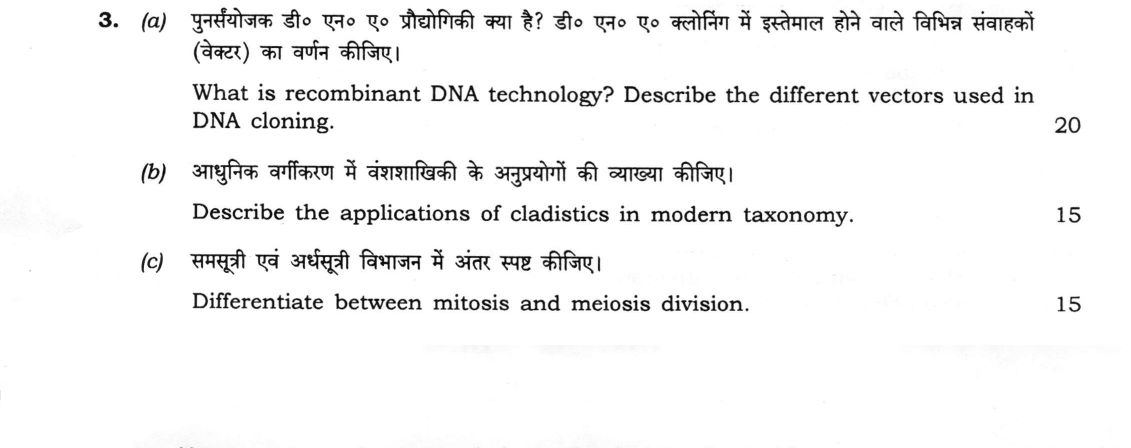
(a) What is recombinant DNA technology? Describe the different vectors used in DNA cloning. (20 marks) (b) Describe the…
What is recombinant DNA technology? Describe the different vectors used in DNA cloning. 20 marks
Describe the applications of cladistics in modern taxonomy. 15 marks
Differentiate between mitosis and meiosis division. 15 marks
हिंदी में प्रश्न पढ़ें
पुनर्संयोजक डी० एन० ए० प्रौद्योगिकी क्या है? डी० एन० ए० क्लोनिंग में इस्तेमाल होने वाले विभिन्न संवाहकों (वेक्टर) का वर्णन कीजिए। (20 अंक)
आधुनिक वर्गीकरण में वंशाशखिकी के अनुप्रयोगों की व्याख्या कीजिए। (15 अंक)
समद्वीय एवं अर्धसूत्री विभाजन में अंतर स्पष्ट कीजिए। (15 अंक)
Model answer
Drafted with AI by UPSC Answer Check against this question's marking rubric, to the expected length. UPSC does not publish answers for Mains — this is one way to score well, not an official key. How we build rubrics and answers.
(a) Recombinant DNA technology and cloning vectors (20 marks)
Recombinant DNA technology. It is the set of techniques by which DNA from different sources is cut and joined in the test tube and introduced into a host cell, where it replicates and may express (Cohen and Boyer, 1973).
Essential steps.
- Isolate the gene of interest and the vector DNA.
- Cut both with the same restriction endonuclease (EcoRI, for example, leaves sticky ends).
- Join them with DNA ligase to make the recombinant molecule.
- Introduce it into a host by transformation (CaCl₂ and heat shock, or electroporation), transfection, microinjection, gene gun or Agrobacterium.
- Select recombinants by antibiotic resistance, insertional inactivation or blue–white screening, and grow them for expression and the product.
Vectors. A vector is a DNA molecule that carries foreign DNA into a host. It needs an origin of replication, a selectable marker and unique cloning sites. The main types are:
- Plasmids: small circular DNA of bacteria, taking inserts up to about 10 kb, such as pBR322 (ampicillin and tetracycline resistance) and the high-copy pUC18/19 with lacZ for blue–white screening.
- Bacteriophage λ vectors: insertion and replacement types, taking about 20–23 kb, and packaged in vitro into phage particles, so infection is efficient.
- Cosmids: plasmids with the cos site of λ, taking up to 45 kb.
- Phagemids: plasmid and M13 features, giving single-stranded DNA (pBluescript).
- Artificial chromosomes: BACs (from the F plasmid, 100–300 kb, used in genome sequencing), PACs (from phage P1, similar size) and YACs (yeast, with centromere, telomeres and ARS, 200–2,000 kb).
- Shuttle and expression vectors: replicate in two hosts (E. coli and yeast), or, like pET, carry strong promoters for protein production.
- Ti plasmid of Agrobacterium for plants.
- Viral vectors (retrovirus, adenovirus, AAV, baculovirus for insect cells) for animal cells and gene therapy.
The choice depends on insert size, the host and the purpose.
(b) Applications of cladistics in modern taxonomy (15 marks)
Cladistics (Hennig) classifies organisms by shared derived characters (synapomorphies) into nested branching groups, shown as a cladogram, and recognises only monophyletic groups (clades) that contain an ancestor and all its descendants. Its uses are as follows.
- Reconstruction of phylogeny from morphological and molecular characters, by maximum parsimony, maximum likelihood or Bayesian methods, using an outgroup to root the tree.
- Monophyly-based classification: birds are placed within the theropod dinosaurs, so "Reptilia" without birds is paraphyletic, and whales fall within the even-toed ungulates (Cetartiodactyla), being sister to hippopotamuses.
- Species delimitation: the phylogenetic species concept identifies cryptic species, as in many frogs and insects.
- Divergence dating: the tree is calibrated with the fossil record and a molecular clock to date splits.
- Conservation: phylogenetic diversity helps to prioritise evolutionarily distinct lineages, as in the EDGE programme for the tuatara and aye-aye.
- Biogeography and comparative biology: they test vicariance and trace the evolution of characters, such as flight, or C₄ photosynthesis in plants.
- Epidemiology: phylogenies of HIV and SARS-CoV-2 track the origin and spread of outbreaks.
(c) Mitosis and meiosis (15 marks)
- Site and cell type: mitosis occurs in somatic cells and in gonial cells, and meiosis in germ-line cells (gonads, or spore mother cells in plants).
- Divisions and products: mitosis is one division giving 2 daughter cells; meiosis is two divisions (I and II) giving 4 cells.
- Chromosome number: mitosis keeps it (2n → 2n); meiosis halves it (2n → n).
- DNA replication: one S phase before mitosis, and one before meiosis I, none between I and II.
- Prophase: short in mitosis; long in meiosis I, with five stages (leptotene, zygotene, pachytene, diplotene and diakinesis).
- Homologues: they do not pair in mitosis; in meiosis I they pair (synapsis) into bivalents.
- Chiasmata and crossing over: absent in mitosis; present in pachytene and seen as chiasmata in diplotene.
- Metaphase and anaphase: in mitosis the chromosomes line up singly and the centromeres split, so sister chromatids separate. In anaphase I homologous chromosomes separate and centromeres do not split, and in anaphase II the centromeres split and sister chromatids separate.
- Genetic result: mitosis gives genetically identical cells; meiosis gives genetically different cells by crossing over and independent assortment.
- Significance: mitosis is for growth, repair and asexual reproduction; meiosis makes gametes or spores, keeps the chromosome number constant across generations and creates variation.
How this answer will be evaluated
Evaluation rubric
Each sub-part is marked on its own, against the marks and word limit printed on the paper.
- (a) What is recombinant DNA technology? Describe the different vectors used in DNA cloning (20 marks). 20 marks
Must cover
- Definition and steps: cutting with restriction enzymes, joining with ligase, introduction into host, selection
- Plasmids such as pBR322 and pUC with capacity and selection
- Phage λ vectors, cosmids and phagemids with capacities
- BAC, YAC and PAC, shuttle and expression vectors, and viral or Ti vectors, with hosts and uses
Loses marks
- Naming only plasmids.
- Confusing a vector with a host.
Earns more
- Insert capacities given for each vector class.
- Hosts and uses stated, not just names.
Extra mark
- Features of a good vector: ori, marker and cloning sites
- (b) Describe the applications of cladistics in modern taxonomy (15 marks). 15 marks
Must cover
- Cladistics defined by synapomorphy and monophyly, with the cladogram
- Phylogeny reconstruction by parsimony, likelihood and Bayesian methods
- Monophyly-based classification, such as birds among dinosaurs and whales among artiodactyls
- Species delimitation, dating, conservation (EDGE), biogeography and epidemiology
Loses marks
- Only defining terms.
- Confusing cladistics with phenetics.
Earns more
- A named example for each application.
- Outgroup and sister group used correctly.
Extra mark
- Divergence dating with the molecular clock
- (c) Differentiate between mitosis and meiosis division (15 marks). 15 marks
Must cover
- Site and cell type, number of divisions and daughter cells, and chromosome number outcome
- Prophase I with pairing, chiasmata and crossing over, absent in mitosis
- Anaphase I against anaphase II centromere and chromosome behaviour
- Genetic consequence and biological significance
Loses marks
- Two separate descriptions.
- Stating that homologues pair in mitosis.
Earns more
- Criterion-wise comparison.
- The five stages of prophase I named.
Extra mark
- Independent assortment as a source of variation
What "Describe" is asking you to do
Give a full, ordered account of the thing named — its parts, stages or mechanism — in the sequence in which it actually exists or occurs. Most describe questions come from the science optionals, where the marks sit in correct technical detail and, where the stem says so, a labelled diagram.
Structure that answers it
One-line identification of the subject → the parts or stages in their real order, each with its defining detail → labelled diagram where the subject is structural → closing line on function or significance
Where marks are lost
Loose general prose where the examiner is ticking named parts, correct terminology and their sequence; and in the General Studies papers, turning to evaluation before the description is finished.
Practice this exact question
Write your answer and it is marked point by point against the model answer above — what you covered, what you missed, what you got wrong.
Evaluate my answer →More from Zoology 2026 Paper II
- Q1 Write on the following in about 150 words each : (a) Semiconservative replication of DNA…
- Q2 (a) What is DNA transcription? Explain the process of DNA transcription in eukaryotes. (2…
- Q3 (a) What is recombinant DNA technology? Describe the different vectors used in DNA clonin…
- Q4 (a) What is Oparin concept? Comment on the chemical theory of origin of life. (20 marks)…
- Q5 Write on the following in about 150 words each : (a) Role of calcium in muscle contractio…
- Q6 (a) Explain various levels of protein organization with suitable examples. (20 marks) (b)…