Paper II — Q2
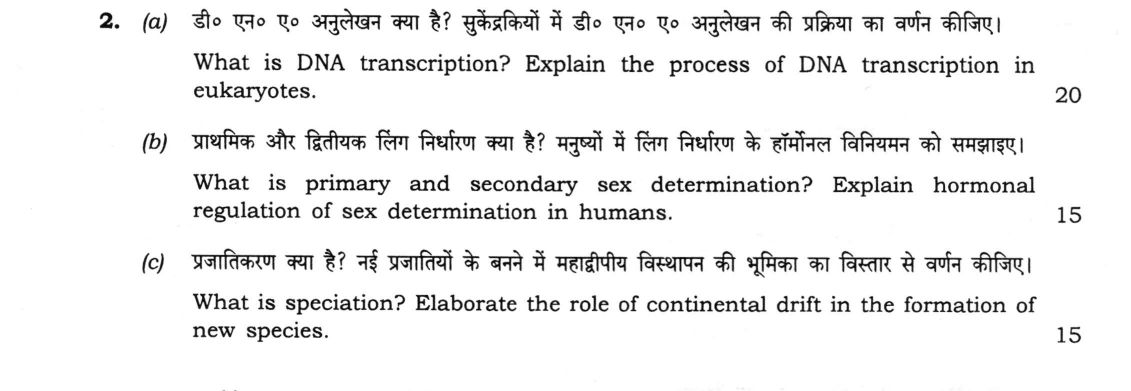
(a) What is DNA transcription? Explain the process of DNA transcription in eukaryotes. (20 marks) (b) What is primary and…
What is DNA transcription? Explain the process of DNA transcription in eukaryotes. 20 marks
What is primary and secondary sex determination? Explain hormonal regulation of sex determination in humans. 15 marks
What is speciation? Elaborate the role of continental drift in the formation of new species. 15 marks
हिंदी में प्रश्न पढ़ें
डी० एन० ए० अनुलेखन क्या है? सुकेंद्रकियों में डी० एन० ए० अनुलेखन की प्रक्रिया का वर्णन कीजिए। (20 अंक)
प्राथमिक और द्वितीयक लिंग निर्धारण क्या है? मनुष्यों में लिंग निर्धारण के हार्मोनल विनियमन को समझाइए। (15 अंक)
प्रजातिकरण क्या है? नई प्रजातियों के बनने में महाद्वीपीय विस्थापन की भूमिका का विस्तार से वर्णन कीजिए। (15 अंक)
Model answer
Drafted with AI by UPSC Answer Check against this question's marking rubric, to the expected length. UPSC does not publish answers for Mains — this is one way to score well, not an official key. How we build rubrics and answers.
(a) DNA transcription in eukaryotes (20 marks)
Transcription. Transcription is the synthesis of an RNA molecule from a DNA template by RNA polymerase. The template (antisense) strand is read 3′→5′ and the RNA grows 5′→3′, so it is complementary and antiparallel to the template and identical to the coding (sense) strand, with U in place of T. The primary product is a precursor RNA (pre-mRNA, or hnRNA).
Eukaryotic process. Transcription is in the nucleus, in chromatin, and uses three RNA polymerases: Pol I makes the large rRNAs (18S, 5.8S, 28S) in the nucleolus, Pol II makes pre-mRNA, snRNA and miRNA, and Pol III makes tRNA and 5S rRNA.
- Promoter: the core promoter has the TATA box (about −25 to −30), the initiator (Inr) and other elements, and enhancers and silencers act from a distance through the Mediator and activators. Nucleosomes are remodelled and histones acetylated to open the chromatin.
- Initiation: general transcription factors assemble on the promoter. TFIID, through its TBP, binds the TATA box, then TFIIA and TFIIB join, then Pol II with TFIIF, and then TFIIE and TFIIH, forming the pre-initiation complex. TFIIH is a helicase that melts the DNA to form the open complex, and a kinase that phosphorylates serine 5 of the C-terminal domain (CTD) of Pol II, releasing it from the promoter.
- Elongation: Pol II moves along the template with elongation factors, and phosphorylation of serine 2 of the CTD recruits the processing factors.
- Co-transcriptional processing: a 5′ cap is added early, introns are spliced out by the spliceosome (snRNPs), and the 3′ end is cleaved at the AAUAAA signal and given a poly-A tail.
- Termination: after the poly-A site is passed, an exonuclease (Xrn2/Rat1) degrades the remaining RNA and dislodges the polymerase (the torpedo model).
Contrast with prokaryotes. Bacteria have a single RNA polymerase that is directed by a sigma factor, with no capping or splicing, coupled to translation, and terminating by Rho-dependent or intrinsic (hairpin) signals.
(b) Sex determination and its hormonal regulation in humans (15 marks)
Primary sex determination is the decision of gonadal sex. It is genetic: the SRY (testis-determining factor) gene on the Y chromosome triggers SOX9 and the development of the embryonic gonad into a testis, with Sertoli and Leydig cells. In XX embryos without SRY, genes such as WNT4, RSPO1 and FOXL2 direct the gonad to become an ovary.
Secondary sex determination is the development of the internal ducts, the external genitalia and, later, the secondary sexual characters, and depends on gonadal hormones.
Hormonal regulation.
- In the male foetus, Sertoli cells secrete anti-Müllerian hormone (AMH), which makes the Müllerian ducts regress. Leydig cells secrete testosterone, first stimulated by hCG and then LH, which preserves the Wolffian ducts to form the epididymis, vas deferens and seminal vesicles.
- Testosterone is converted by 5α-reductase into dihydrotestosterone (DHT), which forms the penis, scrotum and prostate.
- In the female, no AMH is produced, so the Müllerian ducts form the fallopian tubes, uterus and upper vagina. Without testosterone the Wolffian ducts regress, and without DHT the external genitalia become the clitoris and labia.
- At puberty, GnRH, FSH and LH lead to secondary sexual characters, through testosterone in males and oestrogen in females.
Disorders show the role of hormones, such as androgen insensitivity (a 46,XY person with a female phenotype) and 5α-reductase deficiency.
(c) Speciation and the role of continental drift (15 marks)
Speciation is the evolution of new species from an ancestral population. In the biological species concept (Mayr), a species is a group of interbreeding natural populations that are reproductively isolated from others. Modes are allopatric (geographic isolation), peripatric, parapatric and sympatric (as by polyploidy). Isolating mechanisms are pre-zygotic (habitat, seasonal, behavioural, mechanical and gametic) and post-zygotic (hybrid inviability or sterility, as in the mule).
Continental drift. The break-up of Pangaea, and then of Gondwana, split once-continuous populations by vicariance, in which a barrier divides a range. The separated populations, in different environments, diverged genetically, leading to allopatric speciation over millions of years.
Evidence and examples.
- The lungfishes are found in Australia (Neoceratodus), Africa (Protopterus) and South America (Lepidosiren), a Gondwanan distribution.
- Marsupials diversified in Australia after it separated from Antarctica and became isolated, while placental mammals radiated elsewhere.
- Ratites (ostrich, rhea, emu, cassowary and kiwi) are traditionally linked to the break-up of Gondwana, though molecular studies show dispersal has also been important.
- Cichlid fishes in Africa, South America and India, and the southern beeches (Nothofagus), have a Gondwanan pattern. The lemurs of Madagascar evolved in isolation after the island separated, colonised by rafting.
- The northward drift of India and its collision with Asia later allowed the mixing of faunas and further speciation.
Continental drift thus produced large-scale vicariance, and isolated biotas evolved separately.
How this answer will be evaluated
Evaluation rubric
Each sub-part is marked on its own, against the marks and word limit printed on the paper.
- (a) What is DNA transcription? Explain the process of DNA transcription in eukaryotes (20 marks). 20 marks
Must cover
- Definition: RNA synthesis from a DNA template by RNA polymerase, template and polarity
- Three RNA polymerases with their products, and the promoter with TATA box and enhancers
- Initiation with general transcription factors and PIC, elongation with CTD phosphorylation, termination
- Co-transcriptional capping, splicing and polyadenylation, and contrast with prokaryotes
Loses marks
- Describing the bacterial sigma-factor process as the main answer.
- Confusing transcription with replication.
Earns more
- Named factors such as TFIID (TBP) and TFIIH.
- Polarity of strands stated correctly.
Extra mark
- Chromatin remodelling and the torpedo model
- (b) What is primary and secondary sex determination? Explain hormonal regulation of sex determination in humans (15 marks). 15 marks
Must cover
- Primary as gonadal sex by SRY, and secondary as hormone-driven development of ducts and genitalia
- AMH from Sertoli cells regressing Müllerian ducts
- Testosterone maintaining Wolffian ducts, and DHT forming male external genitalia
- Female pathway without AMH and androgens, and puberty hormones
Loses marks
- Confusing sex determination with sex differentiation only.
- Omitting AMH or DHT.
Earns more
- SOX9 and the roles of 5α-reductase named.
- Disorders such as androgen insensitivity as illustration.
Extra mark
- Ovarian genes such as WNT4 and FOXL2
- (c) What is speciation? Elaborate the role of continental drift in the formation of new species (15 marks). 15 marks
Must cover
- Definition of speciation, species concept, modes and isolating mechanisms
- Vicariance from the break-up of Pangaea and Gondwana leading to allopatric speciation
- Named examples: lungfishes, marsupials, ratites, cichlids, lemurs
- Evidence and a balanced note on the role of dispersal
Loses marks
- Defining speciation only.
- Stating that continental drift is the sole cause of speciation.
Earns more
- Majority of the answer devoted to continental drift.
- Time scale of the separations.
Extra mark
- Northward drift of India and mixing of faunas
What "Explain" is asking you to do
Make the working of something clear — what sets it off, what follows from what, and what it produces. Explain is the Commission's mechanism word: it dominates the technical papers and the “explain why” stems, where the marks sit in the causal chain and not in the label.
Structure that answers it
State what it is → the initiating condition → the chain of cause, step by step → an instance where it plays out → what the chain produces
Where marks are lost
Describing what something looks like instead of why it works that way. Naming the stages without linking them reads as description too.
Practice this exact question
Write your answer and it is marked point by point against the model answer above — what you covered, what you missed, what you got wrong.
Evaluate my answer →More from Zoology 2026 Paper II
- Q1 Write on the following in about 150 words each : (a) Semiconservative replication of DNA…
- Q2 (a) What is DNA transcription? Explain the process of DNA transcription in eukaryotes. (2…
- Q3 (a) What is recombinant DNA technology? Describe the different vectors used in DNA clonin…
- Q4 (a) What is Oparin concept? Comment on the chemical theory of origin of life. (20 marks)…
- Q5 Write on the following in about 150 words each : (a) Role of calcium in muscle contractio…