Paper II — Q8
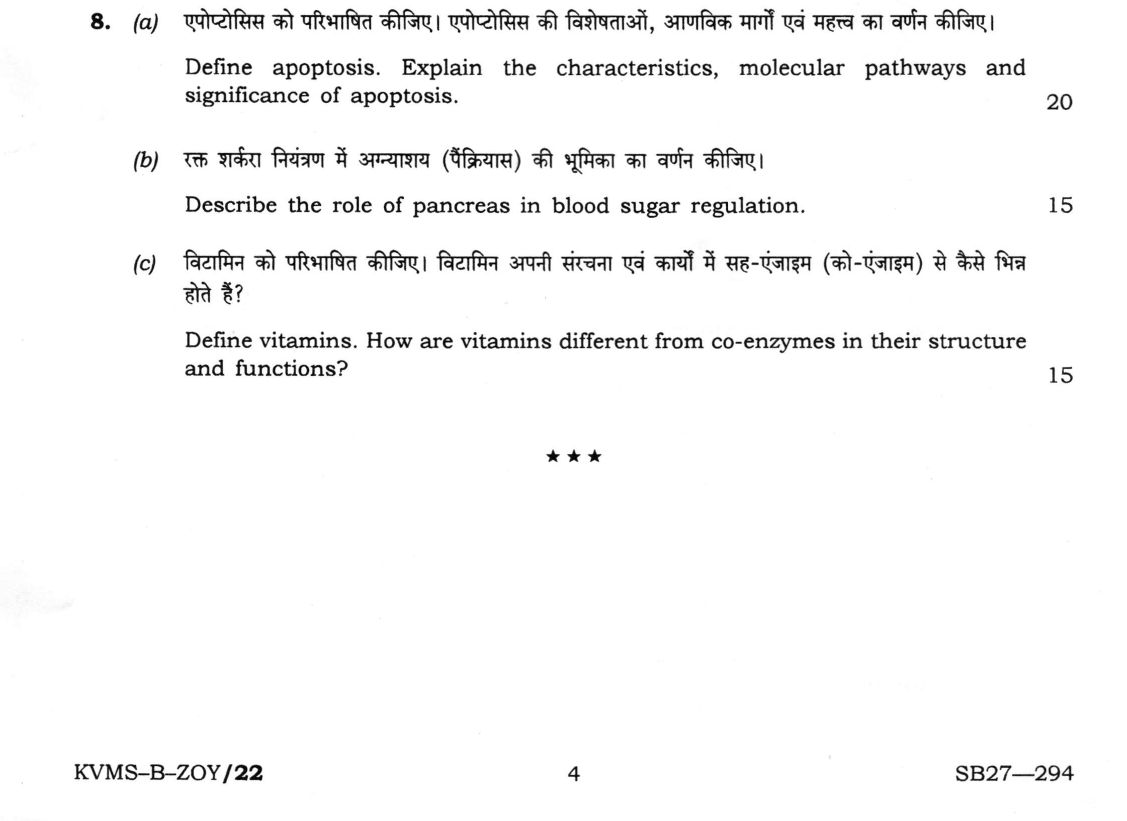
(a) Define apoptosis. Explain the characteristics, molecular pathways and significance of apoptosis. (20 marks) (b) Describe the…
Define apoptosis. Explain the characteristics, molecular pathways and significance of apoptosis. 20 marks
Describe the role of pancreas in blood sugar regulation. 15 marks
Define vitamins. How are vitamins different from co-enzymes in their structure and functions? 15 marks
हिंदी में प्रश्न पढ़ें
एपोप्टोसिस को परिभाषित कीजिए। एपोप्टोसिस की विशेषताओं, आणविक मार्गों एवं महत्व का वर्णन कीजिए। (20 अंक)
रक्त शर्करा नियंत्रण में अग्न्याशय (पैंक्रियास) की भूमिका का वर्णन कीजिए। (15 अंक)
विटामिन को परिभाषित कीजिए। विटामिन अपनी संरचना एवं कार्यों में सह-एंजाइम (को-एंजाइम) से कैसे भिन्न होते हैं? (15 अंक)
Model answer
Drafted with AI by UPSC Answer Check against this question's marking rubric, to the expected length. UPSC does not publish answers for Mains — this is one way to score well, not an official key. How we build rubrics and answers.
(a) Apoptosis: definition, characteristics, molecular pathways and significance (20 marks)
Definition. Apoptosis is genetically programmed, energy-dependent cell death in which a cell dismantles itself in an orderly way and is removed by phagocytes without inflammation.
Characteristics.
- Morphological: the cell shrinks, the chromatin condenses (pyknosis) and the nucleus fragments (karyorrhexis). The membrane blebs but stays intact until the cell breaks into membrane-bound apoptotic bodies, which carry phosphatidylserine on the surface. Organelles are preserved.
- Biochemical: caspases are activated, DNA is cut by CAD/DNase between nucleosomes into fragments of about 180 bp multiples (a "ladder" on gels), and phosphatidylserine flips to the outer leaflet as an "eat-me" signal.
- Contrast with necrosis: necrosis is accidental, the cell swells, the membrane bursts and contents spill out, causing inflammation. Apoptosis affects single cells, needs ATP and is silent.
Molecular pathways.
- Intrinsic (mitochondrial) pathway: DNA damage, growth-factor withdrawal or stress activates p53 and BH3-only proteins. Pro-apoptotic Bax and Bak, opposed by Bcl-2 and Bcl-xL, make pores in the outer mitochondrial membrane, and cytochrome c is released. With Apaf-1 and dATP it forms the apoptosome, which activates initiator caspase-9.
- Extrinsic (death-receptor) pathway: ligands such as FasL and TNF bind Fas and TNF receptors. The adaptor FADD recruits procaspase-8 to form the DISC, which activates caspase-8. In some cells caspase-8 cleaves Bid to tBid, which links to the mitochondrial route.
- Execution: caspase-9 and caspase-8 activate the executioner caspases-3, -6 and -7, which cleave cellular proteins (lamin, PARP, cytoskeleton) and activate CAD. Macrophages then engulf the apoptotic bodies. A third route, granzyme B from cytotoxic T and NK cells, also activates caspases.
Significance.
- Development: removal of interdigital webs, tadpole tail resorption in metamorphosis, sculpting of the nervous system, and elimination of Müllerian ducts in males.
- Homeostasis: balances cell division in renewing tissues and removes damaged or infected cells.
- Immunity: deletes self-reactive lymphocytes and kills virus-infected cells.
- Disease: too little apoptosis (loss of p53, excess Bcl-2) leads to cancer and autoimmunity, and too much causes neurodegeneration, AIDS T-cell loss and ischaemic damage.
(b) Role of the pancreas in blood sugar regulation (15 marks)
Endocrine pancreas. The islets of Langerhans (1–2% of the pancreas) contain α cells (about 20%) secreting glucagon, β cells (about 70%) secreting insulin, δ cells secreting somatostatin, and PP cells secreting pancreatic polypeptide. Fasting blood glucose is kept at about 70–100 mg/dL.
Beta cell sensing. Glucose enters the β cell by GLUT2 and is phosphorylated by glucokinase, and the rise in ATP closes ATP-sensitive K⁺ channels. The cell depolarises, voltage-gated Ca²⁺ channels open, and Ca²⁺ triggers exocytosis of insulin. Amino acids, GIP and GLP-1 (incretins) and the vagus also stimulate release.
Insulin (lowers glucose after a meal).
- Muscle and adipose tissue: it moves GLUT4 to the membrane, so glucose uptake increases.
- Liver: it promotes glycogen synthesis (glycogen synthase) and glycolysis, and inhibits glycogenolysis and gluconeogenesis.
- It stimulates lipogenesis and protein synthesis, and inhibits lipolysis.
Glucagon (raises glucose in fasting). Low glucose stimulates α cells. Glucagon acts on the liver through cAMP to raise glycogenolysis and gluconeogenesis (from amino acids, lactate and glycerol), and ketogenesis in prolonged fasting. Adrenaline, cortisol and growth hormone add to this, so insulin is the only hormone that lowers glucose.
Somatostatin from δ cells inhibits both insulin and glucagon locally and slows nutrient absorption, so it fine-tunes the response.
Failure. Insulin lack (type 1, autoimmune destruction of β cells) or insulin resistance (type 2) causes diabetes mellitus, with hyperglycaemia, glycosuria, polyuria, polydipsia, ketoacidosis and long-term damage to eyes, kidney, nerves and vessels. Excess insulin gives hypoglycaemia.
(c) Vitamins and how they differ from coenzymes (15 marks)
Definition. Vitamins are organic compounds needed in small amounts for normal growth and metabolism that the body cannot make (or makes in insufficient amounts), so they must come from the diet. Their absence causes a specific deficiency disease.
Classification.
- Fat-soluble: A, D, E and K, which are stored in the liver and fat, and can cause toxicity in excess.
- Water-soluble: the B-complex (B₁ thiamine, B₂ riboflavin, B₃ niacin, B₅ pantothenic acid, B₆ pyridoxine, B₇ biotin, B₉ folic acid, B₁₂ cobalamin) and vitamin C. They are not stored much and are lost in urine.
Coenzymes are small organic, non-protein molecules that bind loosely to an enzyme and carry chemical groups, electrons or atoms between reactions. They are needed for its activity (a tightly bound one is a prosthetic group).
Differences.
- Structure: a vitamin is the dietary compound itself (for example niacin, riboflavin) and is often a precursor. A coenzyme is the active form made from it, usually with added groups such as phosphate or nucleotide (NAD⁺ from niacin, FAD from riboflavin, TPP from thiamine, coenzyme A from pantothenic acid). Some coenzymes are not made from vitamins, such as ATP, coenzyme Q and heme.
- Function: a coenzyme works directly at the active site, in group or electron transfer. A vitamin has a wider role: many (B-complex) act through coenzymes, but vitamin A acts in vision and gene expression, vitamin D as a hormone in calcium balance, vitamin K in clotting-factor carboxylation, and vitamin C and E as antioxidants.
- Origin and need: vitamins are essential nutrients taken in the diet, whereas most coenzymes are made in the cell from them. Deficiency of a vitamin therefore reduces the coenzyme.
Thus most water-soluble vitamins are coenzyme precursors, but not all vitamins are coenzymes and not all coenzymes are vitamins.
How this answer will be evaluated
Evaluation rubric
Each sub-part is marked on its own, against the marks and word limit printed on the paper.
- (a) Define apoptosis. Explain the characteristics, molecular pathways and significance of apoptosis (20 marks). 20 marks
Must cover
- Definition: programmed, energy-dependent, non-inflammatory cell death
- Characteristics: shrinkage, chromatin condensation, blebbing, apoptotic bodies, DNA laddering, contrast with necrosis
- Intrinsic and extrinsic pathways with Bcl-2 family, cytochrome c, apoptosome, FasL/TNF, FADD and caspases
- Significance in development, homeostasis, immunity and disease
Loses marks
- Describing apoptosis as accidental or inflammatory.
- Omitting either pathway.
Earns more
- Initiator caspases 8 and 9 and executioner caspases 3, 6, 7 named.
- Examples such as interdigital webbing or tadpole tail.
Extra mark
- Granzyme B route and role of p53
- (b) Describe the role of the pancreas in blood sugar regulation (15 marks). 15 marks
Must cover
- Islet cell types with hormones: α glucagon, β insulin, δ somatostatin
- Beta-cell glucose sensing and insulin release
- Actions of insulin and glucagon on liver, muscle and adipose tissue
- Failure of regulation: diabetes mellitus and hypoglycaemia
Loses marks
- Swapping the actions of insulin and glucagon.
- Ignoring the exocrine and endocrine distinction.
Earns more
- Mechanism through GLUT2, glucokinase and K-ATP channels.
- Role of somatostatin.
Extra mark
- Incretins and counter-regulatory hormones
- (c) Define vitamins. How are vitamins different from co-enzymes in their structure and functions? (15 marks). 15 marks
Must cover
- Definition of vitamins as essential dietary organic micronutrients
- Classification into fat-soluble and water-soluble
- Structure difference: vitamin as precursor, coenzyme as active derivative with examples
- Functional difference: coenzyme in group or electron transfer, vitamins with wider roles
Loses marks
- Treating vitamins and coenzymes as identical.
- Wrong solubility class for vitamins.
Earns more
- Examples pairing niacin and NAD⁺ or riboflavin and FAD.
- Non-vitamin coenzymes such as ATP or heme.
Extra mark
- Note that not all vitamins are coenzymes
What "Explain" is asking you to do
Make the working of something clear — what sets it off, what follows from what, and what it produces. Explain is the Commission's mechanism word: it dominates the technical papers and the “explain why” stems, where the marks sit in the causal chain and not in the label.
Structure that answers it
State what it is → the initiating condition → the chain of cause, step by step → an instance where it plays out → what the chain produces
Where marks are lost
Describing what something looks like instead of why it works that way. Naming the stages without linking them reads as description too.
Practice this exact question
Write your answer and it is marked point by point against the model answer above — what you covered, what you missed, what you got wrong.
Evaluate my answer →More from Zoology 2026 Paper II
- Q5 Write on the following in about 150 words each : (a) Role of calcium in muscle contractio…
- Q6 (a) Explain various levels of protein organization with suitable examples. (20 marks) (b)…
- Q7 (a) Name the proteins and their functions involved in skeletal muscle contraction. Unlike…
- Q8 (a) Define apoptosis. Explain the characteristics, molecular pathways and significance of…