Paper I — Q1
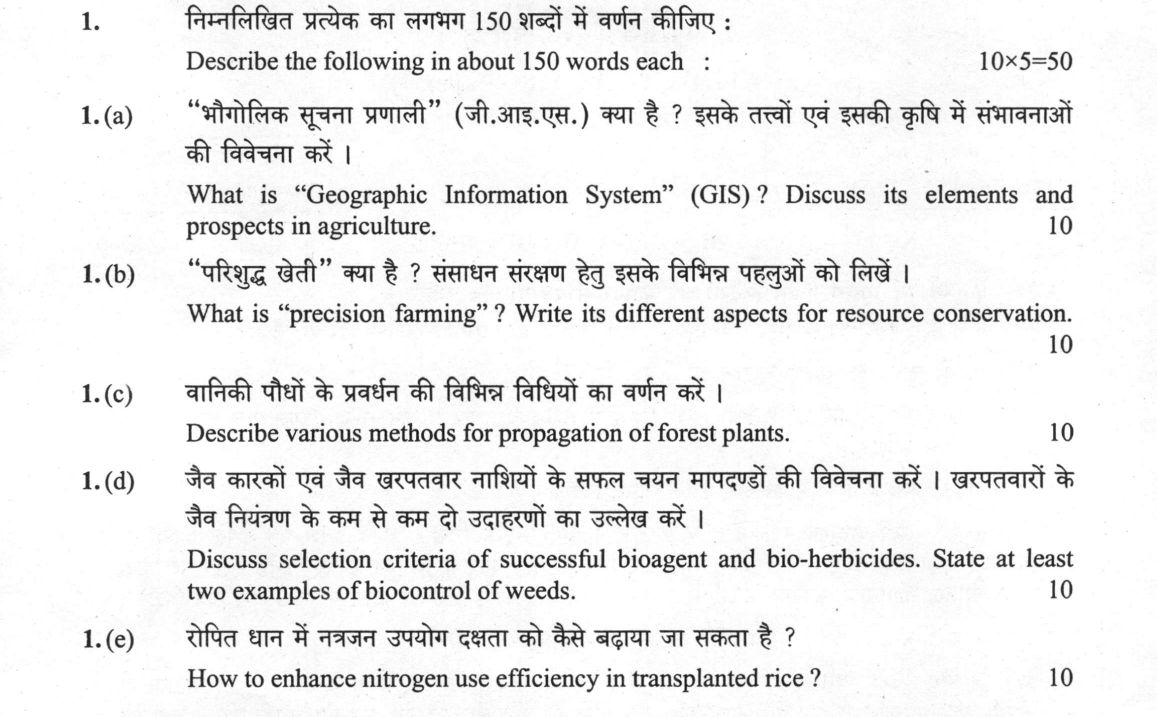
Describe the following in about 150 words each: (a) What is "Geographic Information System" (GIS) ? Discuss its elements and…
Describe the following in about 150 words each: What is "Geographic Information System" (GIS) ? Discuss its elements and prospects in agriculture. 10 marks
What is "precision farming" ? Write its different aspects for resource conservation. 10 marks
Describe various methods for propagation of forest plants. 10 marks
Discuss selection criteria of successful bioagent and bio-herbicides. State at least two examples of biocontrol of weeds. 10 marks
How to enhance nitrogen use efficiency in transplanted rice ? 10 marks
हिंदी में प्रश्न पढ़ें
निम्नलिखित प्रत्येक का लगभग 150 शब्दों में वर्णन कीजिए : "भौगोलिक सूचना प्रणाली" (जी.आई.एस.) क्या है ? इसके तत्त्वों एवं इसकी कृषि में संभावनाओं की विवेचना करें । (10 अंक)
"परिशुद्ध खेती" क्या है ? संसाधन संरक्षण हेतु इसके विभिन्न पहलुओं को लिखें । (10 अंक)
वानिकी पौधों के प्रवर्धन की विभिन्न विधियों का वर्णन करें । (10 अंक)
जैव कारकों एवं जैव खरपतवार नाशियों के सफल चयन मापदण्डों की विवेचना करें । खरपतवारों के जैव नियंत्रण के कम से कम दो उदाहरणों का उल्लेख करें । (10 अंक)
रोपित धान में नत्रजन उपयोग दक्षता को कैसे बढ़ाया जा सकता है ? (10 अंक)
Model answer
Written by UPSC Answer Check against this question's marking rubric, to the 150-word length. UPSC does not publish answers for Mains — this is one way to score well, not an official key.
(a) Geographic Information System (GIS) in Agriculture
A Geographic Information System (GIS) is a computer-based framework designed to capture, store, manipulate, analyze, manage, and display spatially referenced geographical data. The system operates through five essential interrelated elements: hardware (high-speed computers, GPS receivers, digitizers, and servers), software (tools for spatial query, geoprocessing, and modeling), geospatial data (raster grids, vector layers of points, lines, and polygons, along with associated tabular attributes), trained personnel (spatial analysts, agronomists, and cartographers), and established operational methods or procedures. In agriculture, GIS offers extensive prospects for land capability classification and agro-ecological zoning, precision input application via spatial soil-fertility mapping, real-time crop disease and pest outbreak forecasting, drought monitoring, yield modeling, and integrated watershed planning for soil and water conservation.
(b) Precision Farming and Resource Conservation
Precision farming is a site-specific crop management strategy that utilizes information technologies—including Global Positioning Systems (GPS), remote sensing, Geographic Information Systems (GIS), and Variable Rate Technology (VRT)—to identify, quantify, and manage spatial and temporal field variability for optimizing agricultural inputs. Regarding resource conservation, precision farming replaces uniform field treatments with targeted management zones. Delineating soil fertility zones through grid sampling enables variable-rate application of chemical fertilizers and pesticides, preventing agrochemical leaching into groundwater and lowering the environmental footprint. Sensor-based automated drip and sprinkler systems deliver irrigation strictly according to localized soil-moisture deficits, conserving water. Furthermore, yield mapping coupled with tractor auto-guidance systems eliminates overlapping passes, minimizes machinery fuel consumption, and prevents extensive soil compaction.
(c) Methods for Propagation of Forest Plants
Propagation of forest species is broadly classified into sexual and asexual methods:
Sexual propagation involves raising plants from seeds. It encompasses systematic seed collection from selected plus-trees, seed processing, seed pretreatment (such as scarification, stratification, or hot-water soaking to overcome physiological and physical dormancy), followed by sowing in nursery beds, polybags, or root trainers. It is essential for producing taproot systems in forestry species like Tectona grandis (Teak) and Shorea robusta (Sal).
Asexual or vegetative propagation clones true-to-type superior genotypes. Key methods include stem cuttings (hardwood cuttings in Dalbergia sissoo and branch/softwood cuttings in Eucalyptus using auxins like IBA); layering (air layering or ground layering in species that root with difficulty); grafting (whip, tongue, and cleft grafting of superior scions onto hardy rootstocks); budding (patch or T-budding); and in vitro micropropagation/tissue culture, which enables rapid, disease-free, large-scale clonal multiplication of elite forest germplasm.
(d) Selection Criteria of Bioagents and Bio-herbicides
The success of biological control agents and bio-herbicides depends on rigorous screening criteria: strict host specificity ensuring no pathogenicity or toxicity toward non-target flora, fauna, beneficial insects, or human operators; high environmental tolerance allowing survival across fluctuating field temperatures, relative humidity, and solar UV radiation; genetic stability preventing mutation into virulent strains targeting economic crops; high virulence and rapid dispersal capacity; and amenability to mass production and long shelf-life formulation on cost-effective artificial substrates.
Two classic examples of weed biological control include:
- The bio-herbicide Phytophthora palmivora (formulated as DeVine) used for the biological suppression of strangler vine/milkweed vine (Morrenia odorata) in citrus orchards.
- The fungal pathogen Colletotrichum gloeosporioides f. sp. aeschynomene (formulated as COLLEGO) for controlling northern jointvetch, as well as its strains applied in controlling Lantana camara infestations.
(e) Enhancing Nitrogen Use Efficiency in Transplanted Rice
Nitrogen use efficiency (NUE) in transplanted lowland rice remains low (30–40%) primarily due to ammonia volatilization, denitrification, leaching, and surface runoff. Enhancing NUE requires integrated agronomic and chemical interventions:
Synchronizing nitrogen application with crop demand via need-based feeding using a Leaf Color Chart (LCC) or SPAD chlorophyll meter. Adopting split applications (e.g., 25% basal, 50% at active tillering, and 25% at panicle initiation) rather than heavy single basal applications. Deep placement of nitrogen fertilizers, such as Urea Super Granules (USG) or briquettes placed 5–10 cm deep into the reduced soil layer, eliminating volatilization and denitrification losses. Mandatory use of slow-release and coated fertilizers, specifically Neem-Coated Urea (NCU), sulfur-coated urea, or nitrification/urease inhibitors (DCD, neem cake). Adopting water management modifications like alternate wetting and drying (AWD) or aerobic rice culture, alongside cultivating genetically nitrogen-efficient rice varieties such as IR64 and CR Dhan genotypes.
What "Describe" is asking you to do
Give a full, ordered account of the thing named — its parts, stages or mechanism — in the sequence in which it actually exists or occurs. Most describe questions come from the science optionals, where the marks sit in correct technical detail and, where the stem says so, a labelled diagram.
Structure that answers it
One-line identification of the subject → the parts or stages in their real order, each with its defining detail → labelled diagram where the subject is structural → closing line on function or significance
Where marks are lost
Loose general prose where the examiner is ticking named parts, correct terminology and their sequence; and in the General Studies papers, turning to evaluation before the description is finished.
How this answer will be evaluated
Approach
Framework: Concept > Practice or process > Data > Indian application. (a) discuss: intro > 3-4 dimensions > example > balanced close | (b) explain: definition/context > points in order > small example > short close | (c) describe: define > structure or process in order > labelled diagram > significance | (d) discuss: intro > 3-4 dimensions > example > balanced close | (e) suggest: the problem in one line > implementable measures > who acts > conclusion Full marks: Precise definitions, specific examples (species/chemicals), and clear linkage to Indian context or specific technologies.
Key points expected
- Definition of GIS as a computer-based system
- Identification of hardware, software, data, and people as elements
- Explanation of spatial data layers (raster/vector)
- Specific agricultural prospects (e.g., soil mapping, crop monitoring)
- Definition of precision farming (site-specific management)
- Linkage to variable rate technology (VRT)
- Aspect: Water conservation (drip/irrigation based on soil moisture)
- Aspect: Fertilizer conservation (site-specific nutrient management)
Evaluation rubric
Each sub-part is marked on its own, against the marks and word limit printed on the paper.
- (a) Define GIS, list its core elements, and explain its specific applications in agriculture. 10 marks · 150 words
discuss— intro → 3-4 dimensions → example → balanced close
Must cover
- Definition of GIS as a computer-based system
- Identification of hardware, software, data, and people as elements
- Explanation of spatial data layers (raster/vector)
- Specific agricultural prospects (e.g., soil mapping, crop monitoring)
Loses marks
- Confusing GIS with GPS
- Vague generalities without specific agricultural examples
- Missing the 'system' aspect (hardware/software)
Earns more
- Mention of remote sensing integration
- Reference to precision agriculture linkage
- Example of Indian GIS application (e.g., ICAR)
Extra mark
- Mention of specific software (ArcGIS, QGIS)
- Reference to specific Indian scheme (e.g., e-NAM data)
- (b) Define precision farming and list its specific aspects related to resource conservation. 10 marks · 150 words
explain— definition/context → points in order → small example → short close
Must cover
- Definition of precision farming (site-specific management)
- Linkage to variable rate technology (VRT)
- Aspect: Water conservation (drip/irrigation based on soil moisture)
- Aspect: Fertilizer conservation (site-specific nutrient management)
Loses marks
- Treating it as just 'modern farming'
- Failing to link aspects to 'resource conservation'
- Vague agronomic advice without technology context
Earns more
- Mention of GPS/GNSS and sensors
- Aspect: Pesticide reduction (spot spraying)
- Mention of yield mapping
Extra mark
- Mention of specific sensor types (NDVI)
- Reference to Indian precision farming initiatives
- (c) Describe the various methods used for the propagation of forest plants. 10 marks · 150 words
describe— define → structure or process in order → labelled diagram → significance
Must cover
- Sexual propagation (seed collection, processing, sowing)
- Asexual propagation (cuttings, layering, grafting)
- Tissue culture (micropropagation) for rapid multiplication
- Distinction between softwood and hardwood propagation
Loses marks
- Confusing with crop propagation only
- Missing tissue culture (modern method)
- Vague description without specific techniques
Earns more
- Mention of seed dormancy breaking
- Specific example of a forest species (e.g., Teak, Eucalyptus)
- Mention of nursery management
Extra mark
- Mention of somaclonal variation
- Reference to specific Indian forest species
- (d) Discuss selection criteria for bioagents/bio-herbicides and provide two examples of weed biocontrol. 10 marks · 150 words
discuss— intro → 3-4 dimensions → example → balanced close
Must cover
- Criteria: Specificity to target weed
- Criteria: Environmental stability and persistence
- Criteria: Ease of mass production
- Example 1: Specific insect/pathogen for a weed (e.g., *Cactoblastis cactorum* for *Opuntia*)
Loses marks
- Vague criteria (e.g., 'must be good')
- Missing the two required examples
- Confusing bio-herbicides with chemical herbicides
Earns more
- Example 2: Another specific biocontrol agent
- Mention of non-target safety
- Mention of cost-effectiveness
Extra mark
- Mention of specific Indian biocontrol success (e.g., *Parthenium*)
- Reference to specific pathogen name
- (e) Suggest methods to enhance nitrogen use efficiency in transplanted rice. 10 marks · 150 words
suggest— the problem in one line → implementable measures → who acts → conclusion
Must cover
- Split application of nitrogen (basal + top dressing)
- Use of nitrification inhibitors (e.g., DMPP)
- Use of urease inhibitors
- Site-specific nutrient management (SSNM)
Loses marks
- MSP-only solutions (irrelevant)
- Vague advice (e.g., 'use less nitrogen')
- Missing the 'transplanted' context (e.g., direct sowing methods)
Earns more
- Mention of deep placement of urea
- Use of slow-release fertilizers
- Mention of specific variety response
Extra mark
- Mention of specific inhibitor names (e.g., NBPT)
- Reference to specific Indian rice variety
Practice this exact question
Write your answer and it is marked point by point against the model answer above — what you covered, what you missed, what you got wrong.
Evaluate my answer →More from Agriculture 2022 Paper I
- Q1 Describe the following in about 150 words each: (a) What is "Geographic Information Syste…
- Q2 (a) Write the various factors responsible for soil pollution. How organic and natural far…
- Q3 (a) How soil acidity affects crop production ? Elaborate the remedial procedures of soil…
- Q4 (a) Discuss about the types of herbicide resistance in weeds with specific example in Ind…