Paper I — Q3
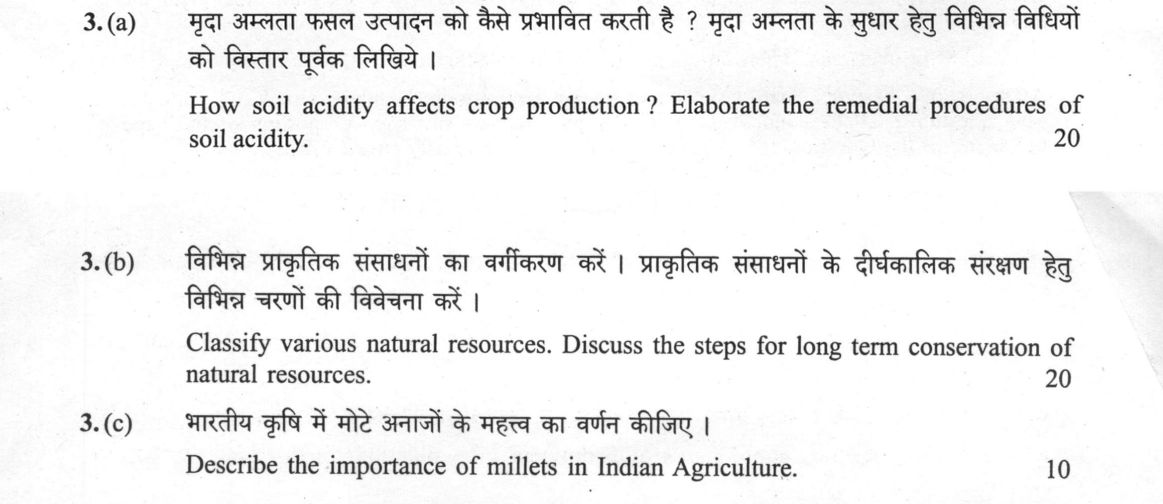
(a) How soil acidity affects crop production ? Elaborate the remedial procedures of soil acidity. (20 marks) (b) Classify various…
How soil acidity affects crop production ? Elaborate the remedial procedures of soil acidity. 20 marks
Classify various natural resources. Discuss the steps for long term conservation of natural resources. 20 marks
Describe the importance of millets in Indian Agriculture. 10 marks
हिंदी में प्रश्न पढ़ें
मृदा अम्लता फसल उत्पादन को कैसे प्रभावित करती है ? मृदा अम्लता के सुधार हेतु विभिन्न विधियों को विस्तार पूर्वक लिखिये । (20 अंक)
विभिन्न प्राकृतिक संसाधनों का वर्गीकरण करें । प्राकृतिक संसाधनों के दीर्घकालिक संरक्षण हेतु विभिन्न चरणों की विवेचना करें । (20 अंक)
भारतीय कृषि में मोटे अनाजों के महत्व का वर्णन कीजिए । (10 अंक)
Model answer
Written by UPSC Answer Check against this question's marking rubric, to the expected length. UPSC does not publish answers for Mains — this is one way to score well, not an official key.
Soil health, resource stewardship, and crop diversification form the triad of sustainable Indian agriculture. Addressing these requires a systematic understanding of chemical constraints, ecological balances, and nutritional imperatives.
Soil Acidity: Mechanisms and Remediation Soil acidity, defined by a pH below 5.5, severely constrains crop production through specific biochemical mechanisms. The primary driver is the accumulation of hydrogen ions (H+) in the soil solution, which directly causes ion toxicity. More critically, low pH mobilizes aluminum (Al) and manganese (Mn) into soluble forms; Al3+ toxicity inhibits root elongation and disrupts cell membrane integrity, while excess Mn interferes with iron uptake. Concurrently, acidity induces nutrient deficiency. Phosphorus (P) becomes unavailable as it binds with iron and aluminum oxides, while calcium (Ca) and magnesium (Mg) are leached or displaced by H+ and Al3+ ions. Major crops like wheat and rice are sensitive, with optimal pH ranges of 6.0–7.5 and 5.5–6.5 respectively; below these thresholds, yield losses can exceed 30%.
The remedial procedure is anchored in liming, the application of agricultural lime (CaCO3) or dolomite (CaCO3·MgCO3). The dose is calculated based on the soil’s Cation Exchange Capacity (CEC) and target pH, typically requiring 1–2 tonnes per hectare for moderate acidity. However, liming is a slow process, taking 2–3 years to fully correct subsoil acidity. Therefore, an integrated approach is essential. This includes the application of organic amendments like farmyard manure and compost, which buffer pH and improve cation exchange. Cultivating acid-tolerant varieties, such as specific rice cultivars bred for Al-tolerance, is crucial. Furthermore, the application of biochar, derived from agricultural residues, offers a long-term solution by raising pH, enhancing water retention, and sequestering carbon, thereby addressing both productivity and climate goals.
Classification and Conservation of Natural Resources Natural resources are broadly classified by origin into abiotic (water, minerals, air) and biotic (forests, wildlife, soil). A more functional classification distinguishes between renewable resources (solar energy, forests, water) and non-renewable resources (coal, petroleum, minerals). Additionally, resources are categorized by ownership into community property (forests, rivers), private property (land), and national property (minerals, air). It is vital to distinguish between stock resources, which are finite and non-renewable like fossil fuels, and fund resources, which are renewable but require management to maintain their stock, such as groundwater.
Long-term conservation demands a shift from extraction to sustainability. The cornerstone is watershed management, which integrates soil conservation, water harvesting, and afforestation to prevent erosion and recharge aquifers. The principle of sustainable yield ensures that the rate of resource extraction does not exceed the rate of natural regeneration. This is particularly critical for groundwater, where over-extraction in states like Punjab and Rajasthan threatens long-term viability. Community-based resource governance, exemplified by the Joint Forest Management (JFM) program, empowers local communities to manage forests, aligning conservation with livelihoods. Legal frameworks like the Forest Rights Act, 2006, further institutionalize this by recognizing the rights of forest-dwelling communities, ensuring that conservation is socially equitable and ecologically sound.
Importance of Millets in Indian Agriculture Millets, often termed "Shree Anna" or supergrains, are pivotal for Indian agriculture due to their nutritional superiority and climate resilience. They possess a low glycemic index, high fiber content, and are rich in minerals like iron, zinc, and magnesium, addressing the dual burden of malnutrition and lifestyle diseases. Agronomically, millets are C4 crops with deep root systems, making them highly efficient in water use and resilient to drought and heat stress. This makes them ideal for rainfed and dryland agro-ecosystems, which constitute a significant portion of Indian agriculture.
For food security, millets offer a viable alternative to water-intensive rice and wheat, reducing the strain on groundwater. They are also crucial for tribal livelihoods, as many indigenous communities in states like Jharkhand, Maharashtra, and Karnataka have traditional knowledge of millet cultivation and consumption. Government initiatives have accelerated this shift. The International Year of Millets (IYoM) 2023, championed by India, has raised global awareness. Domestically, the inclusion of millets in the Minimum Support Price (MSP) framework encourages farmers to cultivate them. The promotion of Farmer Producer Organizations (FPOs) helps aggregate produce and improve market access. Furthermore, the export potential of millets is being tapped into, with India emerging as a major exporter to markets in Africa and Europe, thereby enhancing rural incomes and trade balance.
Conclusion Sustainable agriculture in India requires an integrated strategy. Correcting soil acidity through liming and biochar ensures foundational productivity. Conserving natural resources through watershed management and community governance secures the ecological base. Simultaneously, promoting millets enhances nutritional security and climate resilience. This tripartite approach ensures that agricultural growth is not only productive but also ecologically sustainable and socially inclusive.
What "Elaborate" is asking you to do
Give the full detailed account the question has compressed into a line — every dimension of it, with specifics. Elaborate rewards completeness and detail rather than clarification or argument: the examiner is checking whether you can fill out a topic without being told what its parts are.
Structure that answers it
State the proposition → first dimension in detail → second dimension in detail → the part the statement leaves implicit → the consolidated picture
Where marks are lost
Repeating the statement at greater length instead of adding substance. Elaborate also punishes narrowness: omitting a whole dimension costs more here than anywhere else in this family.
How this answer will be evaluated
Approach
Framework: Concept > Practice or process > Data > Indian application. (a) explain: definition/context > points in order > small example > short close | (b) discuss: intro > 3-4 dimensions > example > balanced close | (c) describe: define > structure or process in order > labelled diagram > significance Full marks: Precise chemical mechanisms, specific schemes, and data-driven conservation strategies.
Key points expected
- Aluminium and Manganese toxicity mechanism
- Phosphorus fixation by Fe/Al oxides
- Lime (Agar) application and CEC increase
- Gypsum use for sodic-acidic soils
- Renewable vs Non-renewable classification
- In-situ vs Ex-situ conservation methods
- Sustainable yield and carrying capacity
- Institutional framework (e.g., NITI Aayog)
Evaluation rubric
Each sub-part is marked on its own, against the marks and word limit printed on the paper.
- (a) Mechanism of soil acidity impact on crops and remedial procedures. 20 marks
explain— definition/context → points in order → small example → short close
Must cover
- Aluminium and Manganese toxicity mechanism
- Phosphorus fixation by Fe/Al oxides
- Lime (Agar) application and CEC increase
- Gypsum use for sodic-acidic soils
Loses marks
- Vague advice without chemical mechanism
- Ignoring micronutrient toxicity
Earns more
- pH effect on microbial activity
- Organic matter role in buffering
- Acid-tolerant crop varieties (e.g., rice)
Extra mark
- Specific CEC values for acidic soils
- Calculation of lime requirement
- (b) Classification of natural resources and long-term conservation steps. 20 marks
discuss— intro → 3-4 dimensions → example → balanced close
Must cover
- Renewable vs Non-renewable classification
- In-situ vs Ex-situ conservation methods
- Sustainable yield and carrying capacity
- Institutional framework (e.g., NITI Aayog)
Loses marks
- Listing resources without classification
- Conservation steps without long-term focus
Earns more
- Water resource management (Jal Shakti)
- Forest cover targets (NAPCC)
- Circular economy principles
Extra mark
- Specific data on forest cover change
- Mention of specific conservation acts
- (c) Importance of millets in Indian Agriculture. 10 marks
describe— define → structure or process in order → labelled diagram → significance
Must cover
- Drought resistance and low water footprint
- Nutritional value (high protein/fiber)
- Soil health and low input requirement
- International Year of Millets 2023
Loses marks
- General talk on 'ancient grains' without data
- Ignoring the 2023 global context
Earns more
- Specific varieties (Jowar, Bajra, Ragi)
- Export potential and market value
- Role in climate change adaptation
Extra mark
- Specific production data for millets
- Mention of specific millet-based schemes
Practice this exact question
Write your answer and it is marked point by point against the model answer above — what you covered, what you missed, what you got wrong.
Evaluate my answer →More from Agriculture 2022 Paper I
- Q1 Describe the following in about 150 words each: (a) What is "Geographic Information Syste…
- Q2 (a) Write the various factors responsible for soil pollution. How organic and natural far…
- Q3 (a) How soil acidity affects crop production ? Elaborate the remedial procedures of soil…
- Q4 (a) Discuss about the types of herbicide resistance in weeds with specific example in Ind…
- Q5 Discuss the followings in about 150 words each: (a) Self Help Groups (SHGs) and Farmers P…
- Q6 (a) What are the target groups in Agricultural Extension ? What role KVKs can play to rea…