Paper I — Q4
(a) Discuss about the types of herbicide resistance in weeds with specific example in Indian perspective. Discuss the management…
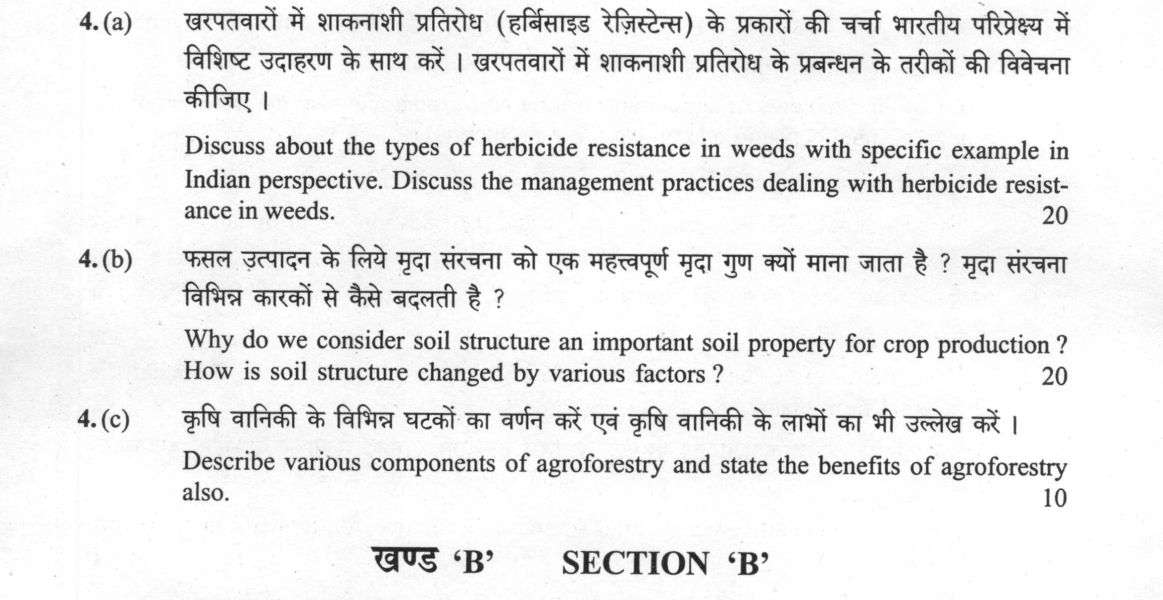
Discuss about the types of herbicide resistance in weeds with specific example in Indian perspective. Discuss the management practices dealing with herbicide resistance in weeds. 20 marks
Why do we consider soil structure an important soil property for crop production ? How is soil structure changed by various factors ? 20 marks
Describe various components of agroforestry and state the benefits of agroforestry also. 10 marks
हिंदी में प्रश्न पढ़ें
खरपतवारों में शाकनाशी प्रतिरोध (हर्बिसाइड रेजिस्टेंस) के प्रकारों की चर्चा भारतीय परिप्रेक्ष्य में विशिष्ट उदाहरण के साथ करें । खरपतवारों में शाकनाशी प्रतिरोध के प्रबंधन के तरीकों की विवेचना कीजिए । (20 अंक)
फसल उत्पादन के लिये मृदा संरचना को एक महत्वपूर्ण मृदा गुण क्यों माना जाता है ? मृदा संरचना विभिन्न कारकों से कैसे बदलती है ? (20 अंक)
कृषि वानिकी के विभिन्न घटकों का वर्णन करें एवं कृषि वानिकी के लाभों का भी उल्लेख करें । (10 अंक)
Model answer
Written by UPSC Answer Check against this question's marking rubric, to the expected length. UPSC does not publish answers for Mains — this is one way to score well, not an official key.
Herbicide Resistance Mechanisms and Management
Herbicide resistance in weeds evolves primarily via Target-Site Resistance (TSR), where mutations or target enzyme overproduction (such as ACCase or ALS) inhibit herbicide binding, and Non-Target-Site Resistance (NTSR/metabolic), where accelerated metabolic degradation by cytochrome P450 monooxygenases or altered translocation lowers the active herbicide dose. Resistance manifests as cross-resistance, where a single mechanism confers resistance to chemically related or unrelated herbicides with the same site of action, or multiple resistance, where distinct mechanisms evolve against different herbicide classes. In India, the intensive rice-wheat system of the Indo-Gangetic plains witnessed widespread metabolic resistance of Phalaris minor to isoproturon, alongside emerging Echinochloa spp. tolerance to butachlor in paddy fields.
Integrated Resistance Management (IRM) entails diversifying selection pressure by rotating herbicide classes across different Herbicide Resistance Action Committee (HRAC) modes of action, utilizing pre-mixes or tank mixes, and timing sequential pre- and post-emergence applications. These chemical tactics must be integrated with non-chemical interventions: adopting stale seedbed techniques, zero-tillage, competitive crop cultivars, mechanical inter-row cultivation, and strategic crop diversification (such as rotating wheat with berseem, mustard, or potato) to disrupt weed life cycles.
Soil Structure Dynamics and Agronomic Significance
Soil structure—the spatial arrangement and aggregation of primary soil particles into peds—is a dynamic property governing crop performance, unlike the permanent matrix of soil texture. An optimal granular or crumb structure ensures an ideal balance of macropores for drainage, gas exchange, and root elongation, alongside micropores for plant-available water retention. Structural stability prevents surface crusting, maintains infiltration, facilitates rhizospheric microbial respiration, and minimizes detachment by wind and water erosion.
Soil structure is continuously altered by coupled biotic and abiotic drivers: Biotic factors: Plant root exudates and mycorrhizal fungi release binding agents like glomalin, while earthworms create macro-channels and generate organo-mineral casts. Heterotrophic microorganisms synthesize polysaccharides and humic fractions that aggregate mineral particles. Abiotic and anthropogenic factors: Wetting-drying and freeze-thaw cycles physically fragment or consolidate peds. Conversely, intensive secondary tillage pulverizes structural aggregates, and heavy machinery induces subsoil compaction and pan formation. Chemically, elevated Exchangeable Sodium Percentage (ESP) triggers clay dispersion and slaking, whereas calcium addition promotes flocculation.
Agroforestry Components and Multifunctional Benefits
Agroforestry deliberately integrates woody perennials (trees, shrubs, bamboos) with herbaceous agricultural crops and livestock within spatial or temporal arrangements. Its structural classifications include Agrisilviculture (crops integrated with trees like Populus deltoides), Silvopasture (trees with forage and livestock), Agrosilvopasture (crops, pasture, and livestock integrated with trees), and multipurpose tree systems.
Agroforestry delivers vital ecosystem services: it facilitates deep-root nutrient pumping and returns organic matter via litterfall, moderates microclimate extremes, stabilizes soil aggregates against degradation, and creates biodiversity corridors. It provides substantial carbon sequestration potential, linking with Clean Development Mechanism (CDM) goals, while bolstering agrarian resilience through timber, fuelwood, fodder, and Non-Timber Forest Products (NTFPs). These multi-tier outputs directly advance the goals of the National Agroforestry Policy 2014 and the National Action Plan on Climate Change (NAPCC).
Way Forward
Sustaining crop productivity necessitates combining aggregate-preserving conservation tillage with HRAC-guided weed management and farm-scale agroforestry integration, establishing a climate-resilient and ecologically balanced agrarian framework.
What "Discuss" is asking you to do
Lay the issue out from more than one side — how it arose, what is claimed for it, what is held against it, and where it now stands. UPSC attaches discuss to broad topics with several live dimensions, so coverage of the dimensions earns more than the strength of your opinion.
Structure that answers it
Set the issue up → the case as it is made → the case against → the dimension both sides leave out → where the balance now lies
Where marks are lost
Listing facts with no thread between them, or arguing one side throughout and calling it a discussion.
How this answer will be evaluated
Approach
Framework: Concept > Practice or process > Data > Indian application. (a) discuss: intro > 3-4 dimensions > example > balanced close | (b) explain: definition/context > points in order > small example > short close | (c) describe: define > structure or process in order > labelled diagram > significance Full marks: Precise technical terminology, specific Indian examples, clear logical flow, and comprehensive coverage of all sub-parts.
Key points expected
- Target-site vs non-target-site resistance
- Specific Indian weed-herbicide example (e.g., Barnyard grass)
- Management: rotation, mixtures, non-chemical control
- Mechanism of resistance (e.g., EPSPS gene)
- Definition of soil structure (aggregates)
- Impact on aeration, water, and root penetration
- Factors: tillage, organic matter, compaction
- Link between structure and crop yield
Evaluation rubric
Each sub-part is marked on its own, against the marks and word limit printed on the paper.
- (a) Classification of resistance types and management strategies with Indian examples. 20 marks
discuss— intro → 3-4 dimensions → example → balanced close
Must cover
- Target-site vs non-target-site resistance
- Specific Indian weed-herbicide example (e.g., Barnyard grass)
- Management: rotation, mixtures, non-chemical control
- Mechanism of resistance (e.g., EPSPS gene)
Loses marks
- Generic advice without specific weed names
- Ignoring the 'Indian perspective' requirement
- Confusing resistance with tolerance
Earns more
- Mention of specific herbicide class (e.g., ALS inhibitors)
- Reference to Indian weed survey data
- Integrated weed management (IWM) framework
Extra mark
- Mention of specific resistant biotypes in India
- Reference to ICAR or state agricultural university research
- (b) Importance of soil structure for crops and factors modifying it. 20 marks
explain— definition/context → points in order → small example → short close
Must cover
- Definition of soil structure (aggregates)
- Impact on aeration, water, and root penetration
- Factors: tillage, organic matter, compaction
- Link between structure and crop yield
Loses marks
- Confusing soil texture with soil structure
- Vague statements without agronomic link
- Ignoring the 'various factors' part of the question
Earns more
- Distinction between granular and platy structures
- Role of soil biota (earthworms, roots)
- Effect of heavy machinery on structure
Extra mark
- Mention of specific soil types (e.g., black cotton soil)
- Reference to soil health card parameters
- (c) Components of agroforestry and its benefits. 10 marks
describe— define → structure or process in order → labelled diagram → significance
Must cover
- Definition of agroforestry
- Components: trees, crops, livestock
- Benefits: economic, ecological, social
- Examples of systems (e.g., Allosylvan)
Loses marks
- Listing benefits without explaining components
- Confusing agroforestry with simple intercropping
- Ignoring the 'components' part of the question
Earns more
- Mention of specific Indian systems (e.g., Jhum)
- Carbon sequestration benefits
- Biodiversity conservation
Extra mark
- Reference to National Agroforestry Policy
- Specific tree species used in Indian agroforestry
Practice this exact question
Write your answer and it is marked point by point against the model answer above — what you covered, what you missed, what you got wrong.
Evaluate my answer →More from Agriculture 2022 Paper I
- Q1 Describe the following in about 150 words each: (a) What is "Geographic Information Syste…
- Q2 (a) Write the various factors responsible for soil pollution. How organic and natural far…
- Q3 (a) How soil acidity affects crop production ? Elaborate the remedial procedures of soil…
- Q4 (a) Discuss about the types of herbicide resistance in weeds with specific example in Ind…
- Q5 Discuss the followings in about 150 words each: (a) Self Help Groups (SHGs) and Farmers P…
- Q6 (a) What are the target groups in Agricultural Extension ? What role KVKs can play to rea…
- Q7 (a) Discuss about Micro-Irrigation Systems and their advantages in Indian Agriculture. (2…