Paper I — Q7
(a) Discuss about Micro-Irrigation Systems and their advantages in Indian Agriculture. (20 marks) (b) Describe the procedure of…
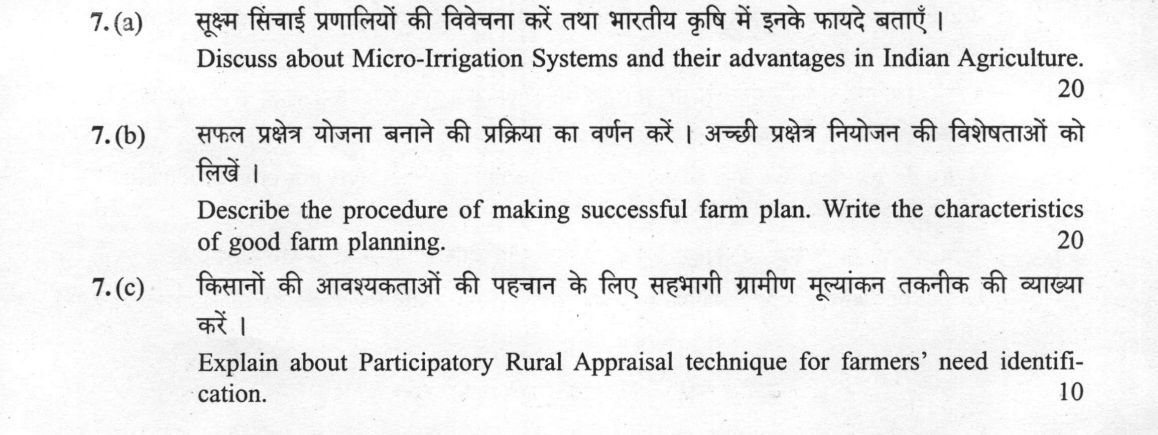
Discuss about Micro-Irrigation Systems and their advantages in Indian Agriculture. 20 marks
Describe the procedure of making successful farm plan. Write the characteristics of good farm planning. 20 marks
Explain about Participatory Rural Appraisal technique for farmers' need identification. 10 marks
हिंदी में प्रश्न पढ़ें
सूक्ष्म सिंचाई प्रणालियों की विवेचना करें तथा भारतीय कृषि में इनके फायदे बताएँ । (20 अंक)
सफल प्रक्षेत्र योजना बनाने की प्रक्रिया का वर्णन करें । अच्छी प्रक्षेत्र नियोजन की विशेषताओं को लिखें । (20 अंक)
किसानों की आवश्यकताओं की पहचान के लिए सहभागी ग्रामीण मूल्यांकन तकनीक की व्याख्या करें । (10 अंक)
Model answer
Written by UPSC Answer Check against this question's marking rubric, to the expected length. UPSC does not publish answers for Mains — this is one way to score well, not an official key.
Micro-irrigation delivers water and nutrients directly to the root zone under low pressure, shifting Indian agriculture from resource-exhaustive to input-efficient farming.
Micro-Irrigation Systems and Advantages in India Primary micro-irrigation systems include drip irrigation (utilizing lateral pipes and emitters for precise, drop-by-drop application), sprinklers (overhead pressurized spray), micro-sprinklers, and bubblers for orchard crops. These systems yield 40–70% water savings compared to traditional flood irrigation while boosting crop productivity by 30–100%. Major advantages include enhanced fertilizer use efficiency via fertigation, significant suppression of weed growth, reduced energy expenditure, and feasibility on undulating terrains and poor-quality soils. Under the Per Drop More Crop component of Pradhan Mantri Krishi Sinchayee Yojana (PMKSY-PDMC), states such as Gujarat, Andhra Pradesh, and Maharashtra have achieved substantial coverage. However, constraints persist, including high initial capital investment, emitter clogging due to poor water quality, and erratic rural electricity supply.
Farm Planning: Procedure and Characteristics A farm plan is a deliberate operational roadmap allocating farm resources to achieve maximum sustained net income. The step-wise procedure entails: (1) Resource Inventory, documenting land capability, labor, water, and capital; (2) Goal Setting, balancing family subsistence and profit maximization; (3) Enterprise Selection, integrating complementary crop, livestock, and fishery systems; (4) Budgeting and Optimization, deploying partial/complete budgeting and linear programming techniques; (5) Implementation; and (6) Monitoring, Review, and Contingency Planning against market price crashes and monsoon aberrations.
A good farm plan exhibits distinct characteristics: operational flexibility to absorb climatic and economic shocks; profitability through cost minimization; ecological sustainability through nutrient recycling; resource optimization preventing idle farm capacities; risk mitigation via enterprise diversification; and time-bound execution aligned with agro-climatic seasons.
Participatory Rural Appraisal (PRA) for Need Identification Participatory Rural Appraisal is a bottom-up methodology enabling rural communities to evaluate their resources, identify systemic constraints, and formulate targeted local solutions. Key PRA tools include transect walks for spatial and ecological profiling, social and resource mapping to delineate village assets, seasonal calendars to track labor and cash flow bottlenecks, Venn (Chapati) diagrams to evaluate institutional support, and pairwise matrix ranking to prioritize community needs. Grounded in principles of triangulation (cross-validation), reversal of learning (experts learning from farmers), and optimal ignorance (focusing on pertinent issues), PRA serves as the foundational diagnostic framework for tailoring technology dissemination and decentralized watershed development projects.
A synergized approach—combining PRA-driven need identification with linear programming-based farm planning and PMKSY-supported micro-irrigation—is vital to realizing climate-resilient and economically viable farming across India.
What "Discuss" is asking you to do
Lay the issue out from more than one side — how it arose, what is claimed for it, what is held against it, and where it now stands. UPSC attaches discuss to broad topics with several live dimensions, so coverage of the dimensions earns more than the strength of your opinion.
Structure that answers it
Set the issue up → the case as it is made → the case against → the dimension both sides leave out → where the balance now lies
Where marks are lost
Listing facts with no thread between them, or arguing one side throughout and calling it a discussion.
How this answer will be evaluated
Approach
Framework: Concept > Practice or process > Data > Indian application. (a) discuss: intro > 3-4 dimensions > example > balanced close | (b) describe: define > structure or process in order > labelled diagram > significance | (c) explain: definition/context > points in order > small example > short close Full marks: Comprehensive coverage of all sub-parts with specific examples, schemes, and tools.
Key points expected
- Define micro-irrigation and list types (drip, sprinkler, sub-surface)
- Explain water use efficiency and reduction in evaporation
- Discuss nutrient delivery (fertigation) and yield improvement
- Mention Indian context: water scarcity and PMKSY scheme
- Outline procedure: data collection, goal setting, resource inventory
- Describe evaluation of alternatives and final plan formulation
- List characteristics: flexibility, realism, and specificity
- Mention the role of record keeping in the process
Evaluation rubric
Each sub-part is marked on its own, against the marks and word limit printed on the paper.
- (a) Overview of micro-irrigation types and their specific benefits for Indian agriculture. 20 marks
discuss— intro → 3-4 dimensions → example → balanced close
Must cover
- Define micro-irrigation and list types (drip, sprinkler, sub-surface)
- Explain water use efficiency and reduction in evaporation
- Discuss nutrient delivery (fertigation) and yield improvement
- Mention Indian context: water scarcity and PMKSY scheme
Loses marks
- Vague generalities without specific system types
- Ignoring the 'Indian Agriculture' context
- Confusing micro-irrigation with general water conservation
Earns more
- Mention specific crops suited to drip (e.g., vegetables, fruits)
- Reference to 'Har Khet Ko Pani' mission
- Comparison with flood irrigation water usage
- Mention of soil salinity control in arid zones
Extra mark
- Specific subsidy percentage under PMKSY
- Name of a specific state's successful micro-irrigation model
- (b) Step-by-step procedure for farm planning and the characteristics of a good plan. 20 marks
describe— define → structure or process in order → labelled diagram → significance
Must cover
- Outline procedure: data collection, goal setting, resource inventory
- Describe evaluation of alternatives and final plan formulation
- List characteristics: flexibility, realism, and specificity
- Mention the role of record keeping in the process
Loses marks
- Listing characteristics without explaining the procedure
- Ignoring the 'successful' aspect (i.e., evaluation/feedback loop)
- Treating it as a general business plan rather than agricultural
Earns more
- Mentioning 'Farm Budgeting' as a tool in the procedure
- Reference to 'Opportunity Cost' in decision making
- Mentioning 'Risk Management' as a characteristic
- Linking plan to 'Sustainable Agriculture' goals
Extra mark
- Reference to a specific farm planning software or model
- Mentioning 'Linear Programming' for resource allocation
- (c) Definition and application of Participatory Rural Appraisal (PRA) for identifying needs. 10 marks
explain— definition/context → points in order → small example → short close
Must cover
- Define PRA as a participatory approach involving farmers
- List specific tools: mapping, seasonal calendars, Venn diagrams
- Explain how these tools help in 'need identification'
- Mention the benefit of local knowledge integration
Loses marks
- Describing it as a top-down survey
- Failing to link the technique to 'need identification'
- Ignoring the 'Participatory' aspect (farmers' active role)
Earns more
- Mentioning 'Social Maps' or 'Wealth Ranking' as tools
- Reference to 'Rapid Rural Appraisal' (RRA) as a precursor
- Mentioning 'Gender' specific needs identification
- Linking PRA to 'Bottom-up' planning
Extra mark
- Specific example of a PRA tool application (e.g., 'Problem Tree')
- Mentioning 'NGOs' or 'Extension workers' as facilitators
Practice this exact question
Write your answer and it is marked point by point against the model answer above — what you covered, what you missed, what you got wrong.
Evaluate my answer →More from Agriculture 2022 Paper I
- Q4 (a) Discuss about the types of herbicide resistance in weeds with specific example in Ind…
- Q5 Discuss the followings in about 150 words each: (a) Self Help Groups (SHGs) and Farmers P…
- Q6 (a) What are the target groups in Agricultural Extension ? What role KVKs can play to rea…
- Q7 (a) Discuss about Micro-Irrigation Systems and their advantages in Indian Agriculture. (2…
- Q8 (a) Discuss the various parameters of quality of irrigation water. Write irrigation sched…