Paper I — Q6
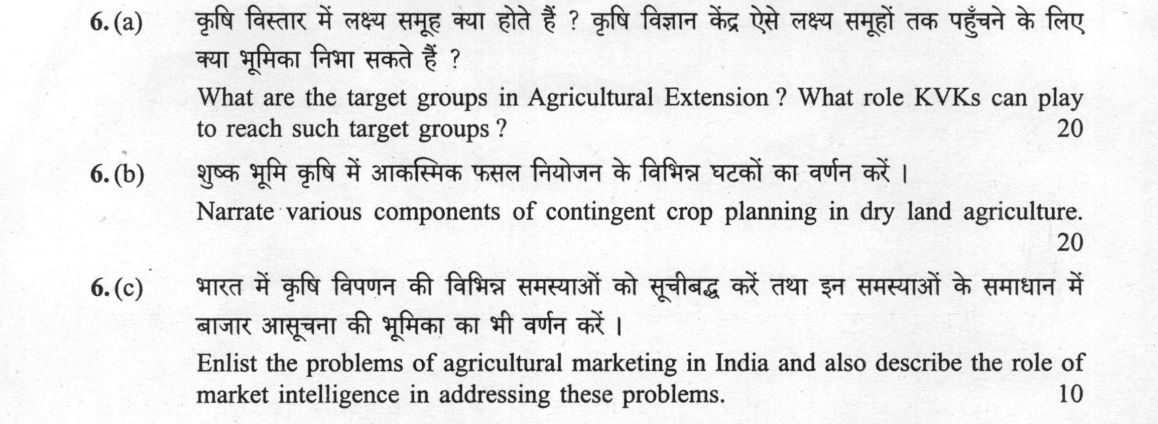
(a) What are the target groups in Agricultural Extension ? What role KVKs can play to reach such target groups ? (20 marks) (b)…
What are the target groups in Agricultural Extension ? What role KVKs can play to reach such target groups ? 20 marks
Narrate various components of contingent crop planning in dry land agriculture. 20 marks
Enlist the problems of agricultural marketing in India and also describe the role of market intelligence in addressing these problems. 10 marks
हिंदी में प्रश्न पढ़ें
कृषि विस्तार में लक्ष्य समूह क्या होते हैं ? कृषि विज्ञान केंद्र ऐसे लक्ष्य समूहों तक पहुँचने के लिए क्या भूमिका निभा सकते हैं ? (20 अंक)
शुष्क भूमि कृषि में आकस्मिक फसल नियोजन के विभिन्न घटकों का वर्णन करें । (20 अंक)
भारत में कृषि विपणन की विभिन्न समस्याओं को सूचीबद्ध करें तथा इन समस्याओं के समाधान में बाजार आसूचना की भूमिका का भी वर्णन करें । (10 अंक)
Model answer
Written by UPSC Answer Check against this question's marking rubric, to the expected length. UPSC does not publish answers for Mains — this is one way to score well, not an official key.
Target Groups in Agricultural Extension and Role of KVKs
Agricultural extension addresses diverse clientele categorized by their socio-economic needs: small and marginal farmers who require low-cost, scale-neutral technologies; farm women needing drudgery-reducing implements, secondary agriculture, and nutritional security; rural youth seeking skill-building for agri-entrepreneurship; grassroot extension personnel requiring technical capacity upgrading; and tribal or disadvantaged groups dependent on indigenous, risk-resilient livelihood systems.
Krishi Vigyan Kendras (KVKs) act as institutional bridges to reach these groups through On-Farm Testing (OFT) to validate location-specific agricultural technologies, Front Line Demonstrations (FLDs) to prove the yield potential of newly released varieties and practices, and tailored vocational training programs. KVKs also produce and distribute certified seeds, bio-agents, and planting materials, while scaling outreach through digital advisory tools including the mKisan portal, Kisan Call Centres, and mobile-based agro-advisories.
Components of Contingent Crop Planning in Dryland Agriculture
Contingent crop planning minimizes risk from aberrant monsoon behavior through predetermined technological interventions. Its structural components encompass:
- Crop and variety substitution prioritizing short-duration, drought-tolerant pulses, millets, and oilseeds.
- In-situ moisture conservation and land configurations, including broad bed and furrow (BBF), ridge-and-furrow, and contour cultivation.
- Nutrient management adjustments, such as split applications and foliar spraying of potassium chloride or urea during dry spells.
- Alternate land-use systems, including silvopastoral and agri-horti models, to cushion total arable crop failure.
- Integration with weather forecasting through Gramin Krishi Mausam Sewa (GKMS) for real-time agromet advisories.
Operational strategies deploy scenario-specific adjustments: shifting from long-duration cereals to castor, pearl millet, or pulses under delayed monsoon onset; executing re-sowing protocols where early-stage dry spells cause severe seedling mortality; modifying intercropping geometry; and implementing mid-season corrections such as mulching, crop canopy thinning, anti-transpirant sprays, and life-saving supplemental irrigation from farm ponds.
Agricultural Marketing Challenges and Market Intelligence
Indian agricultural marketing faces structural bottlenecks: market fragmentation under restrictive APMC regimes, lack of scientific grading and standardization at the farm gate, deficient cold-chain and storage facilities causing post-harvest decay, sharp inter-seasonal price fluctuations, asymmetric market power favoring intermediaries, and weak rural-to-market road infrastructure.
Market intelligence mitigates these issues by providing price discovery and reducing information asymmetry. Digital platforms such as AGMARKNET and the electronic National Agriculture Market (e-NAM) furnish real-time data on spatial arrivals and prevailing commodity prices. State Agricultural Universities and ICAR institutes utilize price forecasting systems to guide farmers on pre-sowing crop selection and post-harvest holding strategies. Linking these intelligence feeds directly with Farmer Producer Organizations (FPOs) enables aggregated bargaining, avoids distress sales, and connects producers directly to alternate terminal markets.
What "Describe" is asking you to do
Give a full, ordered account of the thing named — its parts, stages or mechanism — in the sequence in which it actually exists or occurs. Most describe questions come from the science optionals, where the marks sit in correct technical detail and, where the stem says so, a labelled diagram.
Structure that answers it
One-line identification of the subject → the parts or stages in their real order, each with its defining detail → labelled diagram where the subject is structural → closing line on function or significance
Where marks are lost
Loose general prose where the examiner is ticking named parts, correct terminology and their sequence; and in the General Studies papers, turning to evaluation before the description is finished.
How this answer will be evaluated
Approach
(a) explain: definition/context > points in order > small example > short close | (b) describe: define > structure or process in order > labelled diagram > significance | (c) analyse: intro > causes > effects > stakeholders/linkages > way forward Full marks: Precise definitions, specific KVK/IMD/e-NAM references, clear 'if-then' logic for planning.
Key points expected
- List primary (farmers) and secondary (women, SC/ST, marginal) groups
- Define KVK as a hub for demonstration and training
- Describe KVK's role in bridging research and field
- Mention specific KVK activities like field days or workshops
- Define contingent crop planning (contingency planning)
- Explain the 'if-then' decision tree structure
- Link planning to rainfall thresholds (e.g., 50% of LRAI)
- Mention specific dry land crops (e.g., Bajra, Moong, Guar)
Evaluation rubric
Each sub-part is marked on its own, against the marks and word limit printed on the paper.
- (a) Define target groups in extension and detail KVK's role in reaching them. 20 marks
explain— definition/context → points in order → small example → short close
Must cover
- List primary (farmers) and secondary (women, SC/ST, marginal) groups
- Define KVK as a hub for demonstration and training
- Describe KVK's role in bridging research and field
- Mention specific KVK activities like field days or workshops
Loses marks
- Treating KVKs as only research centers
- Ignoring secondary target groups like women farmers
- Vague description of 'extension' without specific KVK functions
Earns more
- Reference to 'Kisan Call Centre' or 'e-Krishi' as KVK tools
- Mention of 'Kisan Suvidha' app or digital extension
- Specific example of a KVK outreach program
Extra mark
- Reference to the 'Kisan Suvidha' app
- Mention of 'Kisan Call Centre' (1800-180-1551)
- (b) Narrate the components of contingent crop planning in dry land agriculture. 20 marks
describe— define → structure or process in order → labelled diagram → significance
Must cover
- Define contingent crop planning (contingency planning)
- Explain the 'if-then' decision tree structure
- Link planning to rainfall thresholds (e.g., 50% of LRAI)
- Mention specific dry land crops (e.g., Bajra, Moong, Guar)
Loses marks
- Confusing with general crop planning
- Ignoring the 'contingent' (risk-based) aspect
- Failing to link to dry land specific constraints
Earns more
- Reference to IMD (India Meteorological Department) forecasts
- Mention of 'Kharif' vs 'Rabi' contingency
- Specific example of a crop switch (e.g., Paddy to Maize)
Extra mark
- Reference to 'IMD' (India Meteorological Department) forecasts
- Mention of 'LRAI' (Long Rainfall Anomaly Index)
- (c) List marketing problems and describe market intelligence's role in solving them. 10 marks
analyse— intro → causes → effects → stakeholders/linkages → way forward
Must cover
- List 3-4 specific marketing problems (e.g., price volatility, middlemen)
- Define market intelligence (data on price, demand, supply)
- Explain how intelligence helps in 'right time' selling
- Mention specific tools (e.g., e-NAM, mandi reports)
Loses marks
- Listing problems without linking to intelligence
- Vague definition of 'market intelligence'
- Ignoring the 'role' aspect (how it helps)
Earns more
- Reference to 'e-NAM' (National Agriculture Market)
- Mention of 'Mandi' price data or 'Agmarknet'
- Specific example of price discovery mechanism
Extra mark
- Reference to 'e-NAM' (National Agriculture Market)
- Mention of 'Agmarknet' or 'Mandi' price data
Practice this exact question
Write your answer and it is marked point by point against the model answer above — what you covered, what you missed, what you got wrong.
Evaluate my answer →More from Agriculture 2022 Paper I
- Q3 (a) How soil acidity affects crop production ? Elaborate the remedial procedures of soil…
- Q4 (a) Discuss about the types of herbicide resistance in weeds with specific example in Ind…
- Q5 Discuss the followings in about 150 words each: (a) Self Help Groups (SHGs) and Farmers P…
- Q6 (a) What are the target groups in Agricultural Extension ? What role KVKs can play to rea…
- Q7 (a) Discuss about Micro-Irrigation Systems and their advantages in Indian Agriculture. (2…
- Q8 (a) Discuss the various parameters of quality of irrigation water. Write irrigation sched…