Paper I — Q8
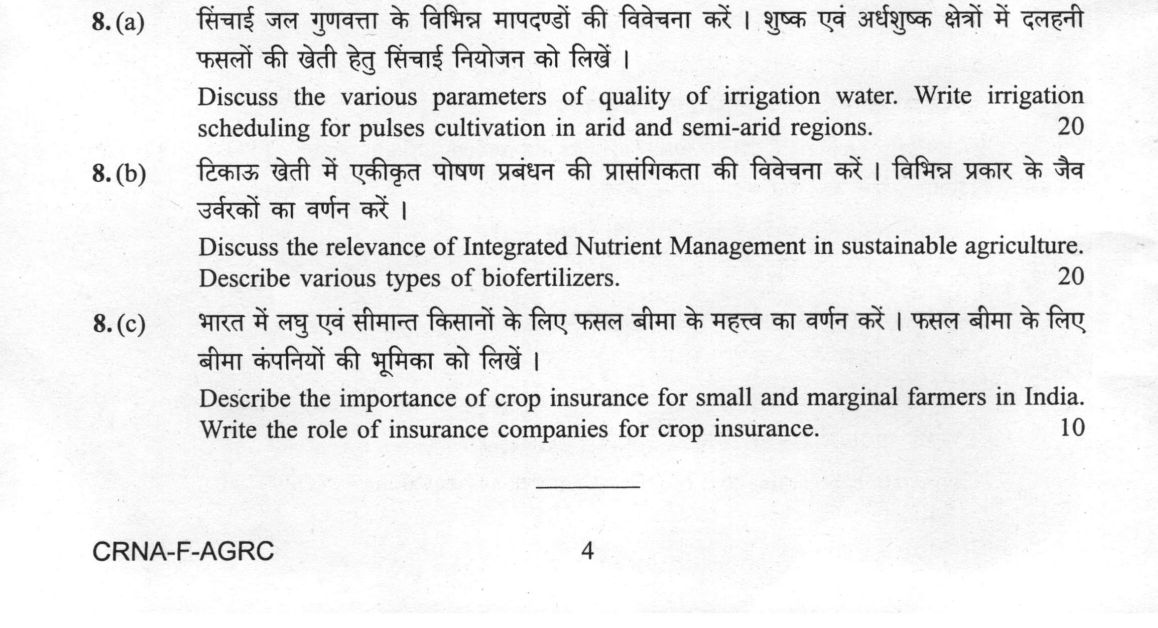
(a) Discuss the various parameters of quality of irrigation water. Write irrigation scheduling for pulses cultivation in arid and…
Discuss the various parameters of quality of irrigation water. Write irrigation scheduling for pulses cultivation in arid and semi-arid regions. 20 marks
Discuss the relevance of Integrated Nutrient Management in sustainable agriculture. Describe various types of biofertilizers. 20 marks
Describe the importance of crop insurance for small and marginal farmers in India. Write the role of insurance companies for crop insurance. 10 marks
हिंदी में प्रश्न पढ़ें
सिंचाई जल गुणवत्ता के विभिन्न मापदंडों की विवेचना करें । शुष्क एवं अर्धशुष्क क्षेत्रों में दलहनी फसलों की खेती हेतु सिंचाई नियोजन को लिखें । (20 अंक)
टिकाऊ खेती में एकीकृत पोषण प्रबंधन की प्रासंगिकता की विवेचना करें । विभिन्न प्रकार के जैव उर्वरकों का वर्णन करें । (20 अंक)
भारत में लघु एवं सीमांत किसानों के लिए फसल बीमा के महत्व का वर्णन करें । फसल बीमा के लिए बीमा कंपनियों की भूमिका को लिखें । (10 अंक)
Model answer
Written by UPSC Answer Check against this question's marking rubric, to the expected length. UPSC does not publish answers for Mains — this is one way to score well, not an official key.
Water, Nutrients, and Risk: Pillars of Resilient Agriculture
The sustainability of Indian agriculture hinges on the synergistic management of water quality, nutrient efficiency, and economic risk. Addressing these three pillars is critical for enhancing productivity in a climate-volatile context.
Irrigation Water Quality and Scheduling for Pulses
Irrigation water quality is assessed through physico-chemical parameters that determine crop safety. Electrical Conductivity (EC) indicates total soluble salts; high EC causes osmotic stress. Sodium Adsorption Ratio (SAR) measures sodium hazard, affecting soil structure, while Residual Sodium Carbonate (RSC) indicates alkalinity hazards. pH influences nutrient availability, and specific ion toxicities, particularly boron and chloride, are critical. Under the Ayers-Westcott classification, water is categorized from excellent to unsuitable based on these thresholds. For instance, boron toxicity is crop-specific: while >2 ppm is a severe restriction for semi-tolerant crops, sensitive crops face restrictions at 0.7–0.75 ppm. Chloride toxicity thresholds vary similarly by crop sensitivity.
In arid and semi-arid regions (e.g., Rajasthan, Gujarat), pulse cultivation (moong, urd, arhar) requires precise irrigation scheduling. Full irrigation must be ensured during critical physiological stages—branching, pre-flowering, and pod development—to prevent yield loss. Conversely, regulated deficit irrigation is applied during stress-tolerant vegetative stages to conserve water without compromising yield. Strategies include maintaining specific Irrigation Water/Crop Pan Evaporation (IW/CPE) ratios, utilizing mulching to reduce evaporation, and adopting drip or sprinkler systems. These micro-irrigation methods, combined with a calculated leaching fraction, limit root-zone salinity build-up, though they do not entirely avoid salt concentration at the wetting-front periphery.
Integrated Nutrient Management and Biofertilizers
Integrated Nutrient Management (INM) is vital for sustainable agriculture as it balances organic and inorganic inputs to enhance nutrient use efficiency. INM restores soil health, breaks yield plateaus, reduces the fiscal burden of fertilizer subsidies, and promotes carbon sequestration. It ensures long-term fertility by recycling nutrients and improving soil structure.
Biofertilizers are key components of INM, utilizing microorganisms to enhance nutrient availability. Rhizobium forms symbiotic associations with legumes, fixing atmospheric nitrogen. Azotobacter and Azospirillum are free-living or associative nitrogen fixers suitable for cereals and pulses. Phosphate Solubilizing Bacteria (PSB), such as Bacillus and Pseudomonas, convert insoluble phosphates into soluble forms. Potassium Mobilizing Bacteria (KMB) release potassium from minerals. Vesicular Arbuscular Mycorrhizae (VAM) extend root systems for better water and nutrient uptake, while Azolla and Blue-Green Algae (BGA) are used in paddy fields for nitrogen fixation. These agents are cost-effective and environmentally benign, reducing chemical dependency.
Crop Insurance for Small and Marginal Farmers
Crop insurance is crucial for small and marginal farmers, who constitute the majority of India’s farming population. It provides income stabilization, mitigates the risk of crop failure due to natural calamities, and enhances credit access by providing collateral security to banks. This financial safety net boosts investment confidence in high-value crops and plays a significant role in preventing farmer distress and suicides.
Insurance companies play a pivotal role in the implementation of schemes like the Pradhan Mantri Fasal Bima Yojana (PMFBY). Their responsibilities include accurate yield estimation using remote sensing and weather data integration, ensuring timely claim settlement, and managing grievance redressal mechanisms. They also conduct awareness campaigns to ensure farmer enrollment and operate under public-private partnership models, with entities like HDFC ERGO and AIC facilitating coverage. The evolution from NAIS to MNAIS and finally PMFBY reflects a shift towards broader coverage and lower premium rates.
Conclusion
In conclusion, quality irrigation water, Integrated Nutrient Management, and robust crop insurance form an integrated framework for climate-resilient farming. While water quality and scheduling ensure physiological efficiency, INM sustains soil productivity, and insurance safeguards economic viability. A holistic approach integrating these elements, supported by institutions like ICAR-IISS and effective policy implementation, is essential for achieving sustainable agricultural growth in India.
What "Discuss" is asking you to do
Lay the issue out from more than one side — how it arose, what is claimed for it, what is held against it, and where it now stands. UPSC attaches discuss to broad topics with several live dimensions, so coverage of the dimensions earns more than the strength of your opinion.
Structure that answers it
Set the issue up → the case as it is made → the case against → the dimension both sides leave out → where the balance now lies
Where marks are lost
Listing facts with no thread between them, or arguing one side throughout and calling it a discussion.
How this answer will be evaluated
Approach
Framework: Concept > Practice or process > Data > Indian application. (a) discuss: intro > 3-4 dimensions > example > balanced close | (b) discuss: intro > 3-4 dimensions > example > balanced close | (c) describe: define > structure or process in order > labelled diagram > significance Full marks: Precise parameters (EC/SAR), specific pulse stages, named biofertilizers (Azospirillum), and PMFBY details.
Key points expected
- EC, SAR, RSC, and pH as quality parameters
- Scheduling based on crop water requirement (CWR)
- Critical growth stages for pulses (flowering/podding)
- Specificity for arid/semi-arid water constraints
- INM components: Organic, Inorganic, Biofertilizers
- Sustainability benefits: Soil health, cost reduction
- Types: N-fixers (Rhizobium), P-solubilizers, K-mobilizers
- Mechanism of action for at least one biofertilizer
Evaluation rubric
Each sub-part is marked on its own, against the marks and word limit printed on the paper.
- (a) Quality parameters of irrigation water and irrigation scheduling for pulses in arid/semi-arid regions. 20 marks
discuss— intro → 3-4 dimensions → example → balanced close
Must cover
- EC, SAR, RSC, and pH as quality parameters
- Scheduling based on crop water requirement (CWR)
- Critical growth stages for pulses (flowering/podding)
- Specificity for arid/semi-arid water constraints
Loses marks
- Generic advice without arid region context
- Ignoring water quality parameters (EC/SAR)
- Vague scheduling without growth stages
Earns more
- Mention of drip or micro-irrigation for arid zones
- Calculation of net irrigation requirement
- Reference to specific pulse varieties (e.g., Moong, Urad)
Extra mark
- Specific EC/SAR threshold values for sensitive crops
- Reference to specific arid region (e.g., Rajasthan, MP)
- (b) Relevance of INM in sustainable agriculture and description of biofertilizer types. 20 marks
discuss— intro → 3-4 dimensions → example → balanced close
Must cover
- INM components: Organic, Inorganic, Biofertilizers
- Sustainability benefits: Soil health, cost reduction
- Types: N-fixers (Rhizobium), P-solubilizers, K-mobilizers
- Mechanism of action for at least one biofertilizer
Loses marks
- Listing biofertilizers without explaining mechanism
- Ignoring the 'sustainable agriculture' aspect
- Vague definition of INM
Earns more
- Specific examples: Azotobacter, Azospirillum, PSB
- Comparison of INM vs. conventional farming
- Mention of government schemes (e.g., PM-KISAN linkage)
Extra mark
- Specific dosage or application method for biofertilizers
- Reference to specific soil type (e.g., alkaline for PSB)
- (c) Importance of crop insurance for small/marginal farmers and role of insurance companies. 10 marks
describe— define → structure or process in order → labelled diagram → significance
Must cover
- Financial security against natural calamities
- Access to credit (collateral for loans)
- Role of insurers: Risk assessment, claim settlement
- Specific scheme: PMFBY (Pradhan Mantri Fasal Bima Yojana)
Loses marks
- Ignoring the role of insurance companies
- Focusing only on government role, not private insurers
- Vague statement on 'importance' without specifics
Earns more
- Mention of small/marginal farmer vulnerability
- Role of GIC Re in reinsurance
- Impact on rural economy stability
Extra mark
- Specific premium rates under PMFBY (2-4%)
- Mention of specific insurer (e.g., New India Assurance)
Practice this exact question
Write your answer and it is marked point by point against the model answer above — what you covered, what you missed, what you got wrong.
Evaluate my answer →More from Agriculture 2022 Paper I
- Q5 Discuss the followings in about 150 words each: (a) Self Help Groups (SHGs) and Farmers P…
- Q6 (a) What are the target groups in Agricultural Extension ? What role KVKs can play to rea…
- Q7 (a) Discuss about Micro-Irrigation Systems and their advantages in Indian Agriculture. (2…
- Q8 (a) Discuss the various parameters of quality of irrigation water. Write irrigation sched…