Paper I — Q5
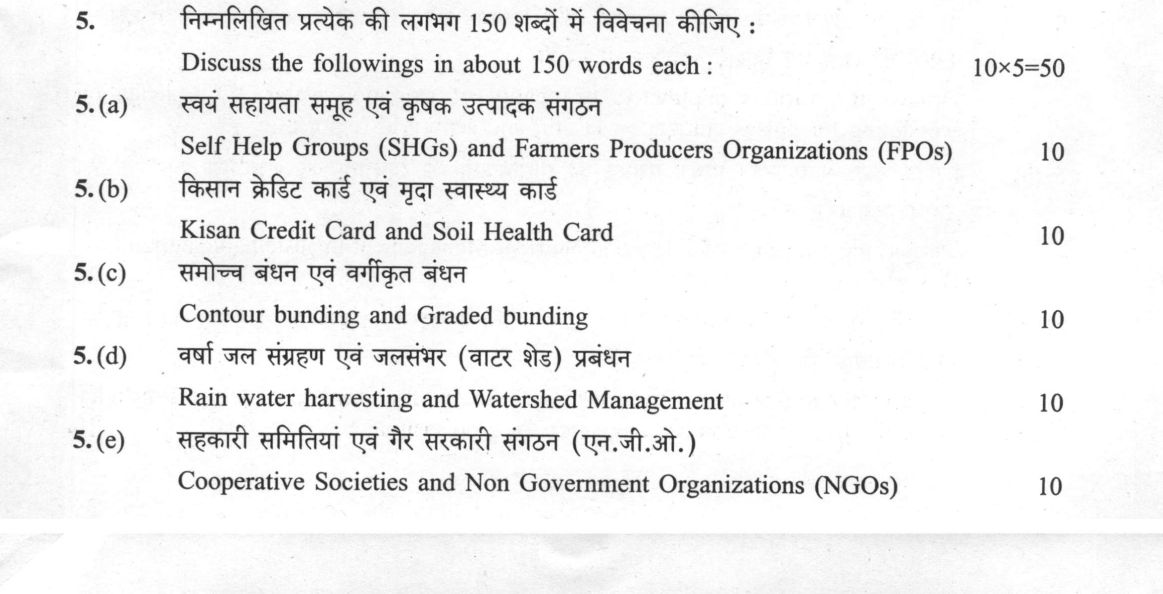
Discuss the followings in about 150 words each: (a) Self Help Groups (SHGs) and Farmers Producers Organizations (FPOs) (10…
Discuss the followings in about 150 words each: Self Help Groups (SHGs) and Farmers Producers Organizations (FPOs) 10 marks
Kisan Credit Card and Soil Health Card 10 marks
Contour bunding and Graded bunding 10 marks
Rain water harvesting and Watershed Management 10 marks
Cooperative Societies and Non Government Organizations (NGOs) 10 marks
हिंदी में प्रश्न पढ़ें
निम्नलिखित प्रत्येक की लगभग 150 शब्दों में विवेचना कीजिए : स्वयं सहायता समूह एवं कृषक उत्पादक संगठन (10 अंक)
किसान क्रेडिट कार्ड एवं मृदा स्वास्थ्य कार्ड (10 अंक)
समोच्च बंधन एवं वर्गीकृत बंधन (10 अंक)
वर्षा जल संग्रहण एवं जलसंभर (वाटर शेड) प्रबंधन (10 अंक)
सहकारी समितियां एवं गैर सरकारी संगठन (एन.जी.ओ.) (10 अंक)
Model answer
Written by UPSC Answer Check against this question's marking rubric, to the 150-word length. UPSC does not publish answers for Mains — this is one way to score well, not an official key.
Self Help Groups (SHGs) and Farmers Producers Organizations (FPOs)
SHGs are self-managed micro-credit groups of 10–20 members, primarily women, operating under the National Rural Livelihoods Mission (NRLM). They focus on social empowerment and financial inclusion through regular savings and bank linkage. In contrast, FPOs are legal entities formed under the Companies Act or Cooperative Societies Act, supported by the Small Farmers Agribusiness Cluster (SFAC) scheme and the National Agricultural Film Wing (NAF). FPOs aggregate produce to improve market bargaining power, with equity grants facilitating collective marketing. While SHGs address livelihood security, FPOs target economic aggregation and value addition. Both are critical for rural economic resilience, with SHGs often serving as feeder units for FPOs.
Kisan Credit Card and Soil Health Card
The Kisan Credit Card (KCC), revised in 2012, provides collateral-free credit for short-term crop loans. The interest subvention is 2%, plus a 3% prompt repayment incentive, resulting in an effective 4% interest rate for eligible farmers. Credit limits are determined by the scale of finance, not capped at ₹3 lakh, which is the threshold for the incentive. Loans are linked to crop insurance under the Pradhan Mantri Fasal Bima Yojana (PMFBY), though coverage is not inherently bundled. The Soil Health Card (SHC), launched in 2015, analyzes 12 chemical and fertility parameters (pH, EC, organic carbon, N, P, K, S, micronutrients) on a 3-year cycle. It provides fertilizer recommendations to optimize input use. The synergy lies in using SHC data to guide credit utilization for specific inputs, ensuring sustainable productivity.
Contour Bunding and Graded Bunding
Contour bunding involves constructing earthen bunds along contour lines, essentially with no longitudinal grade, to intercept runoff on gentle-to-moderate slopes (up to 6%) in low-rainfall areas (<600 mm). It prevents soil erosion by slowing water flow. Graded bunding, suitable for medium slopes, features a longitudinal grade of 0.1–0.2% towards an outlet. This design allows controlled drainage, preventing waterlogging while managing runoff. The critical distinction is that graded bunds incorporate drainage provisions, whereas contour bunds rely on infiltration or spillways. Both are cost-effective conservation measures, with contour bunding preferred for uniform gentle slopes and graded bunding for areas requiring managed water discharge.
Rain water harvesting and Watershed Management
Rainwater harvesting (RWH) involves capturing and storing rainwater for later use through structures like farm ponds, percolation tanks, and check dams. It addresses local water scarcity and groundwater recharge. Watershed management adopts a ridge-to-valley approach, treating micro-watersheds (typically 100–1,000 ha) as units. It integrates soil and water conservation, afforestation, and community participation to manage natural resources holistically. RWH is a key component within the broader watershed framework. While RWH focuses on water storage, watershed management ensures sustainable use of the entire catchment. Both are vital for climate-resilient agriculture, with RWH providing immediate water security and watershed management ensuring long-term ecological balance.
Cooperative Societies and Non Government Organizations (NGOs)
Cooperative societies, such as Primary Agricultural Credit Societies (PACS) and FPOs, are member-owned entities operating under the Cooperative Societies Act. They emphasize democratic control and limited liability, providing institutionalized services like credit, marketing, and input supply. NGOs are civil society actors that often pilot innovative agricultural practices and build community capacity. They are flexible and responsive to local needs but may lack long-term sustainability. The complementarity is clear: NGOs mobilize communities and test models, while cooperatives institutionalize these services for broader reach. Together, they enhance rural development by combining grassroots innovation with structured, democratic governance.
What "Discuss" is asking you to do
Lay the issue out from more than one side — how it arose, what is claimed for it, what is held against it, and where it now stands. UPSC attaches discuss to broad topics with several live dimensions, so coverage of the dimensions earns more than the strength of your opinion.
Structure that answers it
Set the issue up → the case as it is made → the case against → the dimension both sides leave out → where the balance now lies
Where marks are lost
Listing facts with no thread between them, or arguing one side throughout and calling it a discussion.
How this answer will be evaluated
Approach
Framework: Concept > Practice or process > Data > Indian application. (a) discuss: intro > 3-4 dimensions > example > balanced close | (b) discuss: intro > 3-4 dimensions > example > balanced close | (c) discuss: intro > 3-4 dimensions > example > balanced close | (d) discuss: intro > 3-4 dimensions > example > balanced close | (e) discuss: intro > 3-4 dimensions > example > balanced close Full marks: Clear distinction between the two concepts in each part, specific examples, and correct terminology.
Key points expected
- Define SHGs (self-help, micro-credit, women-centric)
- Define FPOs (collective marketing, input procurement, value addition)
- Contrast primary objective (financial inclusion vs market power)
- Mention institutional support (NABARD, Ministry of Agriculture)
- Define KCC (collateral-free credit, crop-wise limit)
- Define SHC (soil testing, nutrient recommendation)
- Link KCC to timely availability of funds for inputs
- Link SHC to precision farming and reducing fertilizer cost
Evaluation rubric
Each sub-part is marked on its own, against the marks and word limit printed on the paper.
- (a) Compare SHGs and FPOs as rural financial and marketing institutions. 10 marks · 150 words
discuss— intro → 3-4 dimensions → example → balanced close
Must cover
- Define SHGs (self-help, micro-credit, women-centric)
- Define FPOs (collective marketing, input procurement, value addition)
- Contrast primary objective (financial inclusion vs market power)
- Mention institutional support (NABARD, Ministry of Agriculture)
Loses marks
- Confusing SHGs with general cooperatives
- Ignoring the 'collective' aspect of FPOs
- Vague definitions without functional distinction
Earns more
- Reference to SHG-Bank Linkage Programme
- Reference to FPO Promotion Scheme (2019)
- Mention of specific state examples (e.g., Andhra SHGs, MP FPOs)
Extra mark
- Citing specific NABARD data on SHG numbers
- Mentioning specific FPO success stories (e.g., in horticulture)
- (b) Explain the utility of KCC for credit and SHC for soil management. 10 marks · 150 words
discuss— intro → 3-4 dimensions → example → balanced close
Must cover
- Define KCC (collateral-free credit, crop-wise limit)
- Define SHC (soil testing, nutrient recommendation)
- Link KCC to timely availability of funds for inputs
- Link SHC to precision farming and reducing fertilizer cost
Loses marks
- Treating KCC as a general bank card
- Ignoring the 'health' aspect of SHC (diagnostic tool)
- Failing to link SHC to input cost reduction
Earns more
- Mentioning the 4% interest subvention for timely repayment
- Mentioning the 'Soil Health Card' portal or app
- Noting the shift from blanket fertilizer use to site-specific
Extra mark
- Citing the specific year of SHC scheme launch (2015)
- Mentioning the specific crop-wise credit limit structure
- (c) Distinguish between contour bunding and graded bunding for soil conservation. 10 marks · 150 words
discuss— intro → 3-4 dimensions → example → balanced close
Must cover
- Define Contour bunding (perpendicular to slope, for gentle slopes)
- Define Graded bunding (along slope, for steep slopes)
- Explain the function of each (check runoff vs channelize flow)
- Mention the specific slope gradient for each (e.g., <5% vs >5%)
Loses marks
- Confusing the orientation of the two bunds
- Failing to mention the slope gradient applicability
- Vague description of 'soil conservation' without mechanism
Earns more
- Mentioning 'spills' or 'outlets' in graded bunds
- Referencing the 'soil and moisture conservation' objective
- Noting the use of vegetation (grass) on bunds
Extra mark
- Providing a simple sketch or diagram of the two types
- Mentioning specific soil types where these are most effective
- (d) Compare rainwater harvesting (micro) and watershed management (macro). 10 marks · 150 words
discuss— intro → 3-4 dimensions → example → balanced close
Must cover
- Define Rainwater Harvesting (RWH) (collection/storage of rain)
- Define Watershed Management (WMM) (integrated land/water management)
- Contrast scale (farm-level vs catchment-level)
- Mention specific structures (e.g., check dams, percolation tanks)
Loses marks
- Treating RWH and WMM as identical
- Ignoring the 'integrated' aspect of WMM
- Failing to mention specific structures or techniques
Earns more
- Mentioning 'micro' vs 'macro' water conservation
- Referencing the 'Watershed Development Programme' (WDP)
- Noting the role of WMM in recharging groundwater
Extra mark
- Citing specific state programs (e.g., Rajasthan's watershed projects)
- Mentioning the 'National Mission for Sustainable Agriculture' (NMSA)
- (e) Compare Cooperative Societies and NGOs in rural development. 10 marks · 150 words
discuss— intro → 3-4 dimensions → example → balanced close
Must cover
- Define Cooperative Societies (member-owned, democratic, profit-sharing)
- Define NGOs (non-profit, voluntary, service-oriented)
- Contrast legal status (Cooperative Act vs Societies Act/Trust)
- Mention the role of each in rural development (credit vs service)
Loses marks
- Confusing the legal status of the two
- Ignoring the 'member-owned' aspect of cooperatives
- Vague description of 'rural development' without specific roles
Earns more
- Mentioning the 'Cooperative Societies Act' (1912/2002)
- Referencing specific NGOs (e.g., ITC, CABI, local NGOs)
- Noting the 'social' vs 'economic' focus of each
Extra mark
- Citing specific cooperative success stories (e.g., Amul, NAFED)
- Mentioning the role of NGOs in 'last mile' delivery
Practice this exact question
Write your answer and it is marked point by point against the model answer above — what you covered, what you missed, what you got wrong.
Evaluate my answer →More from Agriculture 2022 Paper I
- Q2 (a) Write the various factors responsible for soil pollution. How organic and natural far…
- Q3 (a) How soil acidity affects crop production ? Elaborate the remedial procedures of soil…
- Q4 (a) Discuss about the types of herbicide resistance in weeds with specific example in Ind…
- Q5 Discuss the followings in about 150 words each: (a) Self Help Groups (SHGs) and Farmers P…
- Q6 (a) What are the target groups in Agricultural Extension ? What role KVKs can play to rea…
- Q7 (a) Discuss about Micro-Irrigation Systems and their advantages in Indian Agriculture. (2…
- Q8 (a) Discuss the various parameters of quality of irrigation water. Write irrigation sched…