Paper I — Q2
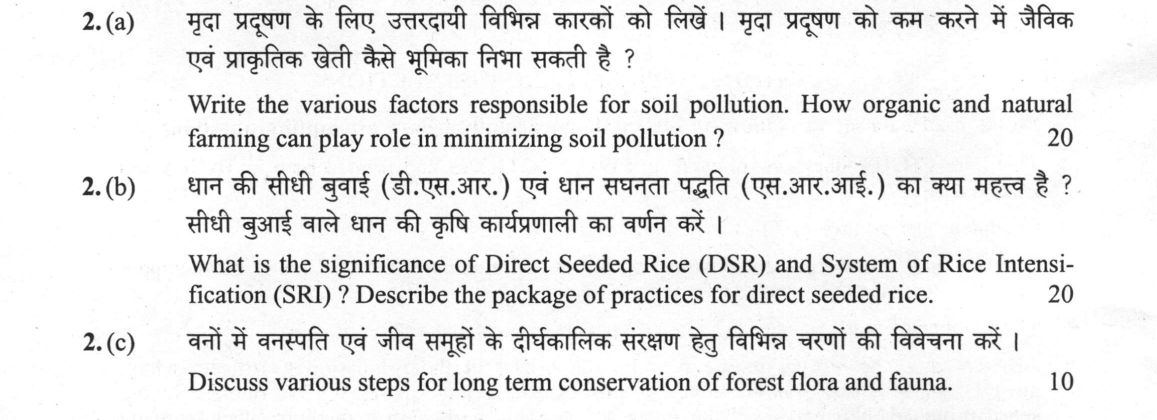
(a) Write the various factors responsible for soil pollution. How organic and natural farming can play role in minimizing soil…
Write the various factors responsible for soil pollution. How organic and natural farming can play role in minimizing soil pollution ? 20 marks
What is the significance of Direct Seeded Rice (DSR) and System of Rice Intensification (SRI) ? Describe the package of practices for direct seeded rice. 20 marks
Discuss various steps for long term conservation of forest flora and fauna. 10 marks
हिंदी में प्रश्न पढ़ें
मृदा प्रदूषण के लिए उत्तरदायी विभिन्न कारकों को लिखें । मृदा प्रदूषण को कम करने में जैविक एवं प्राकृतिक खेती कैसे भूमिका निभा सकती है ? (20 अंक)
धान की सीधी बुवाई (डी.एस.आर.) एवं धान सघनता पद्धति (एस.आर.आई.) का क्या महत्व है ? सीधी बुवाई वाले धान की कृषि कार्यप्रणाली का वर्णन करें । (20 अंक)
वनों में वनस्पति एवं जीव समूहों के दीर्घकालिक संरक्षण हेतु विभिन्न चरणों की विवेचना करें । (10 अंक)
Model answer
Written by UPSC Answer Check against this question's marking rubric, to the expected length. UPSC does not publish answers for Mains — this is one way to score well, not an official key.
Soil Pollution and Role of Organic and Natural Farming
Soil pollution stems from agricultural practices (indiscriminate synthetic fertilizer use, persistent pesticides, and intensive monocropping, which created Punjab’s pesticide-induced cancer belt), industrial activities (untreated effluents and heavy metal toxicity, alongside geogenic-industrial arsenic contamination in West Bengal), and urban pressures (sewage sludge and unsegregated solid waste dumping).
Remediating soil health requires agro-ecological shifts. Organic farming permits certified external biological inputs (such as vermicompost, biofertilizers, and bio-pesticides) to replace synthetics. In contrast, Natural Farming, exemplified by Subhash Palekar’s Zero Budget Natural Farming (ZBNF), is completely self-sustaining, rejecting external purchases in favour of on-farm formulations like Jeevamrutha and Beejamrutha. Both systems arrest soil pollution by eliminating toxic xenobiotics, driving soil organic carbon sequestration, stimulating microbial and enzymatic diversity, and rebuilding natural soil aggregates.
Significance of DSR and SRI, and Package of Practices for DSR
In India’s water-stressed rice-wheat belts, Direct Seeded Rice (DSR) and the System of Rice Intensification (SRI) counter the resource exhaustion of conventional flooded transplantation. DSR saves 25–30% water, eliminates nursery raising and puddling labour, and drastically reduces anaerobic methane emissions. SRI improves water productivity and boosts yields by 20–50% through single-seedling planting, wide spacing, organic fertilization, and alternate wetting and drying, which promotes extensive root aeration.
The standard package of practices for DSR includes: Land Preparation: Precision laser land leveling to ensure uniform water spread, followed by dry tillage while avoiding puddling to preserve soil structure. Seed Treatment and Sowing: Seeds treated with fungicides or Trichoderma are direct-drilled using zero-till seed drills or Happy Seeders at 20–25 kg/ha at optimum soil moisture (tar-watter). Weed Management: Critical in early stages; requires a pre-emergence application of Pendimethalin within 48 hours of sowing, followed by a post-emergence spray such as Bispyribac-sodium. Nutrient and Water Management: Split application of nitrogen, basal application of phosphorus and potassium, and prophylactic sprays of ferrous sulphate and zinc to prevent chlorosis. Irrigation is scheduled on an alternate wetting and drying basis, strictly avoiding standing water during vegetative growth.
Conservation of Forest Flora and Fauna
Long-term biodiversity conservation necessitates a dual strategy: in-situ preservation through Protected Area networks, Biosphere Reserves, and traditional sacred groves; complemented by ex-situ safeguards such as national gene banks, cryopreservation facilities, and botanical gardens. Institutional frameworks like the amended Wildlife (Protection) Act, Compensatory Afforestation Fund Management and Planning Authority (CAMPA), and the National Afforestation Programme (NAP) provide statutory and financial backing.
At the landscape level, securing wildlife corridors maintains gene flow across fragmented habitats. Incorporating community-led institutions, such as Joint Forest Management (JFM) committees and Uttarakhand's Van Panchayats, blends traditional ecological knowledge with modern spatial forestry.
Way Forward
Scaling resource-conserving agricultural systems like DSR and natural farming mitigates chemical run-off and eases land pressure on fringe ecosystems, providing a sustainable foundation for long-term forest and wildlife preservation.
What "Discuss" is asking you to do
Lay the issue out from more than one side — how it arose, what is claimed for it, what is held against it, and where it now stands. UPSC attaches discuss to broad topics with several live dimensions, so coverage of the dimensions earns more than the strength of your opinion.
Structure that answers it
Set the issue up → the case as it is made → the case against → the dimension both sides leave out → where the balance now lies
Where marks are lost
Listing facts with no thread between them, or arguing one side throughout and calling it a discussion.
How this answer will be evaluated
Approach
Framework: Concept > Practice or process > Data > Indian application. (a) explain: definition/context > points in order > small example > short close | (b) describe: define > structure or process in order > labelled diagram > significance | (c) discuss: intro > 3-4 dimensions > example > balanced close Full marks: Comprehensive coverage of all factors/practices/steps with specific examples, data, and clear distinction between concepts.
Key points expected
- Chemical factors: synthetic fertilizers, pesticides, heavy metals
- Industrial factors: effluents, mining waste, radioactive waste
- Agricultural factors: over-irrigation, monoculture, plastic mulch
- Mechanism of organic farming: composting, bio-fertilizers, crop rotation
- Significance of DSR: water saving, labor saving, cost reduction
- Significance of SRI: high yield, low water, reduced seed use
- DSR Practice: Seed treatment (Carbendazim/Thiram), spacing (20x20 cm)
- DSR Practice: Sowing method (drill, manual, mechanical), timing
Evaluation rubric
Each sub-part is marked on its own, against the marks and word limit printed on the paper.
- (a) List soil pollution factors and explain the role of organic/natural farming in minimization. 20 marks
explain— definition/context → points in order → small example → short close
Must cover
- Chemical factors: synthetic fertilizers, pesticides, heavy metals
- Industrial factors: effluents, mining waste, radioactive waste
- Agricultural factors: over-irrigation, monoculture, plastic mulch
- Mechanism of organic farming: composting, bio-fertilizers, crop rotation
Loses marks
- Vague mention of 'pollution' without specific sources
- Ignoring the 'minimization' aspect of the question
- Confusing soil erosion with soil pollution
Earns more
- Specific heavy metals (Pb, Cd, Hg) from industrial sources
- Role of vermicompost in soil remediation
- Mention of bio-pesticides (e.g., Bt, neem oil)
- Reference to soil health card scheme
Extra mark
- Specific data on heavy metal concentration limits
- Name of a specific organic farming initiative (e.g., Paramparagat Krishi Vikas Yojana)
- (b) Explain significance of DSR and SRI, and detail the package of practices for DSR. 20 marks
describe— define → structure or process in order → labelled diagram → significance
Must cover
- Significance of DSR: water saving, labor saving, cost reduction
- Significance of SRI: high yield, low water, reduced seed use
- DSR Practice: Seed treatment (Carbendazim/Thiram), spacing (20x20 cm)
- DSR Practice: Sowing method (drill, manual, mechanical), timing
Loses marks
- Confusing DSR with SRI practices
- Missing specific spacing or seed treatment details
- Failing to distinguish between the two systems
Earns more
- Comparison of water usage: DSR vs Transplanting
- Mention of specific varieties suitable for DSR (e.g., Samba Mahsuri)
- Weed management in DSR (first weeding at 15-20 days)
- Fertilizer schedule for DSR (split application)
Extra mark
- Specific yield data comparing DSR and SRI
- Mention of specific machinery (e.g., Happy Seeder)
- (c) Discuss steps for long-term conservation of forest flora and fauna. 10 marks
discuss— intro → 3-4 dimensions → example → balanced close
Must cover
- In-situ conservation: National Parks, Wildlife Sanctuaries, Biosphere Reserves
- Ex-situ conservation: Botanical gardens, zoos, seed banks
- Legal framework: Wildlife Protection Act, Forest Conservation Act
- Community involvement: Joint Forest Management (JFM), eco-tourism
Loses marks
- Focusing only on one type of conservation (e.g., only in-situ)
- Ignoring the legal or community aspect
- Vague generalities without specific examples
Earns more
- Mention of specific projects (e.g., Project Tiger, Project Elephant)
- Role of technology: GPS tracking, drone surveillance
- Habitat restoration and corridor creation
- Control of invasive species
Extra mark
- Reference to specific international conventions (CITES)
- Mention of specific endangered species (e.g., Great Indian Bustard)
Practice this exact question
Write your answer and it is marked point by point against the model answer above — what you covered, what you missed, what you got wrong.
Evaluate my answer →More from Agriculture 2022 Paper I
- Q1 Describe the following in about 150 words each: (a) What is "Geographic Information Syste…
- Q2 (a) Write the various factors responsible for soil pollution. How organic and natural far…
- Q3 (a) How soil acidity affects crop production ? Elaborate the remedial procedures of soil…
- Q4 (a) Discuss about the types of herbicide resistance in weeds with specific example in Ind…
- Q5 Discuss the followings in about 150 words each: (a) Self Help Groups (SHGs) and Farmers P…