Paper II — Q1
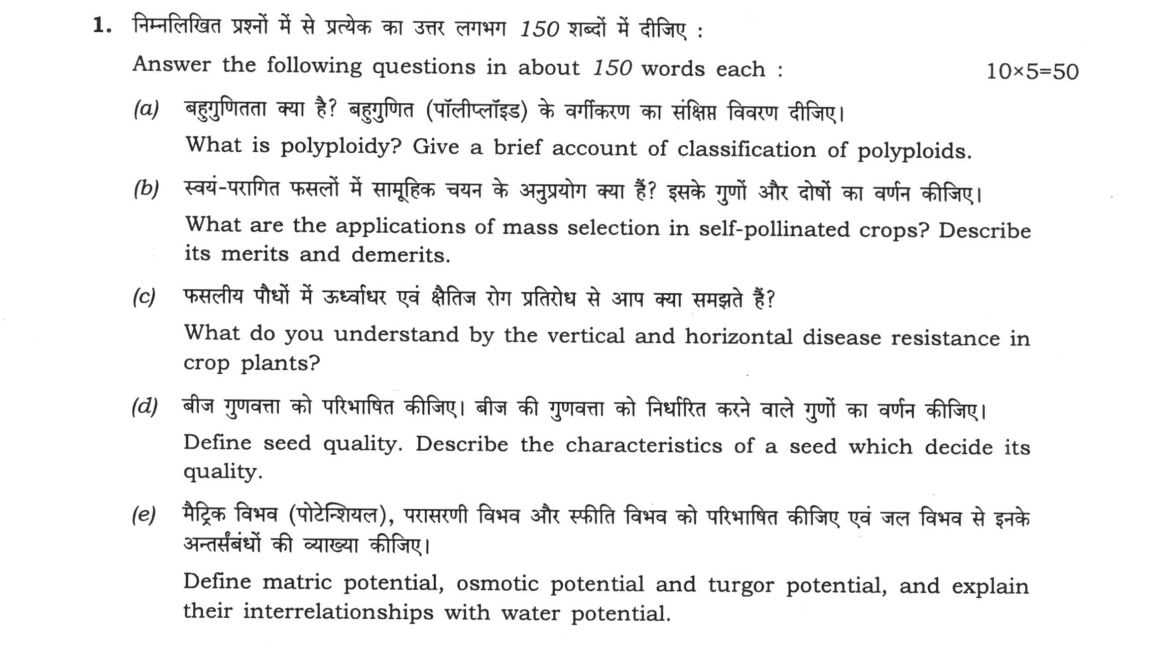
Answer the following questions in about 150 words each: 10×5=50 (a) What is polyploidy? Give a brief account of classification…
Answer the following questions in about 150 words each: 10×5=50
What is polyploidy? Give a brief account of classification of polyploids.
What are the applications of mass selection in self-pollinated crops? Describe its merits and demerits.
What do you understand by the vertical and horizontal disease resistance in crop plants?
Define seed quality. Describe the characteristics of a seed which decide its quality.
Define matric potential, osmotic potential and turgor potential, and explain their interrelationships with water potential.
हिंदी में प्रश्न पढ़ें
निम्नलिखित प्रश्नों में से प्रत्येक का उत्तर लगभग 150 शब्दों में दीजिए : 10×5=50
(क) बहुगुणिता क्या है? बहुगुणित (पॉलीप्लॉइड) के वर्गीकरण का संक्षिप्त विवरण दीजिए।
(ख) स्वयं-परागित फसलों में सामूहिक चयन के अनुप्रयोग क्या हैं? इसके गुणों और दोषों का वर्णन कीजिए।
(ग) फसलीय पौधों में उद्वधिर एवं क्षैतिज रोग प्रतिरोध से आप क्या समझते हैं?
(घ) बीज गुणवत्ता को परिभाषित कीजिए। बीज की गुणवत्ता को निर्धारित करने वाले गुणों का वर्णन कीजिए।
(ङ) मैट्रिक विभव (पोटेंशियल), परासरणी विभव और स्फीति विभव को परिभाषित कीजिए एवं जल विभव से इनके अंतर्संबंधों की व्याख्या कीजिए।
Model answer
Written by UPSC Answer Check against this question's marking rubric, to the 150-word length. UPSC does not publish answers for Mains — this is one way to score well, not an official key.
(a) Polyploidy and its Classification
Polyploidy refers to the condition in which an organism or cell possesses three or more complete sets of chromosomes (3n,4n, etc.) in its somatic complement, representing numerical variation classified under euploidy, as distinct from aneuploidy which involves the loss or gain of individual chromosomes.
Polyploids are primarily classified into two major categories:
Autopolyploids arise from the duplication of the same basic genome within a single species (e.g., AAAA or BBBB). Examples include autotriploid seedless watermelon (3n) and autotetraploid potato (Solanum tuberosum,2n=4x=48). They typically exhibit multivalents during meiotic pairing, reduced seed fertility, and the "gigas" effect characterized by larger cell, stomatal, and organ size.
Allopolyploids originate from interspecific or intergeneric hybridization between two distinct species followed by chromosome doubling (e.g., AABB). When their chromosome complements are fully doubled and behave like diploid species, they are termed amphidiploids. Classical examples include bread wheat (Triticum aestivum, 2n=6x=42,AABBDD), cultivated Brassica species described in U’s Triangle, and the man-made cereal Triticale. Segmental allopolyploids form an intermediate class where the hybridizing genomes share partial homology.
(b) Mass Selection in Self-Pollinated Crops
Mass selection involves choosing individuals based on their phenotypic performance from a heterogeneous population and bulking their harvested seeds together to raise the next generation, without progeny testing.
Applications: In self-pollinated crops, mass selection is widely applied to purify existing, deteriorated, or contaminated commercial varieties by roguing out off-types. It is utilized to develop improved cultivars directly from heterogeneous landraces and introduced germplasm, and to preserve broader genetic variability during early breeding generations or in the development of composite populations.
Merits: The method is simple, rapid, and cost-effective, requiring minimal technical skill and land resources. Because a large number of plants are selected and bulked, it preserves a wide genetic base, conferring high buffering capacity and stability across varying agro-climatic conditions.
Demerits: Genetic gain is limited and slow compared to pure-line selection because selected plants are not evaluated via progeny testing. It cannot utilize non-additive genetic variance or exploit heterosis. Its efficacy is strictly confined to highly heritable traits, as environmental variation often masks true genetic potential in quantitative traits like grain yield.
(c) Vertical and Horizontal Disease Resistance
J.E. Van der Plank classified plant disease resistance into two distinct epidemiological systems: vertical resistance and horizontal resistance.
Vertical Resistance (Qualitative or Race-Specific): Vertical resistance is governed by one or a few major genes (monogenic or oligogenic) and functions in strict accordance with Harold Flor’s gene-for-gene hypothesis. It provides complete or high-level resistance against specific virulent races of a pathogen while remaining fully susceptible to others. Because it exerts intense directional selection pressure on the pathogen population, matching virulent mutants emerge rapidly, resulting in the breakdown of resistance and the classic "boom-and-bust cycle" commonly observed in cereal rusts (e.g., Puccinia graminis in wheat).
Horizontal Resistance (Quantitative or Race-Nonspecific): Horizontal resistance is controlled by multiple minor genes (polygenic) and is evenly effective against all prevalent races of a pathogen. Rather than preventing infection entirely, it reduces the infection frequency, lengthens the latent period, and retards disease spread in the field (partial resistance). Consequently, horizontal resistance is durable, stable, and less vulnerable to breakdown, maintaining equilibrium between the crop host and pathogen populations over extended periods.
(d) Seed Quality and its Determinants
Seed quality is defined as the sum total of all genetic, physical, physiological, and health attributes that determine the potential performance, field stand establishment, and productivity of a seed lot under both optimum and sub-optimum conditions.
The primary characteristics deciding seed quality include:
Genetic Purity: Trueness-to-type ensuring that the seed possesses the exact varietal characteristics and yield potential of the released cultivar without genetic contamination.
Physical Purity: Cleanliness of the seed lot, indicating freedom from inert matter, broken grains, weed seeds, and seeds of other crop species.
Germination and Vigour: The physiological capacity of the seed to germinate rapidly and develop into a normal seedling under diverse field conditions, reflecting its metabolic efficiency.
Moisture Content: Maintenance of optimum, safe moisture levels (typically 8--12%, depending on crop type) to prevent biochemical deterioration, fungal growth, and viability loss during storage.
Seed Health: Absolute freedom from seed-borne pathogenic micro-organisms (fungi, bacteria, viruses) and storage insect pests like bruchids.
Uniformity: Uniform size, shape, and weight, which facilitate mechanized precision planting and uniform seedling emergence.
(e) Water Potential Components and Their Interrelationships
Water potential (Ψ_w) represents the chemical potential of water per unit volume relative to pure free water at standard temperature and atmospheric pressure, measured in Megapascals (MPa). Pure free water is assigned a Ψ_w value of zero.
Components: Osmotic or Solute Potential (Ψₛ) denotes the magnitude by which dissolved solutes lower the chemical potential and free energy of water. It is always zero or negative; higher solute concentrations result in more negative values.
Turgor or Pressure Potential (Ψₚ) is the hydrostatic pressure exerted by the protoplast against the rigid cell wall. In turgid plant cells, it is positive, providing mechanical rigidity, but can become zero under plasmolysis or negative in xylem vessels under tension.
Matric Potential (Ψₘ) represents the reduction in water potential attributable to adsorptive, colloidal, and capillary surface forces. It is significant in dry seeds and dry soils, but negligible in fully hydrated, vacuolated plant cells.
Interrelationship: The fundamental relationship governing cellular water status is expressed as: Ψ_w = Ψₛ + Ψₚ + Ψₘ
In mature, hydrated plant tissues where Ψₘ is negligible (Ψₘ ≈ 0), the equation simplifies to: Ψ_w = Ψₛ + Ψₚ
Water spontaneously moves down a water potential gradient from a region of higher (less negative) Ψ_w to a region of lower (more negative) Ψ_w across cellular membranes.
What "Describe" is asking you to do
Give a full, ordered account of the thing named — its parts, stages or mechanism — in the sequence in which it actually exists or occurs. Most describe questions come from the science optionals, where the marks sit in correct technical detail and, where the stem says so, a labelled diagram.
Structure that answers it
One-line identification of the subject → the parts or stages in their real order, each with its defining detail → labelled diagram where the subject is structural → closing line on function or significance
Where marks are lost
Loose general prose where the examiner is ticking named parts, correct terminology and their sequence; and in the General Studies papers, turning to evaluation before the description is finished.
How this answer will be evaluated
Approach
Framework: Concept > Practice or process > Data > Indian application. (a) describe: define > structure or process in order > labelled diagram > significance | (b) discuss: intro > 3-4 dimensions > example > balanced close | (c) explain: definition/context > points in order > small example > short close | (d) define: precise definition > the distinguishing feature > one example | (e) define: precise definition > the distinguishing feature > one example Full marks: Precise definitions, clear classification, specific examples, correct formulas.
Key points expected
- Definition of polyploidy (multiple sets of chromosomes)
- Classification into Autopolyploids and Allopolyploids
- Explanation of Autopolyploids (same species)
- Explanation of Allopolyploids (different species)
- Application in self-pollinated crops (e.g., wheat, rice)
- Process: Selection of superior plants
- Merits: Simple, low cost, effective for open-pollinated
- Demerits: Slow, ineffective for heterozygous traits
Evaluation rubric
Each sub-part is marked on its own, against the marks and word limit printed on the paper.
- (a) Define polyploidy and classify polyploids. · 150 words
describe— define → structure or process in order → labelled diagram → significance
Must cover
- Definition of polyploidy (multiple sets of chromosomes)
- Classification into Autopolyploids and Allopolyploids
- Explanation of Autopolyploids (same species)
- Explanation of Allopolyploids (different species)
Loses marks
- Confusing polyploidy with aneuploidy
- Failing to distinguish auto vs allo
Earns more
- Mention of Euploids vs Aneuploids
- Example of natural polyploidy (e.g., wheat)
Extra mark
- Mention of specific Indian polyploid crop (e.g., Triticale)
- (b) Applications of mass selection in self-pollinated crops with merits/demerits. · 150 words
discuss— intro → 3-4 dimensions → example → balanced close
Must cover
- Application in self-pollinated crops (e.g., wheat, rice)
- Process: Selection of superior plants
- Merits: Simple, low cost, effective for open-pollinated
- Demerits: Slow, ineffective for heterozygous traits
Loses marks
- Applying to cross-pollinated crops
- Vague description of the process
Earns more
- Mention of 'massed selection' vs 'individual selection'
- Example of a specific crop (e.g., wheat)
Extra mark
- Mention of a specific Indian variety developed via mass selection
- (c) Understand vertical and horizontal disease resistance in crop plants. · 150 words
explain— definition/context → points in order → small example → short close
Must cover
- Definition of Vertical Resistance (gene-for-gene)
- Definition of Horizontal Resistance (quantitative)
- Vertical: Specific to pathogen race, high level
- Horizontal: Broad spectrum, low level, durable
Loses marks
- Confusing vertical with horizontal
- Failing to mention durability
Earns more
- Mention of 'gene-for-gene' hypothesis (Flor)
- Example of a disease (e.g., rust)
Extra mark
- Mention of a specific Indian breeding program for resistance
- (d) Define seed quality and describe characteristics deciding it. · 150 words
define— precise definition → the distinguishing feature → one example
Must cover
- Definition of seed quality (viability, vigor, purity)
- Characteristic: Germination percentage
- Characteristic: Seed vigor (growth rate)
- Characteristic: Purity (freedom from impurities)
Loses marks
- Confusing seed quality with crop quality
- Failing to list specific characteristics
Earns more
- Mention of 'seed health' (disease-free)
- Mention of 'moisture content'
Extra mark
- Mention of a specific Indian seed certification agency (e.g., NABARD)
- (e) Define matric, osmotic, turgor potential and explain interrelationships. · 150 words
define— precise definition → the distinguishing feature → one example
Must cover
- Definition of Matric Potential (soil water)
- Definition of Osmotic Potential (solute concentration)
- Definition of Turgor Pressure (cell wall pressure)
- Formula: Water Potential = Matric + Osmotic + Pressure
Loses marks
- Confusing matric with osmotic
- Failing to show the formula
Earns more
- Mention of units (MPa or bars)
- Explanation of water movement (high to low potential)
Extra mark
- Mention of a specific Indian soil type (e.g., black soil)
Practice this exact question
Write your answer and it is marked point by point against the model answer above — what you covered, what you missed, what you got wrong.
Evaluate my answer →More from Agriculture 2022 Paper II
- Q1 Answer the following questions in about 150 words each: 10×5=50 (a) What is polyploidy? G…
- Q2 (a) Discuss the structure of a plant chromosome and its role in genetic diversity. 20 (b)…
- Q3 (a) What do you mean by mutation? What is the significance of induced mutation in plant b…
- Q4 (a) Discuss the mechanisms of absorption and translocation of mineral nutrients in plants…