Paper II — Q3
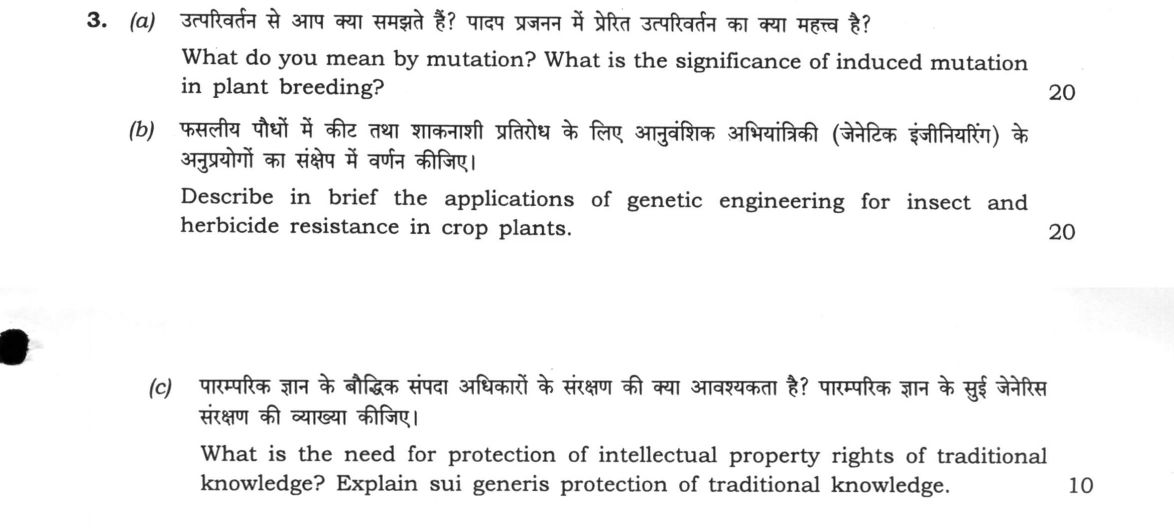
(a) What do you mean by mutation? What is the significance of induced mutation in plant breeding? 20 (b) Describe in brief the…
What do you mean by mutation? What is the significance of induced mutation in plant breeding? 20 marks
Describe in brief the applications of genetic engineering for insect and herbicide resistance in crop plants. 20 marks
What is the need for protection of intellectual property rights of traditional knowledge? Explain sui generis protection of traditional knowledge. 10 marks
हिंदी में प्रश्न पढ़ें
(क) उत्परिवर्तन से आप क्या समझते हैं? पादप प्रजनन में प्रेरित उत्परिवर्तन का क्या महत्व है? 20 marks
(ख) फसलीय पौधों में कीट तथा शाकनाशी प्रतिरोध के लिए आनुवंशिक अभियांत्रिकी (जेनेटिक इंजीनियरिंग) के अनुप्रयोगों का संक्षेप में वर्णन कीजिए। 20
(ग) पारंपरिक ज्ञान के बौद्धिक संपदा अधिकारों के संरक्षण की क्या आवश्यकता है? पारंपरिक ज्ञान के सुई जेनेरिस संरक्षण की व्याख्या कीजिए। 10
Model answer
Written by UPSC Answer Check against this question's marking rubric, to the expected length. UPSC does not publish answers for Mains — this is one way to score well, not an official key.
Mutation Breeding and Genetic Engineering in Crop Improvement
Part (a): Mutation and Induced Mutation
Mutation is a heritable change in the DNA sequence of an organism. These changes can be spontaneous, arising from natural replication errors or environmental factors, or induced, resulting from deliberate exposure to physical (radiation) or chemical (mutagens like EMS) agents. Mutations are classified into gene mutations (point mutations), chromosomal mutations (deletions, duplications, inversions), and genomic mutations (changes in chromosome number).
The significance of induced mutation in plant breeding lies in its ability to create novel genetic variability in a short timeframe, bypassing the lengthy process of hybridization. It allows breeders to generate new alleles for desirable traits such as disease resistance, drought tolerance, and improved quality without introducing undesirable linked genes (linkage drag). A landmark achievement in this domain is the development of 'Sharbati Sonora' wheat, which exhibits high lysine content, and 'Golden Promise' barley, known for its high yield and quality. In India, the Bhabha Atomic Research Centre (BARC) at Trombay has been pivotal in mutation breeding. Their Gamma Gardens have facilitated the development of the 'Trombay Groundnut' (TG) series, which offers resistance to leaf spot and high oil content. It is crucial to distinguish that while BARC contributed to radiation-induced rice mutants, the specific high-yielding and disease-resistant rice varieties 'Jagannath' and 'Padma' were developed by the Central Rice Research Institute (CRRI), Cuttack, through conventional breeding and selection, not directly as BARC mutants. This distinction highlights the collaborative nature of Indian agricultural research, where nuclear technology complements institutional breeding programs to enhance food security.
Part (b): Applications of Genetic Engineering
Genetic engineering has revolutionized crop protection by introducing specific genes for insect and herbicide resistance. For insect resistance, the most prominent technology is the Bt (Bacillus thuringiensis) system. Bt genes, such as Cry1Ac and Cry2Ab, encode Cry proteins that are toxic to specific insect larvae. The mode of action involves the ingestion of these proteins by the insect, which then bind to specific receptors in the midgut epithelium, creating pores that lead to cell lysis and insect death. In India, Bt cotton varieties like MECH-162 and RCH-2 have been widely adopted, significantly reducing the use of chemical pesticides for bollworm control. The introduction of Bt brinjal, however, faced regulatory and public controversy, leading to a moratorium, illustrating the complex socio-political landscape of transgenic crops.
For herbicide resistance, genetic engineering enables crops to survive the application of specific herbicides, facilitating weed management. A key example is the EPSPS gene, which confers resistance to glyphosate (the active ingredient in Roundup). This allows for the development of 'Roundup Ready' crops, such as soybean and maize, where weeds can be sprayed with glyphosate without harming the crop. Other mechanisms include resistance to ALS inhibitors. In India, the regulatory stance on High-Tech (HT) crops remains cautious, with the Genetic Engineering Appraisal Committee (GEAC) evaluating each case for biosafety and economic viability. While Bt cotton is approved, other HT crops like Bt brinjal and Bt mustard are subject to ongoing debate and regulatory scrutiny, balancing agricultural productivity with ecological and consumer concerns.
Part (c): Protection of Traditional Knowledge (TK)
The protection of Intellectual Property Rights (IPR) for Traditional Knowledge is essential to prevent biopiracy, where indigenous knowledge is exploited by commercial entities without consent or benefit-sharing. Historical cases, such as the patenting of turmeric and neem by foreign entities, highlight the vulnerability of TK to misappropriation. Protecting TK ensures the preservation of indigenous knowledge systems and promotes equitable benefit-sharing, as mandated by international frameworks like the Nagoya Protocol.
Sui generis protection refers to a distinct legal framework designed specifically for TK, differing from standard IPR regimes like patents or copyrights, which are often ill-suited for communal, evolving, and non-disclosed knowledge. In India, the Protection of Plant Varieties and Farmers’ Rights (PPV&FR) Act, 2001, provides sui generis protection by recognizing farmers' rights to save, use, exchange, and sell farm-produced seeds, while also protecting new plant varieties. Additionally, the Traditional Knowledge Digital Library (TKDL) documents indigenous knowledge in multiple languages, serving as prior art to prevent erroneous patent grants. This approach ensures that TK is respected, preserved, and utilized in a manner that benefits the communities who have stewarded it for generations.
Conclusion
In conclusion, while induced mutation and genetic engineering offer powerful tools for enhancing crop resilience and productivity, their deployment must be governed by robust regulatory frameworks. Simultaneously, the sui generis protection of traditional knowledge is vital to safeguard indigenous heritage from biopiracy. A balanced approach that integrates modern biotechnology with the preservation of traditional wisdom is essential for sustainable agricultural development in India.
What "Describe" is asking you to do
Give a full, ordered account of the thing named — its parts, stages or mechanism — in the sequence in which it actually exists or occurs. Most describe questions come from the science optionals, where the marks sit in correct technical detail and, where the stem says so, a labelled diagram.
Structure that answers it
One-line identification of the subject → the parts or stages in their real order, each with its defining detail → labelled diagram where the subject is structural → closing line on function or significance
Where marks are lost
Loose general prose where the examiner is ticking named parts, correct terminology and their sequence; and in the General Studies papers, turning to evaluation before the description is finished.
How this answer will be evaluated
Approach
Framework: Concept > Practice or process > Data > Indian application. (a) explain: definition/context > points in order > small example > short close | (b) describe: define > structure or process in order > labelled diagram > significance | (c) explain: definition/context > points in order > small example > short close Full marks: Precise definitions, specific examples (Bt cotton, TKDL), clear mechanisms, and strong Indian context.
Key points expected
- Precise definition of mutation as a heritable change in DNA
- Distinction between spontaneous and induced mutations
- Significance: creation of new genetic variability for selection
- Significance: rapid development of new crop varieties
- Mechanism of insect resistance (e.g., Bt toxin/Cry proteins)
- Mechanism of herbicide resistance (e.g., EPSPS gene for glyphosate)
- Specific examples of transgenic crops (e.g., Bt cotton, Bt brinjal)
- Benefits: reduced pesticide use, yield protection
Evaluation rubric
Each sub-part is marked on its own, against the marks and word limit printed on the paper.
- (a) Define mutation and explain the significance of induced mutation in plant breeding. 20 marks
explain— definition/context → points in order → small example → short close
Must cover
- Precise definition of mutation as a heritable change in DNA
- Distinction between spontaneous and induced mutations
- Significance: creation of new genetic variability for selection
- Significance: rapid development of new crop varieties
Loses marks
- Confusing mutation with recombination or hybridization
- Vague statements without linking to breeding objectives
- Ignoring the 'induced' aspect and discussing only natural mutation
Earns more
- Mention of mutagens (chemical/physical) like EMS or gamma rays
- Reference to specific Indian success stories (e.g., rice varieties)
- Mention of Mather's work or historical context of mutation breeding
Extra mark
- Specific example of an Indian variety developed via mutation (e.g., Pusa Basmati)
- Mention of specific mutagen concentration or dosage
- (b) Describe applications of genetic engineering for insect and herbicide resistance in crop plants. 20 marks
describe— define → structure or process in order → labelled diagram → significance
Must cover
- Mechanism of insect resistance (e.g., Bt toxin/Cry proteins)
- Mechanism of herbicide resistance (e.g., EPSPS gene for glyphosate)
- Specific examples of transgenic crops (e.g., Bt cotton, Bt brinjal)
- Benefits: reduced pesticide use, yield protection
Loses marks
- Confusing genetic engineering with conventional breeding
- Failing to distinguish between insect and herbicide resistance mechanisms
- Vague description without naming specific genes or proteins
Earns more
- Mention of specific genes (Cry1Ac, Cry2Ab, cp4-epsps)
- Reference to Indian regulatory context (GEAC approval for Bt brinjal)
- Mention of specific herbicides (Glyphosate, 2,4-D)
Extra mark
- Specific data on yield increase or pesticide reduction in India
- Mention of specific cultivar names (e.g., Bt cotton hybrids)
- (c) Explain the need for IP protection of traditional knowledge and sui generis protection. 10 marks
explain— definition/context → points in order → small example → short close
Must cover
- Need: preventing biopiracy and misappropriation of indigenous knowledge
- Definition of Sui Generis: a special, unique legal system for TK
- Distinction from standard patent/copyright laws
- Examples of TK (e.g., Ayurveda, tribal knowledge)
Loses marks
- Confusing Sui Generis with standard patent law
- Failing to explain 'why' protection is needed (biopiracy)
- Vague definition of Traditional Knowledge
Earns more
- Mention of the Neem case or Turmeric case as examples of biopiracy
- Reference to India's Traditional Knowledge Digital Library (TKDL)
- Mention of the Nagoya Protocol or CBD
Extra mark
- Specific reference to the Protection of Plant Varieties and Farmers' Rights Act
- Mention of specific tribal communities whose knowledge is protected
Practice this exact question
Write your answer and it is marked point by point against the model answer above — what you covered, what you missed, what you got wrong.
Evaluate my answer →More from Agriculture 2022 Paper II
- Q1 Answer the following questions in about 150 words each: 10×5=50 (a) What is polyploidy? G…
- Q2 (a) Discuss the structure of a plant chromosome and its role in genetic diversity. 20 (b)…
- Q3 (a) What do you mean by mutation? What is the significance of induced mutation in plant b…
- Q4 (a) Discuss the mechanisms of absorption and translocation of mineral nutrients in plants…
- Q5 Answer the following questions in about 150 words each: 10×5=50 (a) Give a detailed accou…
- Q6 (a) Describe the vicious cycle of poverty and enlist the existing policy instruments for…