Paper II — Q8
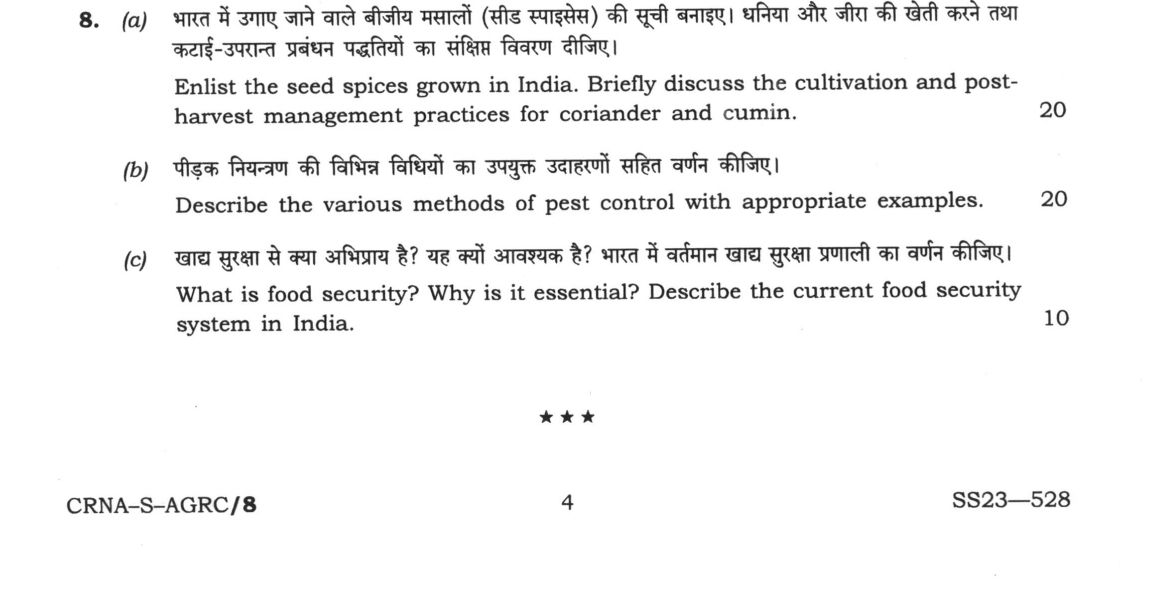
(a) Enlist the seed spices grown in India. Briefly discuss the cultivation and post-harvest management practices for coriander…
Enlist the seed spices grown in India. Briefly discuss the cultivation and post-harvest management practices for coriander and cumin. 20 marks
Describe the various methods of pest control with appropriate examples. 20 marks
What is food security? Why is it essential? Describe the current food security system in India. 10 marks
हिंदी में प्रश्न पढ़ें
(क) भारत में उगाए जाने वाले बीजीय मसालों (सीड स्पाइसेस) की सूची बनाइए। धनिया और जीरा की खेती करने तथा कटाई-उपरांत प्रबंधन पद्धतियों का संक्षिप्त विवरण दीजिए। 20
(ख) पीड़क नियंत्रण की विभिन्न विधियों का उपयुक्त उदाहरणों सहित वर्णन कीजिए। 20
(ग) खाद्य सुरक्षा से क्या अभिप्राय है? यह क्यों आवश्यक है? भारत में वर्तमान खाद्य सुरक्षा प्रणाली का वर्णन कीजिए। 10
Model answer
Written by UPSC Answer Check against this question's marking rubric, to the expected length. UPSC does not publish answers for Mains — this is one way to score well, not an official key.
Seed Spices in India: Cultivation and Post-Harvest Management
India is the largest producer and consumer of seed spices globally. The major seed spices cultivated are coriander (Coriandrum sativum), cumin (Cuminum cyminum), fennel, fenugreek, ajwain, nigella, aniseed, dill seed, celery, mustard, and poppy. The primary production belt, known as the "Seed Spice Bowl," is concentrated in Rajasthan and Gujarat, alongside Madhya Pradesh, Andhra Pradesh, and Uttar Pradesh.
For coriander, improved varieties such as CS-4, Hisar Sugandh, and RCr-435 are widely grown. It requires a cool, dry climate and thrives in well-drained loamy soils. Seeds are split into two mericarps and treated with Trichoderma or carbendazim before sowing during mid-October to mid-November at a spacing of 30 cm × 10 cm. Nutrient management involves applying 60:40:20 kg NPK/ha. Four to five light irrigations are given at critical stages: branching, flowering, and grain filling.
For cumin, prominent varieties include GC-4 and RZ-209. It requires a cool, dry, frost-free winter climate and sandy loam soil; excess humidity triggers devastating blight (Alternaria burnsii) and wilt (Fusarium oxysporum). Sowing is carried out in November via line sowing (25–30 cm) or broadcasting. Due to slow initial emergence, weed management is vital during the first 30–45 days; pre-emergence application of pendimethalin (1.0 kg a.i./ha) or oxadiargyl, followed by one hand weeding, ensures a clean field.
Post-harvest management begins when coriander umbels turn brownish-green and cumin plants turn golden-yellow. Plants are harvested in early morning to avoid seed shattering. Harvested crops are sun-dried for 2–3 days and threshed gently using wooden mallets or mechanical spice threshers. Seeds are cleaned and shade-dried to reduce moisture down to 8–9% to preserve essential volatile oils (linalool in coriander, cuminaldehyde in cumin). Cleaned produce is graded according to AGMARK standards and packed in moisture-proof, multi-layered poly-lined bags. Storage occurs in aerated, cool, dry warehouses to prevent Lasioderma serricorne (cigarette beetle) infestation. Value addition includes producing ground spices, steam-distilled essential oils, and solvent-extracted oleoresins.
Methods of Pest Control
Pest control strategies protect crops from economic damage and include the following approaches:
Cultural Control: Manipulation of farming practices to disrupt pest life cycles. Examples include deep summer plowing to expose pupae of soil-borne pests to sun and predators, crop rotation to break host specificity, and trap cropping, such as planting marigold borders around tomato fields to trap Helicoverpa armigera.
Physical and Mechanical Control: Direct destruction or physical exclusion of pests. Examples include using yellow sticky traps for whiteflies and aphids, blue sticky traps for thrips, sleeve pheromone traps for pink bollworm (Pectinophora gossypiella), light traps for nocturnal moths, and handpicking large caterpillars.
Biological Control: Utilization of natural enemies, including parasitoids, predators, and pathogens. Key examples comprise field releases of the egg parasitoid Trichogramma chilonis to control sugarcane shoot borers, the predator Cryptolaemus montrouzieri against mealybugs, the bacterium Bacillus thuringiensis (Bt) against lepidopteran larvae, and botanical bio-pesticides like Neem Seed Kernel Extract (NSKE 5% containing azadirachtin).
Chemical Control: Application of synthetic pesticides categorized into organophosphates, synthetic pyrethroids, and neonicotinoids. To manage and prevent pesticide resistance, chemicals with different modes of action (as designated by the Insecticide Resistance Action Committee) are rotated systematically.
Integrated Pest Management (IPM): The harmonious integration of cultural, mechanical, biological, and selective chemical methods to suppress pest populations below the Economic Injury Level (EIL) without destabilizing the agro-ecosystem.
Food Security in India
Food security, as defined by the Food and Agriculture Organization (FAO), exists when all people, at all times, have physical, social, and economic access to sufficient, safe, and nutritious food to meet dietary needs for an active and healthy life. It rests on four pillars: availability, accessibility, utilization, and stability. Food security is essential to eliminate chronic hunger and child stunting, build human capital, maintain domestic socio-economic stability, and protect national sovereignty from global market shocks.
The current food security architecture in India functions as an integrated, multi-tiered framework:
- Procurement: The Food Corporation of India (FCI) and state agencies procure wheat and paddy directly from farmers at Minimum Support Price (MSP), ensuring remunerative returns and production incentives.
- Buffer Stocks: FCI maintains mandatory strategic and operational food grain reserves to stabilize domestic prices and handle emergency supply shocks.
- Targeted Public Distribution System (TPDS): Governed by the National Food Security Act (NFSA), 2013, the system legally entitles up to 75% of rural and 50% of urban populations to highly subsidized grains under Priority Households (5 kg/person/month) and Antyodaya Anna Yojana (35 kg/family/month), currently provided free under the unified Pradhan Mantri Garib Kalyan Anna Yojana (PMGKAY).
- Welfare and Portability Extensions: Direct nutritional interventions operate through PM-POSHAN (school mid-day meals) and the Anganwadi system under POSHAN 2.0. The One Nation One Ration Card (ONORC) framework ensures nationwide biometric ration portability for migrant workers.
Diversifying agriculture toward high-value seed spices strengthens farm incomes, complementing India's staple-based food security architecture with broad-based economic and nutritional resilience.
What "Describe" is asking you to do
Give a full, ordered account of the thing named — its parts, stages or mechanism — in the sequence in which it actually exists or occurs. Most describe questions come from the science optionals, where the marks sit in correct technical detail and, where the stem says so, a labelled diagram.
Structure that answers it
One-line identification of the subject → the parts or stages in their real order, each with its defining detail → labelled diagram where the subject is structural → closing line on function or significance
Where marks are lost
Loose general prose where the examiner is ticking named parts, correct terminology and their sequence; and in the General Studies papers, turning to evaluation before the description is finished.
How this answer will be evaluated
Approach
Framework: Concept > Practice or process > Data > Indian application. (a) discuss: intro > 3-4 dimensions > example > balanced close | (b) describe: define > structure or process in order > labelled diagram > significance | (c) explain: definition/context > points in order > small example > short close Full marks: Comprehensive, specific, and well-structured answers with named examples and schemes.
Key points expected
- Enlist at least 5 seed spices grown in India
- Coriander: sowing time, spacing, and irrigation requirements
- Cumin: soil preference and specific sowing season
- Post-harvest: threshing, drying, and storage for both
- Cultural control methods (e.g., crop rotation, sanitation)
- Biological control (e.g., Trichogramma, Bacillus thuringiensis)
- Chemical control (e.g., specific insecticides and their targets)
- Mechanical/Physical control (e.g., traps, barriers)
Evaluation rubric
Each sub-part is marked on its own, against the marks and word limit printed on the paper.
- (a) List Indian seed spices and detail cultivation/post-harvest for coriander and cumin. 20 marks
discuss— intro → 3-4 dimensions → example → balanced close
Must cover
- Enlist at least 5 seed spices grown in India
- Coriander: sowing time, spacing, and irrigation requirements
- Cumin: soil preference and specific sowing season
- Post-harvest: threshing, drying, and storage for both
Loses marks
- Vague agronomic advice without specific parameters
- Confusing leaf spices with seed spices in the list
Earns more
- Mention of specific varieties (e.g., C-101 for cumin)
- Details on seed treatment or fertilizer doses
- Specific storage conditions to prevent moisture damage
Extra mark
- Mention of specific market demand or export data
- Reference to specific government schemes for spice production
- (b) Explain various pest control methods with specific examples. 20 marks
describe— define → structure or process in order → labelled diagram → significance
Must cover
- Cultural control methods (e.g., crop rotation, sanitation)
- Biological control (e.g., Trichogramma, Bacillus thuringiensis)
- Chemical control (e.g., specific insecticides and their targets)
- Mechanical/Physical control (e.g., traps, barriers)
Loses marks
- Listing methods without providing appropriate examples
- Over-reliance on chemical control without mentioning IPM
Earns more
- Integrated Pest Management (IPM) strategy overview
- Specific examples of pests and their corresponding controls
- Mention of pheromone traps or light traps
Extra mark
- Reference to specific IPM guidelines or government recommendations
- Mention of biopesticides like neem oil or verticillium
- (c) Define food security, its necessity, and describe India's current system. 10 marks
explain— definition/context → points in order → small example → short close
Must cover
- Definition of food security (availability, access, utilization)
- Reasons for its essentiality (population, nutrition)
- Description of current Indian food security system (e.g., PDS, NFSA)
- Mention of specific schemes like National Food Security Act
Loses marks
- Vague definition of food security
- Failing to mention specific Indian schemes or systems
Earns more
- Details on Public Distribution System (PDS) structure
- Mention of buffer stock management
- Reference to specific targets or coverage of NFSA
Extra mark
- Mention of specific data on food distribution or coverage
- Reference to specific challenges in the current system
Practice this exact question
Write your answer and it is marked point by point against the model answer above — what you covered, what you missed, what you got wrong.
Evaluate my answer →More from Agriculture 2022 Paper II
- Q5 Answer the following questions in about 150 words each: 10×5=50 (a) Give a detailed accou…
- Q6 (a) Describe the vicious cycle of poverty and enlist the existing policy instruments for…
- Q7 (a) Enlist the different commercial flowers cultivated on a large scale for cut flower tr…
- Q8 (a) Enlist the seed spices grown in India. Briefly discuss the cultivation and post-harve…