Paper II — Q7
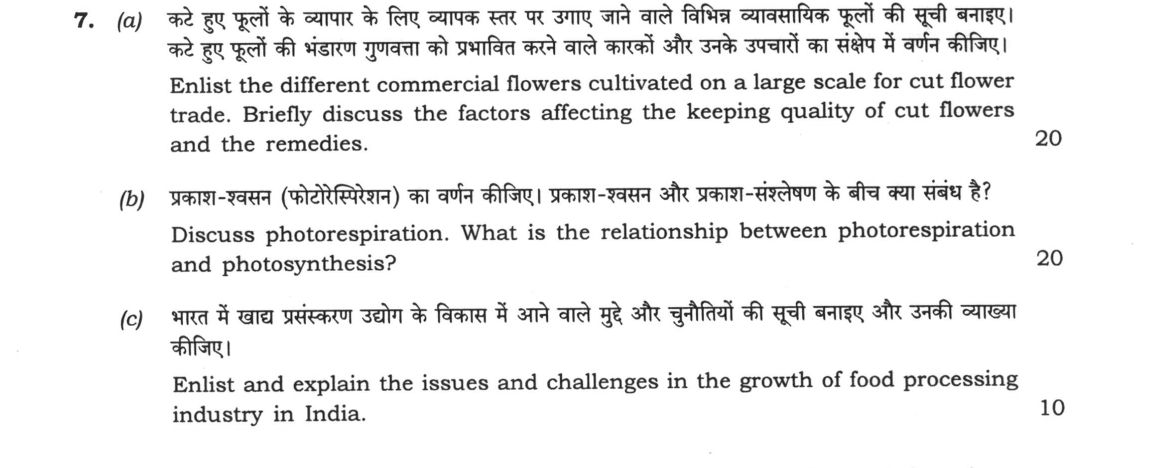
(a) Enlist the different commercial flowers cultivated on a large scale for cut flower trade. Briefly discuss the factors…
Enlist the different commercial flowers cultivated on a large scale for cut flower trade. Briefly discuss the factors affecting the keeping quality of cut flowers and the remedies. 20 marks
Discuss photorespiration. What is the relationship between photorespiration and photosynthesis? 20 marks
Enlist and explain the issues and challenges in the growth of food processing industry in India. 10 marks
हिंदी में प्रश्न पढ़ें
(क) कटे हुए फूलों के व्यापार के लिए व्यापक स्तर पर उगाए जाने वाले विभिन्न व्यावसायिक फूलों की सूची बनाइए। कटे हुए फूलों की भंडारण गुणवत्ता को प्रभावित करने वाले कारकों और उनके उपचारों का संक्षेप में वर्णन कीजिए। 20
(ख) प्रकाश-श्वसन (फोटोरेस्पिरेशन) का वर्णन कीजिए। प्रकाश-श्वसन और प्रकाश-संश्लेषण के बीच क्या संबंध है? 20 marks
(ग) भारत में खाद्य प्रसंस्करण उद्योग के विकास में आने वाले मुद्दे और चुनौतियों की सूची बनाइए और उनकी व्याख्या कीजिए। 10
Model answer
Written by UPSC Answer Check against this question's marking rubric, to the expected length. UPSC does not publish answers for Mains — this is one way to score well, not an official key.
Commercial floriculture in India is a high-value segment of the horticultural economy, driven by domestic demand and export potential. To address the multifaceted nature of this sector, it is essential to examine the commercial species, post-harvest physiology, and the broader agricultural contexts of photorespiration and food processing.
Commercial Cut Flowers and Keeping Quality The major commercial flowers cultivated on a large scale for the cut flower trade in India include rose, carnation, chrysanthemum, gerbera, orchid, anthurium, lily, and gladiolus. While tulips are globally significant, they are not cultivated on a large scale for the cut flower trade in India due to climatic constraints. Production is concentrated in hubs like Bengaluru, Pune, and Hyderabad, which offer favorable microclimates.
The keeping quality of cut flowers is determined by post-harvest physiology, primarily governed by ethylene biosynthesis. Ethylene production is initiated by ACC synthase and completed by ACC oxidase, leading to senescence. Other critical factors include water stress, which causes wilting; temperature fluctuations that accelerate respiration; and microbial load, which leads to stem blockage and decay. Additionally, membrane integrity loss and carbohydrate depletion reduce vase life.
Remedies involve a robust cold chain and chemical interventions. For ethylene-sensitive species, Silver Thiosulphate (STS) or 8-Hydroxyquinoline citrate (8-HQC) are used to inhibit ethylene action. Pulsing solutions with sugars and preservatives enhance energy reserves and antimicrobial properties. Crucially, refrigerated transport must be species-specific; while temperate flowers like roses tolerate 2–5°C, tropical species like orchids and anthurium are chilling-sensitive and require higher temperatures, often 7–15°C, to prevent cellular damage.
Photorespiration and its Relationship with Photosynthesis Photorespiration is a metabolic pathway that reduces the efficiency of photosynthesis. It occurs when Rubisco, the key enzyme in carbon fixation, acts as an oxygenase rather than a carboxylase, binding with O2 instead of CO2. This initiates the C2 cycle, where glycolate is processed through a shuttle involving chloroplasts, peroxisomes, and mitochondria. This process consumes ATP and releases CO2 without generating ATP, resulting in a net loss of approximately 25% of the fixed carbon in C3 plants.
The relationship between photorespiration and photosynthesis is one of competitive inhibition at the Rubisco active site. The ratio of CO2 to O2 determines the enzyme's preference; high O2/CO2 ratios favor oxygenation. This mechanism is an evolutionary trade-off. In C3 plants, photorespiration is high, acting as a safety valve against photoinhibition but reducing yield. In contrast, C4 and CAM plants have evolved spatial or temporal separation of carbon fixation to minimize photorespiration, thereby enhancing photosynthetic efficiency under high light and temperature conditions.
Challenges in India’s Food Processing Industry The growth of India’s food processing industry faces several structural and policy challenges. Supply chain fragmentation is a primary issue; while developed nations process around 70% of their produce, India processes only about 10% of its total perishables, with specific categories like fruits and vegetables processed at merely 2%. This gap leads to significant post-harvest losses.
Infrastructure deficits persist, particularly in the aggregation capabilities of Farmer Producer Organizations (FPOs) and the underutilization of Mega Food Parks under the PM Kisan SAMPADA Yojana. Compliance costs for Micro, Small, and Medium Enterprises (MSMEs) remain high due to stringent FSSAI regulations and complex GST rate anomalies that create cascading tax effects. Furthermore, enforcement of contract farming agreements is weak, leading to disputes between processors and farmers.
Export challenges are compounded by Maximum Residue Limit (MRL) issues, resulting in rejections from stringent markets like the EU and US. Policy implementation bottlenecks, such as delays in cold chain development and lack of standardized grading, further hinder value addition.
Conclusion A comprehensive approach is required to enhance the agricultural value chain. For floriculture, species-specific cold chain management and ethylene control are vital. Understanding photorespiration aids in developing stress-tolerant crop varieties. For food processing, bridging the infrastructure gap, simplifying compliance, and enforcing contract farming are essential to transform India from a raw material exporter to a value-added food processor.
What "Discuss" is asking you to do
Lay the issue out from more than one side — how it arose, what is claimed for it, what is held against it, and where it now stands. UPSC attaches discuss to broad topics with several live dimensions, so coverage of the dimensions earns more than the strength of your opinion.
Structure that answers it
Set the issue up → the case as it is made → the case against → the dimension both sides leave out → where the balance now lies
Where marks are lost
Listing facts with no thread between them, or arguing one side throughout and calling it a discussion.
How this answer will be evaluated
Approach
Framework: Concept > Practice or process > Data > Indian application. (a) discuss: intro > 3-4 dimensions > example > balanced close | (b) discuss: intro > 3-4 dimensions > example > balanced close | (c) challenges: 3-4 challenges > solutions mapped to them > conclusion Full marks: Comprehensive, specific, and well-structured answers with named examples and clear linkages.
Key points expected
- List 5-6 major commercial cut flowers (e.g., Rose, Chrysanthemum, Gladiolus)
- Identify factors: water uptake, microbial growth, ethylene, temperature
- Detail remedies: recutting, preservatives, cold chain, anti-ethylene agents
- Link specific factors to specific remedies (e.g., bacteria -> preservatives)
- Define photorespiration and its trigger (Rubisco oxygenation)
- Outline the C4 cycle pathway (chloroplast -> peroxisome -> mitochondria)
- Explain the relationship: competition for RuBP, energy loss
- Discuss the net effect on photosynthetic efficiency
Evaluation rubric
Each sub-part is marked on its own, against the marks and word limit printed on the paper.
- (a) List commercial cut flowers and analyze factors affecting keeping quality with remedies. 20 marks
discuss— intro → 3-4 dimensions → example → balanced close
Must cover
- List 5-6 major commercial cut flowers (e.g., Rose, Chrysanthemum, Gladiolus)
- Identify factors: water uptake, microbial growth, ethylene, temperature
- Detail remedies: recutting, preservatives, cold chain, anti-ethylene agents
- Link specific factors to specific remedies (e.g., bacteria -> preservatives)
Loses marks
- Listing flowers without discussing keeping quality
- Vague remedies like 'keep in water' without mechanism
- Ignoring the 'remedies' part of the question
Earns more
- Mention specific preservative chemicals (e.g., 8-HQC, sucrose)
- Reference specific Indian varieties (e.g., 'Kashmiri' rose)
- Mention specific temperature ranges for storage
Extra mark
- Mention specific Indian export data or market share
- Reference specific Indian horticultural research institute (e.g., IIHR)
- (b) Explain photorespiration mechanism and its relationship with photosynthesis. 20 marks
discuss— intro → 3-4 dimensions → example → balanced close
Must cover
- Define photorespiration and its trigger (Rubisco oxygenation)
- Outline the C4 cycle pathway (chloroplast -> peroxisome -> mitochondria)
- Explain the relationship: competition for RuBP, energy loss
- Discuss the net effect on photosynthetic efficiency
Loses marks
- Confusing photorespiration with dark respiration
- Failing to explain the 'relationship' with photosynthesis
- Omitting the organelle pathway (chloroplast/peroxisome/mitochondria)
Earns more
- Mention specific enzymes (e.g., glycolate oxidase)
- Compare C3 vs C4 plants in this context
- Mention the 'oxygenation' vs 'carboxylation' reaction
Extra mark
- Mention specific research on reducing photorespiration
- Reference specific Indian agricultural context (e.g., heat stress)
- (c) List and explain issues/challenges in India's food processing industry growth. 10 marks
challenges— 3-4 challenges → solutions mapped to them → conclusion
Must cover
- Identify 3-4 key challenges (e.g., supply chain, infrastructure, policy)
- Explain each challenge with specific Indian context
- Map solutions to the identified challenges
- Provide a balanced conclusion on industry potential
Loses marks
- Listing challenges without explanation
- Ignoring the 'Indian' context (generic global issues)
- Failing to map solutions to challenges
Earns more
- Mention specific schemes (e.g., PMFME, Mega Food Parks)
- Reference specific infrastructure gaps (e.g., cold chain %)
- Mention specific policy issues (e.g., FDI, FSSAI)
Extra mark
- Mention specific recent government data or reports
- Reference specific successful Indian food processing companies
Practice this exact question
Write your answer and it is marked point by point against the model answer above — what you covered, what you missed, what you got wrong.
Evaluate my answer →More from Agriculture 2022 Paper II
- Q4 (a) Discuss the mechanisms of absorption and translocation of mineral nutrients in plants…
- Q5 Answer the following questions in about 150 words each: 10×5=50 (a) Give a detailed accou…
- Q6 (a) Describe the vicious cycle of poverty and enlist the existing policy instruments for…
- Q7 (a) Enlist the different commercial flowers cultivated on a large scale for cut flower tr…
- Q8 (a) Enlist the seed spices grown in India. Briefly discuss the cultivation and post-harve…