Paper II — Q6
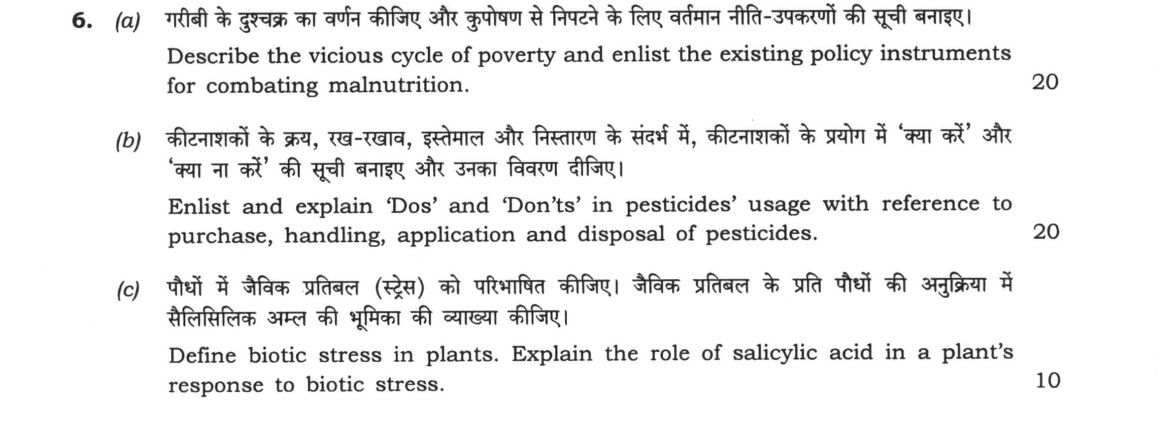
(a) Describe the vicious cycle of poverty and enlist the existing policy instruments for combating malnutrition. 20 (b) Enlist…
Describe the vicious cycle of poverty and enlist the existing policy instruments for combating malnutrition. 20 marks
Enlist and explain 'Dos' and 'Don'ts' in pesticides' usage with reference to purchase, handling, application and disposal of pesticides. 20 marks
Define biotic stress in plants. Explain the role of salicylic acid in a plant's response to biotic stress. 10 marks
हिंदी में प्रश्न पढ़ें
(क) गरीबी के दुष्चक्र का वर्णन कीजिए और कुपोषण से निपटने के लिए वर्तमान नीति-उपकरणों की सूची बनाइए। 20
(ख) कीटनाशकों के क्रय, रख-रखाव, इस्तेमाल और निस्तारण के संदर्भ में, कीटनाशकों के प्रयोग में 'क्या करें' और 'क्या ना करें' की सूची बनाइए और उनका विवरण दीजिए। 20
(ग) पौधों में जैविक प्रतिबल (स्ट्रेस) को परिभाषित कीजिए। जैविक प्रतिबल के प्रति पौधों की अनुक्रिया में सैलिसिलिक अम्ल की भूमिका की व्याख्या कीजिए। 10
Model answer
Written by UPSC Answer Check against this question's marking rubric, to the expected length. UPSC does not publish answers for Mains — this is one way to score well, not an official key.
Part (a): The Vicious Cycle of Poverty and Malnutrition
The relationship between poverty and malnutrition is a bidirectional trap, often described as a vicious cycle. Low income restricts household expenditure, forcing families to prioritize quantity over quality in their diet. This results in a lack of dietary diversity, leading to micronutrient deficiencies and stunting in children. Malnourished individuals suffer from reduced physical and cognitive capacity, which lowers their productivity and earning potential in the labor market. Consequently, this diminished productivity perpetuates low income, ensuring the cycle continues across generations. In India, this is evident in the high prevalence of stunting among children in low-income agrarian communities.
To combat this, the Indian government has deployed a multi-pronged policy framework. The Integrated Child Development Services (ICDS) scheme provides supplementary nutrition and health check-ups to children under five and pregnant/lactating women. The Mid-Day Meal (MDM) scheme targets school children, ensuring regular meals to improve attendance and nutritional status. The National Food Security Act (NFSA), 2013 guarantees subsidized food grains to eligible households, addressing the income constraint directly. More recently, PM-POSHAN (Pradhan Mantri Poshan Shala Abhiyan) has replaced MDM, aiming to provide hot, cooked meals in schools. For specific deficiencies, the Anaemia Mukt Bharat strategy focuses on iron-folic acid supplementation and dietary diversification. The overarching POSHAN Abhiyaan (National Nutrition Mission) integrates these efforts to reduce stunting, wasting, and anemia, targeting a 3% annual reduction in stunting and wasting.
Part (b): Dos and Don’ts in Pesticide Usage
Safe pesticide management is critical to prevent environmental degradation and health hazards, guided by the Insecticides Act, 1968 and the FAO Code of Conduct.
Purchase: Dos: Buy only from licensed dealers with valid registration numbers. Check the label for the WHO hazard classification (e.g., Class Ia, Ib, II, III) and ensure the product is registered for the specific crop. Don’ts: Never purchase unbranded, expired, or repackaged pesticides. Avoid buying from informal sources that lack quality assurance.
Handling: Dos: Use personal protective equipment (PPE) such as gloves, masks, and goggles. Store pesticides in their original, tightly sealed containers in a locked, ventilated area away from food and water sources. Don’ts: Never transfer pesticides to food or drink containers. Do not store them in open areas where children or animals can access them.
Application: Dos: Calibrate the sprayer to ensure the correct dose per hectare. Apply pesticides during calm weather conditions, preferably early morning or late evening, to avoid drift and high temperatures. Don’ts: Do not spray against the wind direction. Never exceed the recommended dosage or pre-harvest interval (PHI). Avoid spraying during rain or high winds.
Disposal: Dos: Perform triple rinsing of empty containers. The rinse water must be added to the spray tank and applied to the target crop or field, ensuring no chemical waste is discarded. Empty containers should be crushed and disposed of in designated hazardous waste pits or collection centers. Don’ts: Do not bury rinse-waste in soak pits or open fields, as this contaminates soil and groundwater. Never burn empty containers in open areas, as this releases toxic fumes.
Part (c): Biotic Stress and Salicylic Acid
Biotic stress refers to physiological damage caused by living organisms, including pathogens (bacteria, fungi, viruses), pests (insects, nematodes), and competing weeds. This is distinct from abiotic stress, which is caused by non-living factors like drought or salinity.
In response to biotic stress, plants activate Systemic Acquired Resistance (SAR), a long-lasting, broad-spectrum defense mechanism. Salicylic Acid (SA) is the key signaling molecule in this process. Upon initial infection, SA levels rise in the local tissue. This triggers the activation of the NPR1 (Non-Expressor of PR Genes 1) pathway. NPR1 acts as a central regulator, moving to the nucleus to activate the expression of Pathogenesis-Related (PR) genes. These genes produce proteins that enhance the plant’s defense, such as chitinases and glucanases, which degrade pathogen cell walls. SA also promotes the production of reactive oxygen species (ROS) and strengthens cell walls, making the plant resistant to subsequent attacks by the same or different pathogens.
Conclusion
Addressing the poverty-malnutrition cycle requires sustained investment in social security schemes like PM-POSHAN and NFSA. Simultaneously, strict adherence to pesticide safety protocols is essential to protect farmer health and food safety. Understanding plant defense mechanisms like SAR through salicylic acid signaling offers a biological basis for developing resistant crop varieties, which can reduce crop losses and enhance food security, thereby indirectly supporting the nutritional goals of the nation.
What "Describe" is asking you to do
Give a full, ordered account of the thing named — its parts, stages or mechanism — in the sequence in which it actually exists or occurs. Most describe questions come from the science optionals, where the marks sit in correct technical detail and, where the stem says so, a labelled diagram.
Structure that answers it
One-line identification of the subject → the parts or stages in their real order, each with its defining detail → labelled diagram where the subject is structural → closing line on function or significance
Where marks are lost
Loose general prose where the examiner is ticking named parts, correct terminology and their sequence; and in the General Studies papers, turning to evaluation before the description is finished.
How this answer will be evaluated
Approach
Framework: Concept > Practice or process > Data > Indian application. (a) describe: define > structure or process in order > labelled diagram > significance | (b) explain: definition/context > points in order > small example > short close | (c) define: precise definition > the distinguishing feature > one example Full marks: Comprehensive, well-structured, with specific examples and data.
Key points expected
- Define the vicious cycle of poverty
- Explain the link between poverty and malnutrition
- List policy instruments for combating malnutrition
- Mention specific Indian schemes (e.g., PDS, ICDS)
- List 'Dos' for pesticide purchase
- List 'Dos' for pesticide handling
- List 'Dos' for pesticide application
- List 'Dos' for pesticide disposal
Evaluation rubric
Each sub-part is marked on its own, against the marks and word limit printed on the paper.
- (a) Explain the vicious cycle of poverty and list policy instruments for malnutrition. 20 marks
describe— define → structure or process in order → labelled diagram → significance
Must cover
- Define the vicious cycle of poverty
- Explain the link between poverty and malnutrition
- List policy instruments for combating malnutrition
- Mention specific Indian schemes (e.g., PDS, ICDS)
Loses marks
- Vague description of the poverty cycle
- Listing schemes without explaining their role
- Ignoring the link between poverty and malnutrition
Earns more
- Mention specific data on malnutrition rates
- Discuss the role of education and health
- Reference specific government missions (e.g., POSHAN Abhiyaan)
Extra mark
- Cite specific budget allocations for nutrition
- Mention specific success stories or case studies
- (b) List and explain 'Dos' and 'Don'ts' in pesticide usage. 20 marks
explain— definition/context → points in order → small example → short close
Must cover
- List 'Dos' for pesticide purchase
- List 'Dos' for pesticide handling
- List 'Dos' for pesticide application
- List 'Dos' for pesticide disposal
Loses marks
- Mixing 'Dos' and 'Don'ts' without clear structure
- Vague advice without specific examples
- Ignoring safety precautions
Earns more
- List 'Don'ts' for pesticide purchase
- List 'Don'ts' for pesticide handling
- List 'Don'ts' for pesticide application
- List 'Don'ts' for pesticide disposal
Extra mark
- Mention specific safety equipment (e.g., PPE)
- Reference specific regulations (e.g., Insecticides Act)
- (c) Define biotic stress and explain the role of salicylic acid. 10 marks
define— precise definition → the distinguishing feature → one example
Must cover
- Define biotic stress in plants
- Explain the role of salicylic acid in plant response
- Mention specific mechanisms of salicylic acid action
- Provide an example of biotic stress (e.g., pathogen attack)
Loses marks
- Confusing biotic and abiotic stress
- Vague explanation of salicylic acid's role
- Ignoring the specific mechanisms of action
Earns more
- Discuss the signaling pathways involved
- Mention specific genes or proteins regulated by salicylic acid
Extra mark
- Cite specific research findings on salicylic acid
- Mention specific plant species studied
Practice this exact question
Write your answer and it is marked point by point against the model answer above — what you covered, what you missed, what you got wrong.
Evaluate my answer →More from Agriculture 2022 Paper II
- Q3 (a) What do you mean by mutation? What is the significance of induced mutation in plant b…
- Q4 (a) Discuss the mechanisms of absorption and translocation of mineral nutrients in plants…
- Q5 Answer the following questions in about 150 words each: 10×5=50 (a) Give a detailed accou…
- Q6 (a) Describe the vicious cycle of poverty and enlist the existing policy instruments for…
- Q7 (a) Enlist the different commercial flowers cultivated on a large scale for cut flower tr…
- Q8 (a) Enlist the seed spices grown in India. Briefly discuss the cultivation and post-harve…