Paper II — Q2
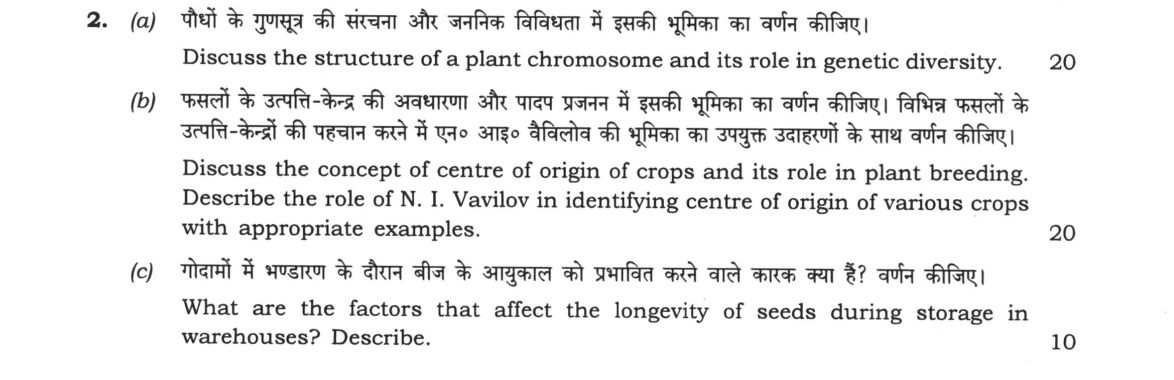
(a) Discuss the structure of a plant chromosome and its role in genetic diversity. 20 (b) Discuss the concept of centre of…
Discuss the structure of a plant chromosome and its role in genetic diversity. 20 marks
Discuss the concept of centre of origin of crops and its role in plant breeding. Describe the role of N. I. Vavilov in identifying centre of origin of various crops with appropriate examples. 20 marks
What are the factors that affect the longevity of seeds during storage in warehouses? Describe. 10 marks
हिंदी में प्रश्न पढ़ें
(क) पौधों के गुणसूत्र की संरचना और जननिक विविधता में इसकी भूमिका का वर्णन कीजिए। 20
(ख) फसलों के उत्पत्ति-केंद्र की अवधारणा और पादप प्रजनन में इसकी भूमिका का वर्णन कीजिए। विभिन्न फसलों के उत्पत्ति-केंद्रों की पहचान करने में एन० आई० वैविलोव की भूमिका का उपयुक्त उदाहरणों के साथ वर्णन कीजिए। 20
(ग) गोदामों में भंडारण के दौरान बीज के आयुकाल को प्रभावित करने वाले कारक क्या हैं? वर्णन कीजिए। 10
Model answer
Written by UPSC Answer Check against this question's marking rubric, to the expected length. UPSC does not publish answers for Mains — this is one way to score well, not an official key.
Structure of Plant Chromosomes and Genetic Diversity
A plant chromosome is the fundamental unit of heredity, composed of chromatin—a complex of DNA and histone proteins. Structurally, DNA wraps around a histone octamer (two each of H2A, H2B, H3, and H4) to form a nucleosome, resembling beads on a string. These nucleosomes coil into a 30nm fiber, which further organizes into looped domains anchored to a protein scaffold. The chromosome features a centromere, the constriction region essential for spindle attachment during cell division, and telomeres, repetitive DNA sequences at the ends that protect genetic integrity. This architecture facilitates genetic diversity through several mechanisms. During meiosis, independent assortment of chromosomes and crossing over between homologous chromosomes create new allelic combinations. Additionally, mutations introduce novel variations, while polyploidy—common in crops like wheat and banana—amplifies gene dosage and creates new species. These mechanisms provide the raw material for crop improvement, enabling breeders to select for desirable traits such as yield and stress tolerance.
Centres of Origin and Vavilov’s Contributions
The concept of the "Centre of Origin" posits that each crop species originated in a specific geographic region where its wild relatives and maximum genetic diversity are found. Nikolai Vavilov, the Russian botanist, identified eight primary centres of origin based on the differential phytogeographical method, which analyzes the distribution of wild relatives to trace domestication sites. He also defined secondary centres, where crops were independently domesticated or significantly modified.
Vavilov’s expeditions to over 50 countries allowed him to map these centres. For instance, the Near East (Middle East) is the primary centre for wheat, barley, and lentils, while Central Asia is the distinct primary centre for cotton and melons. In the Indian context, the Hindustan Centre is a major primary centre encompassing the Indian subcontinent and Southeast Asia. It is the origin of rice, sugarcane, pigeonpea, mango, and citrus. It is crucial to note that the Indo-Burma region is not a separate primary centre but is integral to the Hindustan Centre. Other examples include the Mexican Centre for maize and the Andean Centre (Peru-Chile) for potato.
In plant breeding, these centres are vital reservoirs of genetic diversity. They provide sources of dominant genes for disease resistance, drought tolerance, and nutritional enhancement. Breeders utilize wild relatives from these centres for wide hybridization to break inbreeding depression and introduce new traits into elite cultivars. For example, wild rice from the Hindustan Centre is used to enhance blast resistance in cultivated rice. Vavilov’s Law of Homologous Series further aided breeders by predicting trait inheritance across related species, streamlining the search for useful genes.
Factors Affecting Seed Longevity in Storage
Seed longevity in warehouses is determined by intrinsic and extrinsic factors. Intrinsic factors include the genetic constitution of the species, seed structure (e.g., presence of a thick testa), chemical composition (oil content vs. carbohydrates), and initial seed quality. Extrinsic factors are primarily environmental. Temperature is the most critical; higher temperatures accelerate metabolic rates and degrade viability. Relative humidity and seed moisture content are directly linked; high moisture promotes fungal growth and respiration. Oxygen pressure also affects longevity, as lower oxygen levels reduce oxidative damage.
To manage these factors, Harrington’s rules suggest that for every 1°C decrease in temperature or 1% decrease in moisture content, seed longevity increases by a factor of two. In India, the National Bureau of Plant Genetic Resources (NBPGR) employs these principles in its gene banks. Seeds are dried to low moisture levels (often below 5%) and stored at low temperatures (4°C for short-term, -20°C for medium-term). Cryopreservation in liquid nitrogen is used for long-term conservation. Hermetic storage containers are also used to maintain low oxygen levels. These protocols ensure the preservation of genetic resources, linking directly to global initiatives like the Svalbard Global Seed Vault, thereby securing food security against future climate and biological threats.
Conclusion
Understanding chromosome structure elucidates the mechanisms of diversity, while Vavilov’s centres of origin guide the strategic sourcing of this diversity for breeding. Combined with rigorous seed storage protocols, these elements form the backbone of sustainable agricultural development and food security in India and globally.
What "Discuss" is asking you to do
Lay the issue out from more than one side — how it arose, what is claimed for it, what is held against it, and where it now stands. UPSC attaches discuss to broad topics with several live dimensions, so coverage of the dimensions earns more than the strength of your opinion.
Structure that answers it
Set the issue up → the case as it is made → the case against → the dimension both sides leave out → where the balance now lies
Where marks are lost
Listing facts with no thread between them, or arguing one side throughout and calling it a discussion.
How this answer will be evaluated
Approach
Framework: Concept > Practice or process > Data > Indian application. (a) discuss: intro > 3-4 dimensions > example > balanced close | (b) discuss: intro > 3-4 dimensions > example > balanced close | (c) describe: define > structure or process in order > labelled diagram > significance Full marks: Comprehensive coverage of all required elements with specific examples, data, and practical applications. Clear structure and accurate terminology.
Key points expected
- Define chromosome structure (DNA, histones, centromere, telomere)
- Explain mechanisms of genetic diversity (crossing over, recombination)
- Link chromosomal variation to plant breeding outcomes
- Provide specific examples of chromosomal changes in crops
- Define centre of origin concept clearly
- Describe Vavilov's methodology and contributions
- Provide specific crop examples with their centres of origin
- Explain practical application in plant breeding programs
Evaluation rubric
Each sub-part is marked on its own, against the marks and word limit printed on the paper.
- (a) Explain plant chromosome structure and its role in genetic diversity. 20 marks
discuss— intro → 3-4 dimensions → example → balanced close
Must cover
- Define chromosome structure (DNA, histones, centromere, telomere)
- Explain mechanisms of genetic diversity (crossing over, recombination)
- Link chromosomal variation to plant breeding outcomes
- Provide specific examples of chromosomal changes in crops
Loses marks
- Vague description without specific structural components
- Confusing chromosome with gene or DNA
- No connection between structure and diversity
Earns more
- Mention polyploidy or aneuploidy in crop improvement
- Reference specific plant species (e.g., wheat, rice)
- Include a labelled diagram of chromosome structure
- Discuss meiotic recombination in detail
Extra mark
- Cite specific research on chromosomal mapping in Indian crops
- Reference specific plant breeding institute work
- (b) Explain centre of origin concept, Vavilov's role, and plant breeding applications. 20 marks
discuss— intro → 3-4 dimensions → example → balanced close
Must cover
- Define centre of origin concept clearly
- Describe Vavilov's methodology and contributions
- Provide specific crop examples with their centres of origin
- Explain practical application in plant breeding programs
Loses marks
- No specific crop examples provided
- Confusing centre of origin with centre of diversity
- No connection to practical breeding applications
Earns more
- List multiple centres of origin (e.g., Mediterranean, Indo-Burma)
- Mention specific crops (wheat, rice, cotton) with origins
- Discuss germplasm collection and utilization
- Reference Indian agricultural research institutions
Extra mark
- Cite specific Vavilov publications or dates
- Mention specific Indian crop varieties from centres of origin
- (c) List and explain factors affecting seed longevity in warehouse storage. 10 marks
describe— define → structure or process in order → labelled diagram → significance
Must cover
- Identify key storage factors (temperature, humidity, oxygen)
- Explain how each factor affects seed viability
- Mention specific storage conditions or standards
- Provide practical storage recommendations
Loses marks
- Vague factors without specific values or ranges
- No explanation of how factors affect longevity
- Ignoring practical storage management aspects
Earns more
- Include specific temperature and humidity ranges
- Mention seed moisture content limits
- Reference specific storage facilities or technologies
- Discuss pest and disease management in storage
Extra mark
- Cite specific Indian seed storage standards or schemes
- Mention specific warehouse types or technologies
Practice this exact question
Write your answer and it is marked point by point against the model answer above — what you covered, what you missed, what you got wrong.
Evaluate my answer →More from Agriculture 2022 Paper II
- Q1 Answer the following questions in about 150 words each: 10×5=50 (a) What is polyploidy? G…
- Q2 (a) Discuss the structure of a plant chromosome and its role in genetic diversity. 20 (b)…
- Q3 (a) What do you mean by mutation? What is the significance of induced mutation in plant b…
- Q4 (a) Discuss the mechanisms of absorption and translocation of mineral nutrients in plants…
- Q5 Answer the following questions in about 150 words each: 10×5=50 (a) Give a detailed accou…