Paper II — Q4
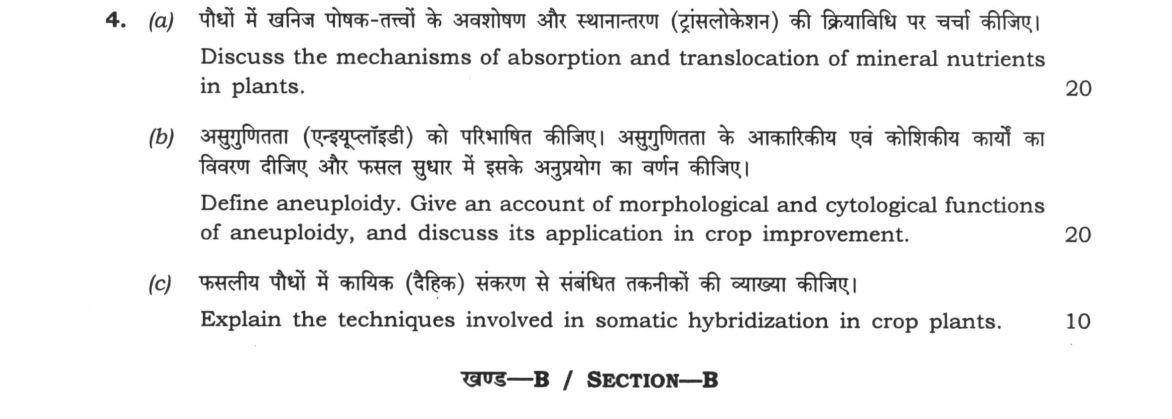
(a) Discuss the mechanisms of absorption and translocation of mineral nutrients in plants. 20 (b) Define aneuploidy. Give an…
Discuss the mechanisms of absorption and translocation of mineral nutrients in plants. 20 marks
Define aneuploidy. Give an account of morphological and cytological functions of aneuploidy, and discuss its application in crop improvement. 20 marks
Explain the techniques involved in somatic hybridization in crop plants. 10 marks
हिंदी में प्रश्न पढ़ें
(क) पौधों में खनिज पोषक-तत्वों के अवशोषण और स्थानांतरण (ट्रांसलोकेशन) की क्रियाविधि पर चर्चा कीजिए। 20
(ख) असुपुंजितता (एन्ड्यूप्लॉइडी) को परिभाषित कीजिए। असुपुंजितता के आकारिकीय एवं कोशिकीय कार्यों का विवरण दीजिए और फसल सुधार में इसके अनुप्रयोग का वर्णन कीजिए। 20
(ग) फसलीय पौधों में कायिक (दैहिक) संकरण से संबंधित तकनीकों की व्याख्या कीजिए। 10
Model answer
Written by UPSC Answer Check against this question's marking rubric, to the expected length. UPSC does not publish answers for Mains — this is one way to score well, not an official key.
Mechanisms of Mineral Nutrition, Aneuploidy, and Somatic Hybridization
Plant productivity is governed by the efficient uptake and distribution of mineral nutrients, the stability of the genetic constitution, and the ability to combine diverse traits through biotechnology. Understanding these physiological and genetic mechanisms is crucial for addressing India’s food security challenges.
Absorption and Translocation of Minerals Mineral absorption occurs via two primary mechanisms: passive and active. Passive absorption involves the movement of ions down their concentration gradient through ion channels or carrier proteins without energy expenditure. Active absorption, however, requires energy (ATP) to move ions against the gradient. This process is driven by H+-ATPase proton pumps that acidify the apoplast, creating an electrochemical gradient. Carrier proteins and channels facilitate the specific uptake of ions like nitrate, potassium, and magnesium.
Once absorbed, nutrients move via apoplastic and symplastic pathways. The apoplastic route involves movement through cell walls and intercellular spaces, while the symplastic route utilizes plasmodesmata for cell-to-cell transport. Translocation to sink tissues occurs primarily through the xylem and phloem. In the xylem, mobile ions like nitrate and potassium move via mass flow driven by transpiration pull. In the phloem, nutrients are translocated according to the pressure-flow hypothesis, where loading at source tissues creates turgor pressure, driving sap flow towards sinks. During senescence, nutrients are remobilized from older leaves to developing seeds, ensuring optimal resource allocation.
Aneuploidy: Definition, Features, and Applications Aneuploidy is defined as a change in chromosome number from the euploid state, specifically involving the gain or loss of individual chromosomes, represented as 2n ± 1, 2n ± 2, etc. It is distinct from polyploidy, which involves whole set changes. Common types include nullisomy (2n-2), monosomy (2n-1), trisomy (2n+1), and tetrasomy (2n+2).
Morphologically, aneuploids often exhibit altered growth patterns. Trisomics may show gigantism or vigor changes due to gene dosage effects, while monosomics can be sterile or have reduced vigor. Cytologically, aneuploidy disrupts meiosis. The presence of an extra or missing chromosome leads to the formation of univalents, which fail to pair properly. This results in chromosome lagging during anaphase and segregation distortion, leading to unbalanced gametes and reduced fertility.
In crop improvement, aneuploidy is a powerful tool for gene mapping and chromosome engineering. Monosomic series, such as those developed in Chinese Spring wheat, allow researchers to identify the chromosomal location of specific genes by observing phenotypic changes in monosomic lines. Trisomics are used to locate genes on specific chromosomes through comparative analysis. Furthermore, aneuploidy is essential in developing addition and substitution lines, where alien chromosomes are introduced into a crop genome to transfer desirable traits like disease resistance. While Triticale is a synthetic allopolyploid, the principles of aneuploidy are applied in stabilizing such hybrids and creating chromosome addition lines in wheat and other cereals at institutions like IARI.
Somatic Hybridization Techniques Somatic hybridization, or somatic cell fusion, enables the combination of genomes from sexually incompatible species. The process begins with protoplast isolation, where plant cells are treated with enzymes like cellulase, pectinase, and hemicellulase to remove the cell wall. The resulting protoplasts are purified using density gradient centrifugation to ensure viability.
Fusion is achieved through chemical or physical methods. Polyethylene glycol (PEG) mediated fusion is common, where PEG induces membrane fusion. Electrofusion uses electric pulses to align protoplasts and facilitate membrane merging. To identify heterokaryons (fused cells), dual fluorescent labeling is employed, using contrasting dyes like FDA (green) and RITC (red) to distinguish the parental contributions. Heterokaryons are selected using marker systems, such as antibiotic resistance or auxotrophy. Finally, the hybrid protoplasts are cultured on regeneration media to induce cell wall formation and plantlet development, resulting in a fertile somatic hybrid.
Conclusion The integration of physiological understanding of nutrient transport, genetic tools like aneuploidy for gene mapping, and biotechnological techniques like somatic hybridization provides a comprehensive framework for crop improvement. For India, leveraging these mechanisms to develop stress-tolerant and high-yielding varieties is essential for sustainable agricultural growth.
What "Discuss" is asking you to do
Lay the issue out from more than one side — how it arose, what is claimed for it, what is held against it, and where it now stands. UPSC attaches discuss to broad topics with several live dimensions, so coverage of the dimensions earns more than the strength of your opinion.
Structure that answers it
Set the issue up → the case as it is made → the case against → the dimension both sides leave out → where the balance now lies
Where marks are lost
Listing facts with no thread between them, or arguing one side throughout and calling it a discussion.
How this answer will be evaluated
Approach
Framework: Concept > Practice or process > Data > Indian application. (a) discuss: intro > 3-4 dimensions > example > balanced close | (b) define: precise definition > the distinguishing feature > one example | (c) explain: definition/context > points in order > small example > short close Full marks: Comprehensive coverage of all mechanisms, effects, and techniques with specific examples and clear distinctions.
Key points expected
- Passive absorption (mass flow, diffusion)
- Active absorption (energy, ion exchange)
- Translocation via xylem (apoplastic pathway)
- Translocation via phloem (symplastic pathway)
- Definition of aneuploidy (2n ± x)
- Morphological effects (e.g., semi-dwarfism)
- Cytological effects (unbalanced gametes)
- Application in crop improvement (e.g., wheat)
Evaluation rubric
Each sub-part is marked on its own, against the marks and word limit printed on the paper.
- (a) Mechanisms of mineral absorption and translocation in plants. 20 marks
discuss— intro → 3-4 dimensions → example → balanced close
Must cover
- Passive absorption (mass flow, diffusion)
- Active absorption (energy, ion exchange)
- Translocation via xylem (apoplastic pathway)
- Translocation via phloem (symplastic pathway)
Loses marks
- Confusing xylem and phloem transport
- Ignoring active transport mechanisms
- Vague description of root uptake
Earns more
- Role of root hairs and mycorrhiza
- Ion exchange mechanism details
- Cation/anion exchange specifics
- Transpiration pull in xylem transport
Extra mark
- Diagram of root hair absorption
- Mention of specific mineral ions (e.g., K+, NO3-)
- (b) Definition, morphological/cytological effects, and crop application of aneuploidy. 20 marks
define— precise definition → the distinguishing feature → one example
Must cover
- Definition of aneuploidy (2n ± x)
- Morphological effects (e.g., semi-dwarfism)
- Cytological effects (unbalanced gametes)
- Application in crop improvement (e.g., wheat)
Loses marks
- Confusing aneuploidy with polyploidy
- Ignoring cytological consequences
- No specific crop application mentioned
Earns more
- Distinction between monosomy and trisomy
- Example of nullisomic lines
- Mention of specific crop varieties
- Link to sterility in aneuploids
Extra mark
- Specific example of wheat aneuploidy
- Mention of B. D. S. Jha or similar researcher
- (c) Techniques involved in somatic hybridization in crop plants. 10 marks
explain— definition/context → points in order → small example → short close
Must cover
- Protoplast isolation (enzymatic)
- Fusion methods (PEG, electrofusion)
- Regeneration of plantlets
- Selection of hybrids
Loses marks
- Skipping protoplast isolation step
- Confusing with sexual hybridization
- No mention of regeneration
Earns more
- Use of PEG (polyethylene glycol)
- Mention of specific crop examples
- Role of culture media
- Verification of hybrid nature
Extra mark
- Diagram of protoplast fusion
- Mention of specific successful hybrid (e.g., Pomato)
Practice this exact question
Write your answer and it is marked point by point against the model answer above — what you covered, what you missed, what you got wrong.
Evaluate my answer →More from Agriculture 2022 Paper II
- Q1 Answer the following questions in about 150 words each: 10×5=50 (a) What is polyploidy? G…
- Q2 (a) Discuss the structure of a plant chromosome and its role in genetic diversity. 20 (b)…
- Q3 (a) What do you mean by mutation? What is the significance of induced mutation in plant b…
- Q4 (a) Discuss the mechanisms of absorption and translocation of mineral nutrients in plants…
- Q5 Answer the following questions in about 150 words each: 10×5=50 (a) Give a detailed accou…
- Q6 (a) Describe the vicious cycle of poverty and enlist the existing policy instruments for…
- Q7 (a) Enlist the different commercial flowers cultivated on a large scale for cut flower tr…