Paper II — Q5
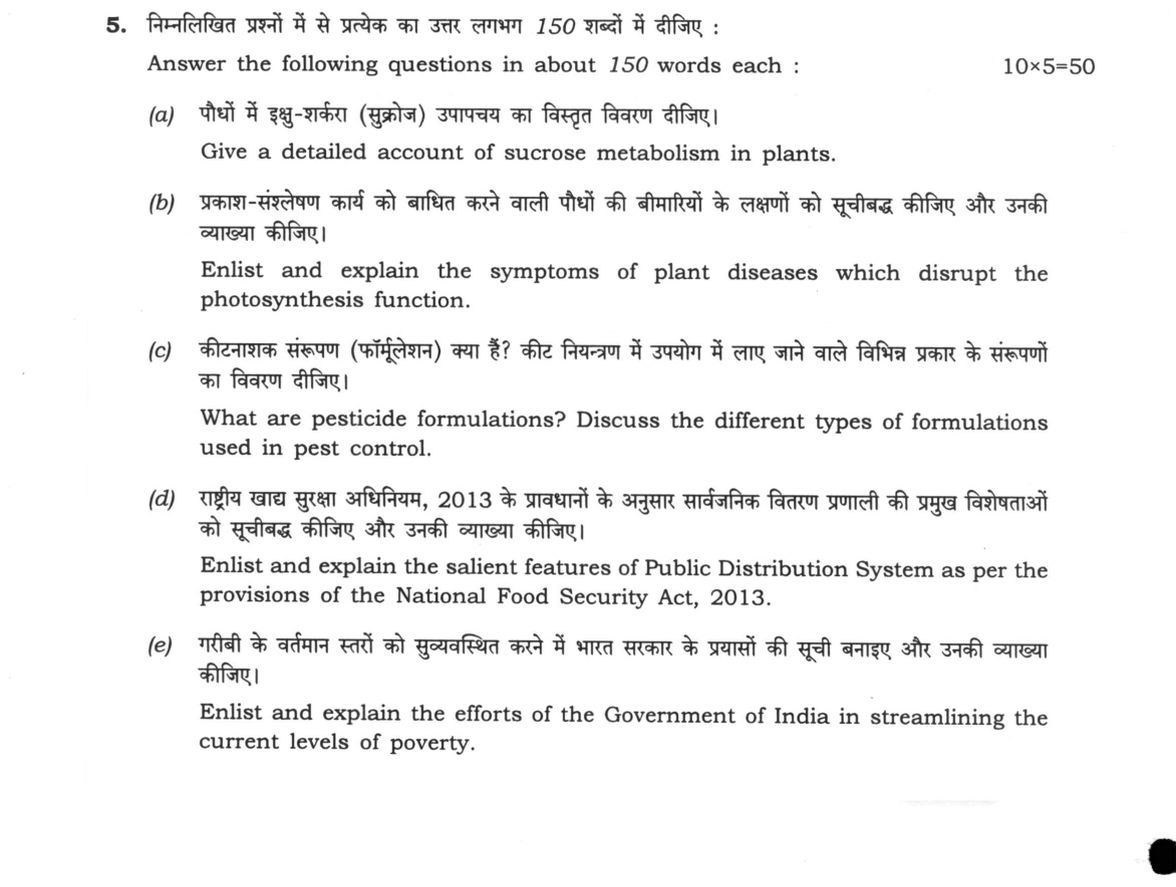
Answer the following questions in about 150 words each: 10×5=50 (a) Give a detailed account of sucrose metabolism in…
Answer the following questions in about 150 words each: 10×5=50
Give a detailed account of sucrose metabolism in plants.
Enlist and explain the symptoms of plant diseases which disrupt the photosynthesis function.
What are pesticide formulations? Discuss the different types of formulations used in pest control.
Enlist and explain the salient features of Public Distribution System as per the provisions of the National Food Security Act, 2013.
Enlist and explain the efforts of the Government of India in streamlining the current levels of poverty.
हिंदी में प्रश्न पढ़ें
निम्नलिखित प्रश्नों में से प्रत्येक का उत्तर लगभग 150 शब्दों में दीजिए : 10×5=50
(क) पौधों में इक्षु-शर्करा (सुक्रोज) उपापचय का विस्तृत विवरण दीजिए।
(ख) प्रकाश-संश्लेषण कार्य को बाधित करने वाली पौधों की बीमारियों के लक्षणों को सूचीबद्ध कीजिए और उनकी व्याख्या कीजिए।
(ग) कीटनाशक संस्करण (फॉर्म्युलेशन) क्या है? कीट नियंत्रण में उपयोग में लाए जाने वाले विभिन्न प्रकार के संस्करणों का विवरण दीजिए।
(घ) राष्ट्रीय खाद्य सुरक्षा अधिनियम, 2013 के प्रावधानों के अनुसार सार्वजनिक वितरण प्रणाली की प्रमुख विशेषताओं को सूचीबद्ध कीजिए और उनकी व्याख्या कीजिए।
(ङ) गरीबी के वर्तमान स्तरों को सुसंगठित करने में भारत सरकार के प्रयासों की सूची बनाइए और उनकी व्याख्या कीजिए।
Model answer
Written by UPSC Answer Check against this question's marking rubric, to the 150-word length. UPSC does not publish answers for Mains — this is one way to score well, not an official key.
(a) Sucrose Metabolism Sucrose metabolism in plants involves its synthesis, transport, and degradation. Synthesis occurs in the cytosol of source tissues, primarily via the sucrose phosphate synthase (SPS) pathway, where UDP-glucose and fructose-6-phosphate combine to form sucrose-6-phosphate, which is then dephosphorylated by sucrose-6-phosphate phosphatase to yield sucrose. This sugar is loaded into the phloem for long-distance transport to sink tissues. In sinks, sucrose is cleaved by invertase (hydrolyzing it into glucose and fructose) or sucrose synthase (converting it to UDP-glucose and fructose). These products fuel respiration, growth, and storage. The balance between SPS and invertase activities regulates the source-sink dynamics, ensuring efficient carbohydrate distribution for plant development.
(b) Photosynthesis-Disrupting Diseases Plant diseases disrupt photosynthesis by physically or chemically impairing leaf function. Leaf spots and blights, caused by fungi like Cercospora or bacteria like Xanthomonas, destroy mesophyll tissue, reducing the effective photosynthetic surface area. Mosaic viruses, such as Tobacco Mosaic Virus, induce chlorosis and necrosis by destroying chlorophyll and disrupting chloroplast ultrastructure, thereby lowering light capture efficiency. Rusts, characterized by uredinia (spore-producing structures), and powdery mildews, which produce superficial mycelia on leaf surfaces, obstruct light penetration and can interfere with gas exchange. Bacterial pathogens like Pseudomonas syringae produce toxins; for instance, phaseolotoxin inhibits ornithine carbamoyltransferase, while coronatine mimics jasmonic acid to promote stomatal opening and chlorosis, indirectly affecting photosynthetic efficiency by altering water status and nutrient flow.
(c) Pesticide Formulations Pesticide formulations are preparations that combine the active ingredient with inert carriers, adjuvants, and solvents to enhance stability, ease of application, and efficacy. They are not necessarily homogeneous; many are heterogeneous mixtures. Key types include Emulsifiable Concentrates (EC), where the active ingredient is dissolved in an organic solvent and emulsified with water; Wettable Powders (WP), which are dry powders that form suspensions in water; Suspension Concentrates (SC), stable liquid suspensions that reduce solvent use; Granules (GR), solid particles for soil application; and Ultra-Low Volume (ULV) formulations, designed for aerial spraying with minimal water. The choice of formulation depends on the target pest, crop sensitivity, and application method, ensuring optimal coverage and minimal environmental impact.
(d) NFSA and PDS Features The National Food Security Act, 2013, mandates the Public Distribution System (PDS) to provide legal entitlement to foodgrains. It covers 75% of the rural and 50% of the urban population. Households are categorized into Priority Households, entitled to 5 kg per person per month, and Antyodaya Anna Yojana (AAY) households, the poorest, entitled to 7 kg per person per month. Subsidized prices are fixed at ₹3, ₹2, and ₹1 per kg for rice, wheat, and coarse cereals, respectively. The Act emphasizes women-headed households by making the eldest woman the primary cardholder, empowering her in ration management. It also establishes a grievance redressal mechanism at district, state, and national levels to ensure accountability and timely delivery of entitled foodgrains, thereby strengthening food security.
(e) Poverty Alleviation Efforts The Government of India has implemented multi-pronged strategies to alleviate poverty. MGNREGA guarantees 100 days of wage employment per year to rural households, providing a safety net and generating rural infrastructure. PM-KISAN provides direct income support of ₹6,000 annually to small and marginal farmers, boosting their purchasing power. The National Social Assistance Programme (NSAP) offers pensions to the elderly, widows, and disabled, ensuring social security for vulnerable groups. Ayushman Bharat provides health insurance coverage of ₹5 lakh per family per year, preventing catastrophic health expenditures that push families into poverty. Additionally, the Skill India Mission, which includes the Pradhan Mantri Kaushal Vikas Yojana (PMKVY), enhances employability by providing skill training, thereby increasing income generation opportunities for the poor.
What "Explain" is asking you to do
Make the working of something clear — what sets it off, what follows from what, and what it produces. Explain is the Commission's mechanism word: it dominates the technical papers and the “explain why” stems, where the marks sit in the causal chain and not in the label.
Structure that answers it
State what it is → the initiating condition → the chain of cause, step by step → an instance where it plays out → what the chain produces
Where marks are lost
Describing what something looks like instead of why it works that way. Naming the stages without linking them reads as description too.
How this answer will be evaluated
Approach
Framework: Concept > Practice or process > Data > Indian application. (a) account for: state the phenomenon > the causes in order of weight > conclusion | (b) explain: definition/context > points in order > small example > short close | (c) discuss: intro > 3-4 dimensions > example > balanced close | (d) explain: definition/context > points in order > small example > short close | (e) explain: definition/context > points in order > small example > short close Full marks: Comprehensive, specific, and well-structured answers with named examples and data.
Key points expected
- Sucrose synthesis via cytosolic pathway
- Sucrose hydrolysis by invertase/sucrase
- Sucrose transport via phloem
- Conversion to starch or cell wall components
- Chlorosis (yellowing of leaves)
- Necrosis (tissue death)
- Leaf drop or defoliation
- Stunted growth or reduced yield
Evaluation rubric
Each sub-part is marked on its own, against the marks and word limit printed on the paper.
- (a) Detailed account of sucrose metabolism in plants. · 150 words
account for— state the phenomenon → the causes in order of weight → conclusion
Must cover
- Sucrose synthesis via cytosolic pathway
- Sucrose hydrolysis by invertase/sucrase
- Sucrose transport via phloem
- Conversion to starch or cell wall components
Loses marks
- Vague description without specific enzymes or pathways
- Confusing sucrose with other sugars (e.g., glucose, fructose)
- Ignoring the role of sucrose in transport
Earns more
- Mention of specific enzymes (e.g., SPS, UDP-glucose pyrophosphorylase)
- Distinction between source and sink tissues
- Role of sucrose in energy storage
Extra mark
- Mention of specific plant species or crop examples
- Reference to specific metabolic pathways (e.g., glycolysis link)
- (b) Symptoms of plant diseases disrupting photosynthesis. · 150 words
explain— definition/context → points in order → small example → short close
Must cover
- Chlorosis (yellowing of leaves)
- Necrosis (tissue death)
- Leaf drop or defoliation
- Stunted growth or reduced yield
Loses marks
- Listing symptoms without linking to photosynthesis disruption
- Vague descriptions (e.g., 'plant looks sick')
- Ignoring the physiological basis of symptoms
Earns more
- Linking symptoms to specific pathogens (e.g., viruses, fungi)
- Mentioning impact on chlorophyll content
- Describing visible signs on leaves or stems
Extra mark
- Naming specific diseases (e.g., mosaic virus, rust)
- Mentioning economic impact on specific crops
- (c) Pesticide formulations and types used in pest control. · 150 words
discuss— intro → 3-4 dimensions → example → balanced close
Must cover
- Definition of pesticide formulation
- Types: Wettable powder (WP), Emulsifiable concentrate (EC)
- Types: Granules (GR), Suspensions (SC)
- Advantages of formulations over technical grade
Loses marks
- Confusing formulation with active ingredient
- Listing types without explaining their use
- Ignoring the purpose of formulation (e.g., stability, application)
Earns more
- Mentioning specific adjuvants or carriers
- Discussing environmental impact of formulations
- Examples of common pesticide formulations
Extra mark
- Mentioning specific regulatory standards for formulations
- Reference to recent trends in formulation technology
- (d) Salient features of PDS under National Food Security Act, 2013. · 150 words
explain— definition/context → points in order → small example → short close
Must cover
- Coverage: 75% rural, 50% urban population
- Entitlement: 5 kg per person per month
- Subsidized prices for food grains
- Role of Fair Price Shops (FPS)
Loses marks
- Confusing PDS with other food security schemes
- Vague description of coverage or entitlements
- Ignoring the legal framework of the Act
Earns more
- Mentioning the role of state governments in implementation
- Discussing the exclusion of the top 25% income group
- Reference to the National Commission for Food Security
Extra mark
- Mentioning specific food grains covered (e.g., rice, wheat, coarse grains)
- Reference to the financial burden on the central government
- (e) Efforts of Government of India in streamlining poverty levels. · 150 words
explain— definition/context → points in order → small example → short close
Must cover
- Direct Benefit Transfer (DBT) schemes
- Mission Antyodaya Yojana (MAY)
- National Rural Livelihoods Mission (NRLM)
- Skill development programs (e.g., Skill India)
Loses marks
- Listing schemes without explaining their impact
- Vague descriptions of government efforts
- Ignoring the multi-dimensional nature of poverty
Earns more
- Mentioning specific targets or outcomes of schemes
- Discussing the role of technology in poverty alleviation
- Reference to recent policy changes or updates
Extra mark
- Mentioning specific state-level initiatives
- Reference to international comparisons or benchmarks
Practice this exact question
Write your answer and it is marked point by point against the model answer above — what you covered, what you missed, what you got wrong.
Evaluate my answer →More from Agriculture 2022 Paper II
- Q2 (a) Discuss the structure of a plant chromosome and its role in genetic diversity. 20 (b)…
- Q3 (a) What do you mean by mutation? What is the significance of induced mutation in plant b…
- Q4 (a) Discuss the mechanisms of absorption and translocation of mineral nutrients in plants…
- Q5 Answer the following questions in about 150 words each: 10×5=50 (a) Give a detailed accou…
- Q6 (a) Describe the vicious cycle of poverty and enlist the existing policy instruments for…
- Q7 (a) Enlist the different commercial flowers cultivated on a large scale for cut flower tr…
- Q8 (a) Enlist the seed spices grown in India. Briefly discuss the cultivation and post-harve…