Paper II — Q1
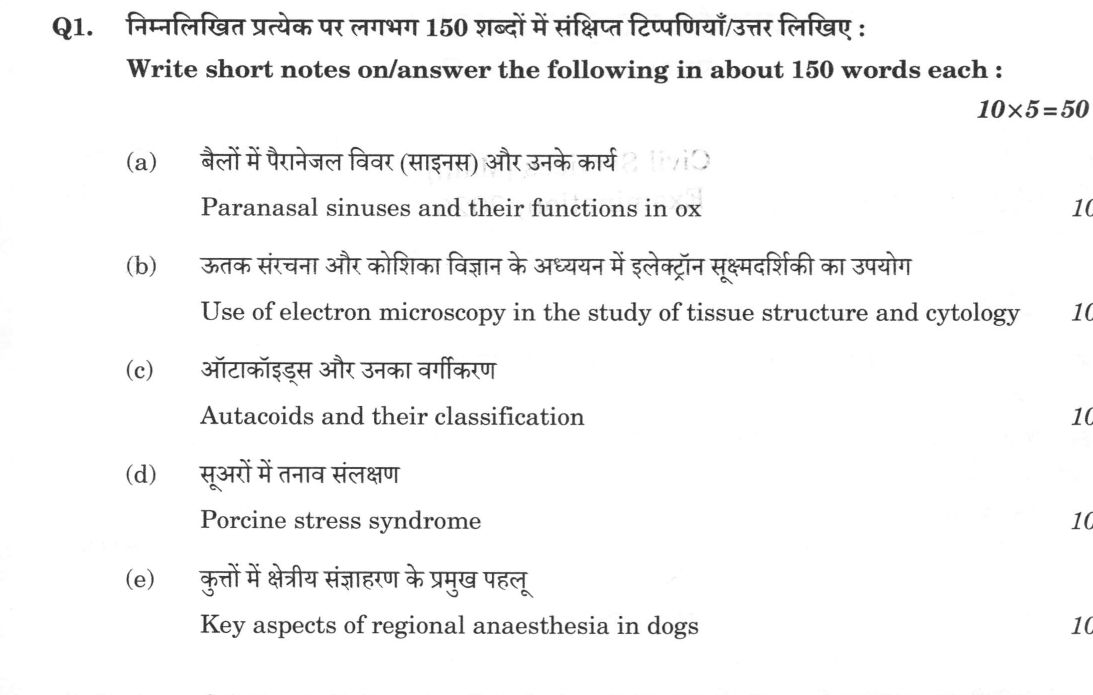
(a) Paranasal sinuses and their functions in ox (10 marks) (b) Use of electron microscopy in the study of tissue structure and…
Write short notes on/answer the following in about 150 words each :
Paranasal sinuses and their functions in ox 10 marks
Use of electron microscopy in the study of tissue structure and cytology 10 marks
Autacoids and their classification 10 marks
Porcine stress syndrome 10 marks
Key aspects of regional anaesthesia in dogs 10 marks
हिंदी में प्रश्न पढ़ें
निम्नलिखित प्रत्येक पर लगभग 150 शब्दों में संक्षिप्त टिप्पणियाँ/उत्तर लिखिए :
बैलों में पैरानेजल विवर (साइनस) और उनके कार्य (10 अंक)
ऊतक संरचना और कोशिका विज्ञान के अध्ययन में इलेक्ट्रॉन सूक्ष्मदर्शिकी का उपयोग (10 अंक)
ऑटाकॉइड्स और उनका वर्गीकरण (10 अंक)
सूअरों में तनाव संलक्षण (10 अंक)
कुत्तों में क्षेत्रीय संज्ञाहरण के प्रमुख पहलू (10 अंक)
Model answer
Drafted with AI by UPSC Answer Check against this question's marking rubric, to the 150-word length. UPSC does not publish answers for Mains — this is one way to score well, not an official key. How we build rubrics and answers.
(a) Paranasal sinuses of the ox and their functions (10 marks)
Paranasal sinuses are air-filled cavities in the skull bones, lined by respiratory mucosa, that open into the nasal cavity. In the ox they are large:
- Frontal sinus: the largest, divided by septa into compartments, extending into the neighbouring bones and, through the cornual diverticulum, into the horn core.
- Maxillary sinus and palatine sinus, which communicate with each other and open into the middle nasal meatus.
- Lacrimal sinus in the lacrimal bone, sphenoidal sinus in the sphenoid, and conchal sinuses in the dorsal and ventral nasal conchae.
Functions:
- Lighten the skull, especially the large frontal region that carries the horns.
- Protect the brain and eyes from shock and trauma, as an air cushion.
- Warm and humidify inspired air, and give thermal insulation to the brain.
- Give resonance to the voice.
Clinically, dehorning opens the frontal sinus, which can lead to sinusitis.
(b) Use of electron microscopy in the study of tissue structure and cytology (10 marks)
An electron microscope uses a beam of electrons, accelerated at 60 to 120 kV, whose very short wavelength (about 0.005 nm) is focused by electromagnetic lenses in a vacuum. It resolves details of about 0.1 to 0.2 nm, against about 200 nm for the light microscope.
- Transmission electron microscopy (TEM): ultrathin sections (50 to 90 nm), fixed in glutaraldehyde and osmium tetroxide, embedded in resin and stained with uranyl acetate and lead citrate, show the internal ultrastructure: membranes, mitochondria, endoplasmic reticulum, Golgi, ribosomes, cell junctions and viruses.
- Scanning electron microscopy (SEM): the surface is coated with gold, and gives a three-dimensional view of the surface of cells and tissues, such as microvilli, cilia, sperm and bacteria.
- Other techniques: negative staining for virus identification, immunogold labelling to locate proteins, and cryo-EM.
Uses include diagnosis (kidney biopsy, storage diseases, muscle and ciliary defects, viral diseases) and research. Limitations are cost, vacuum, and processing artefacts in dead material.
(c) Autacoids and their classification (10 marks)
Autacoids ("self-remedies") are biologically active substances made locally in tissues and cells, which act near their site of production and are short-lived, unlike hormones, which are made in glands and act at a distance. They take part in inflammation, allergy, pain, fever and smooth muscle tone.
Classification:
- Amine autacoids: histamine (from mast cells; H₁ and H₂ actions) and 5-hydroxytryptamine (serotonin).
- Lipid-derived autacoids (from membrane phospholipids): eicosanoids, that is prostaglandins, prostacyclin, thromboxanes and leukotrienes, and platelet-activating factor.
- Polypeptide autacoids: kinins (bradykinin, kallidin), angiotensin, endothelin and substance P.
- Others: nitric oxide and adenosine.
Drugs act on them: antihistamines, NSAIDs (which inhibit cyclooxygenase), 5-HT antagonists, leukotriene inhibitors, ACE inhibitors.
(d) Porcine stress syndrome (10 marks)
Porcine stress syndrome (PSS), or malignant hyperthermia of pigs, is an inherited disorder of heavy-muscled breeds (Pietrain, Landrace, Poland China) in which stress causes a sudden, often fatal, muscle and metabolic crisis.
- Genetic basis: an autosomal recessive mutation in the RYR1 gene (ryanodine receptor 1, the calcium-release channel of the sarcoplasmic reticulum; the Arg615Cys point mutation, the "halothane gene"). Affected pigs are homozygous (nn); carriers are Nn.
- Triggers: transport, mixing, mating, fighting, heat, handling, or halothane anaesthesia. Calcium leaks uncontrollably from the sarcoplasmic reticulum.
- Signs: muscle tremors and rigidity, hyperthermia (above 41 °C), open-mouth breathing, blotchy skin, tachycardia, lactic acidosis, and sudden death.
- Meat: pale, soft, exudative (PSE) pork, from rapid post-mortem glycolysis and a fall of pH while the carcass is warm.
- Diagnosis and control: halothane test and PCR test for the RYR1 mutation, and removal of carriers from breeding; reduce stress and rest pigs before slaughter; cool the affected pig, and give sedatives such as azaperone, or dantrolene.
(e) Key aspects of regional anaesthesia in dogs (10 marks)
Regional anaesthesia is the injection of a local anaesthetic near a nerve or the spinal cord to block sensation in an area, while the dog stays conscious or lightly sedated.
- Mechanism: local anaesthetics (lidocaine, bupivacaine, ropivacaine) block voltage-gated sodium channels and stop conduction.
- Techniques: infiltration and line or ring block, nerve blocks (brachial plexus, dental and infraorbital, mandibular, testicular), epidural (lumbosacral) and intravenous regional anaesthesia.
- Drugs and doses: lidocaine (2%) acts in a few minutes for about 60 to 90 minutes, maximum about 6 mg/kg; bupivacaine (0.5%) acts more slowly but lasts 4 to 6 hours, maximum about 2 mg/kg and never intravenous. Adrenaline prolongs lidocaine, except at end-arteries.
- Precautions: aseptic technique, correct landmarks, aspiration before injection, and avoiding overdose.
- Benefits: pre-emptive, multimodal analgesia, less general anaesthetic needed, and safer in high-risk patients.
- Complications: systemic toxicity (seizures, arrhythmia), nerve injury, haematoma, infection, and hypotension after epidural.
How this answer will be evaluated
Evaluation rubric
Each sub-part is marked on its own, against the marks and word limit printed on the paper.
- (a) (a) Paranasal sinuses of the ox and their functions (10, about 150 words). 10 marks · 150 words
Must cover
- Definition: air-filled cavities in skull bones lined by respiratory mucosa opening into the nasal cavity
- Named sinuses: frontal (largest, extends into the horn core), maxillary, palatine, lacrimal, sphenoid, conchal
- Functions: lighten skull, protect from shock, warm and humidify air, insulate the brain, voice resonance
- Clinical point: dehorning opens the frontal sinus and may cause sinusitis
Loses marks
- Describing sinuses of the horse or dog.
- Functions without any named sinus.
- Over the word limit.
Earns more
- Communication of the sinuses with the nasal meatus.
- Cornual diverticulum.
Extra mark
- Sinus trephination
- (b) (b) Use of electron microscopy in the study of tissue structure and cytology (10, about 150 words). 10 marks · 150 words
Must cover
- Principle: electron beam, short wavelength, electromagnetic lenses, vacuum, resolution about 0.1–0.2 nm
- TEM: ultrathin sections, fixation, staining with heavy metals, internal ultrastructure (organelles, membranes)
- SEM: surface topography of cells and tissues (gold coating)
- Diagnostic and research uses; limitations
Loses marks
- Confusing with light or fluorescence microscopy.
- No mention of TEM and SEM.
- Over the word limit.
Earns more
- Negative staining and immunogold labelling.
- Comparison with light microscope resolution.
Extra mark
- Cryo-EM
- (c) (c) Autacoids and their classification (10, about 150 words). 10 marks · 150 words
Must cover
- Definition: locally produced, short-acting bioactive substances, unlike hormones
- Amines: histamine and 5-HT
- Lipid-derived: prostaglandins, thromboxanes, leukotrienes, PAF
- Polypeptides: kinins (bradykinin), angiotensin, endothelin; drugs acting on them
Loses marks
- Classifying hormones instead.
- Definition without classification.
- Over the word limit.
Earns more
- Roles in inflammation, allergy, pain and smooth muscle tone.
- Other autacoids: nitric oxide, adenosine.
Extra mark
- Antihistamines and NSAIDs as examples of drugs
- (d) (d) Porcine stress syndrome (10, about 150 words). 10 marks · 150 words
Must cover
- Genetic basis: autosomal recessive RYR1 mutation (nn), calcium-release channel defect
- Stress triggers (transport, mixing, handling, halothane)
- Signs: tremors, rigidity, hyperthermia, cyanotic blotches, sudden death; PSE meat
- Diagnosis (halothane test, DNA test) and control (removing carriers, reducing stress)
Loses marks
- Stating dominant inheritance.
- Attributing it to an infectious agent.
- Over the word limit.
Earns more
- Breeds affected (Pietrain, Landrace).
- Treatment (cooling, sedatives, dantrolene).
Extra mark
- Malignant hyperthermia analogy
- (e) (e) Key aspects of regional anaesthesia in dogs (10, about 150 words). 10 marks · 150 words
Must cover
- Definition and mechanism: block of sodium channels near a nerve or the spinal cord
- Techniques: infiltration, line block, nerve blocks, epidural, intravenous regional
- Drugs and doses: lidocaine (6 mg/kg maximum), bupivacaine (2 mg/kg, never intravenous)
- Precautions, benefits (pre-emptive analgesia) and complications (toxicity, nerve injury)
Loses marks
- Dosing cats or humans instead of dogs.
- Intravenous bupivacaine.
- Over the word limit.
Earns more
- Onset and duration of each drug.
- Adrenaline addition.
Extra mark
- Multimodal analgesia
What "Write short notes" is asking you to do
Five or six self-contained answers, marked separately, typically 10 marks and about 150 words each. Each note must carry its own definition, its two or three defining features and a line on why it matters; a common introduction or conclusion across the notes earns nothing.
Structure that answers it
Per note: one-line definition or identification → two or three features, mechanisms or named examples → one line of significance or Indian application
Where marks are lost
Writing the first two notes at essay length and rationing the rest. Each note is marked on its own, so marks surrendered on a compressed or unattempted note cannot be won back by the long ones.
Practice this exact question
Write your answer and it is marked point by point against the model answer above — what you covered, what you missed, what you got wrong.
Evaluate my answer →More from Animal Husbandry & Veterinary Science 2026 Paper II
- Q1 Write short notes on/answer the following in about 150 words each : (a) Paranasal sinuses…
- Q2 (a) Enlist the cranial nerves of bovines. Discuss the origin, distribution and functions…
- Q3 (a) Enlist the major sources of Vitamin A and its deficiency symptoms in newborn calves,…
- Q4 (a) Give a detailed account of the impact of water, air and soil pollution on animal heal…