Paper II — Q2
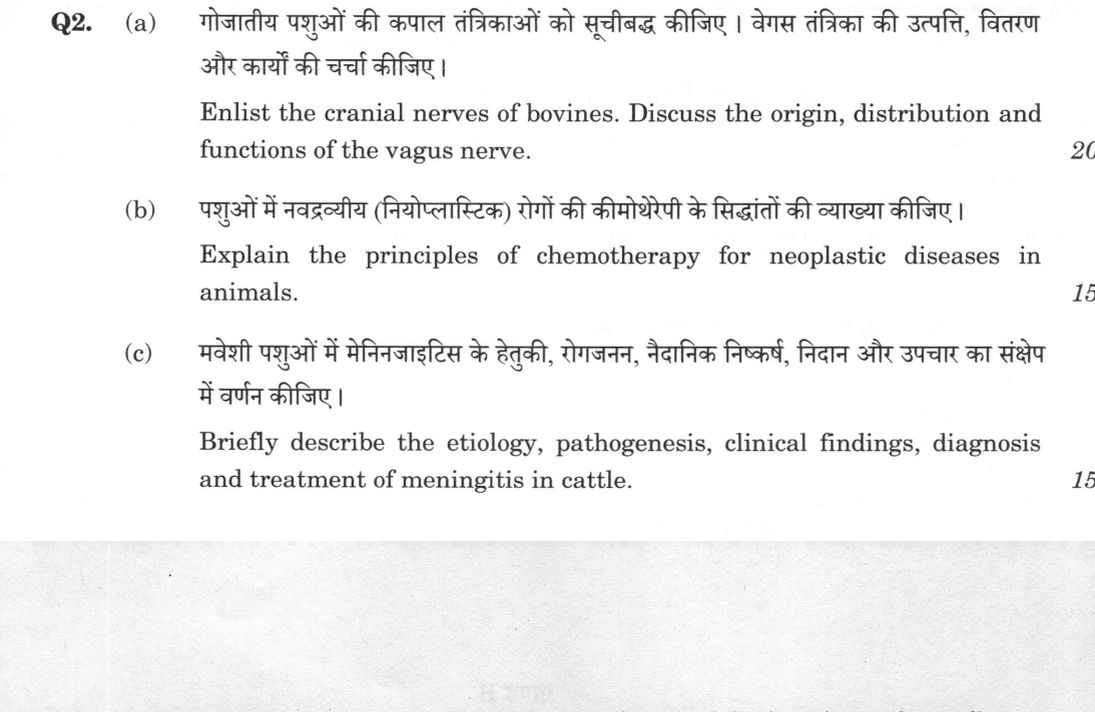
(a) Enlist the cranial nerves of bovines. Discuss the origin, distribution and functions of the vagus nerve. (20 marks) (b)…
Enlist the cranial nerves of bovines. Discuss the origin, distribution and functions of the vagus nerve. 20 marks
Explain the principles of chemotherapy for neoplastic diseases in animals. 15 marks
Briefly describe the etiology, pathogenesis, clinical findings, diagnosis and treatment of meningitis in cattle. 15 marks
हिंदी में प्रश्न पढ़ें
गोजातीय पशुओं की कपाल तंत्रिकाओं को सूचीबद्ध कीजिए । वेगस तंत्रिका की उत्पत्ति, वितरण और कार्यों की चर्चा कीजिए । (20 अंक)
पशुओं में नवद्रव्यीय (नियोप्लास्टिक) रोगों की कीमोथेरेपी के सिद्धांतों की व्याख्या कीजिए । (15 अंक)
मवेशी पशुओं में मेनिनजाइटिस के हेतुकी, रोगजनन, नैदानिक निष्कर्ष, निदान और उपचार का संक्षेप में वर्णन कीजिए । (15 अंक)
Model answer
Drafted with AI by UPSC Answer Check against this question's marking rubric, to the expected length. UPSC does not publish answers for Mains — this is one way to score well, not an official key. How we build rubrics and answers.
(a) Cranial nerves of bovines; origin, distribution and functions of the vagus nerve (20 marks)
Bovines have twelve pairs of cranial nerves:
- I Olfactory (sensory, smell).
- II Optic (sensory, vision).
- III Oculomotor (motor, most eye muscles, pupil constriction and lens accommodation).
- IV Trochlear (motor, dorsal oblique muscle).
- V Trigeminal (mixed; ophthalmic, maxillary and mandibular branches; sensation of the face and motor to the chewing muscles).
- VI Abducens (motor, lateral rectus and retractor bulbi).
- VII Facial (mixed; facial muscles, taste from the tongue front, salivary and lacrimal glands).
- VIII Vestibulocochlear (sensory, hearing and balance).
- IX Glossopharyngeal (mixed; taste and sensation of the tongue back and pharynx, parotid gland).
- X Vagus (mixed, see below).
- XI Accessory (motor, trapezius, sternocephalic and brachiocephalic muscles).
- XII Hypoglossal (motor, tongue muscles).
Vagus nerve:
- Origin: from the lateral surface of the medulla oblongata, caudal to the glossopharyngeal nerve, by several rootlets. Its nuclei are the nucleus ambiguus (motor to the pharynx, larynx and oesophagus), the dorsal motor nucleus (parasympathetic to the viscera), and the nucleus of the tractus solitarius (visceral sensation). It leaves the skull through the jugular foramen.
- Course and distribution: in the neck it runs with the sympathetic trunk as the vagosympathetic trunk beside the common carotid artery. Branches: pharyngeal, cranial laryngeal (with the external branch to the cricothyroid muscle) and the recurrent laryngeal nerve (the left hooks round the aortic arch, the right round the subclavian artery) to the larynx and oesophagus; then cardiac and pulmonary branches in the thorax. The dorsal and ventral vagal trunks accompany the oesophagus through the diaphragm and supply the reticulum, rumen, omasum and abomasum, and also the liver, pancreas, and the small and part of the large intestine, through the coeliac and cranial mesenteric plexuses.
- Functions: motor to the muscles of the pharynx, larynx and oesophagus (swallowing and voice); parasympathetic slowing of the heart, bronchoconstriction, and stimulation of gastrointestinal secretion and motility, including the ruminant forestomach contractions; sensory from the larynx (cough), the pharynx, and the thoracic and abdominal viscera, including baroreceptors, chemoreceptors and stretch receptors of the rumen.
- Clinical: vagal indigestion in cattle (damage to the vagal branches causes forestomach motility failure and distension), and recurrent laryngeal damage.
(b) Principles of chemotherapy for neoplastic diseases in animals (15 marks)
Chemotherapy uses cytotoxic drugs to kill tumour cells while sparing normal ones. Its principles are:
- Log-kill hypothesis: each dose kills a constant fraction of cells, not a fixed number, so repeated cycles are needed to reduce the cell number to a very low level, and cure requires killing every clonogenic cell.
- Growth kinetics: small tumours have a large growth fraction and are most sensitive (Gompertzian growth), so treatment is best begun early or as an adjuvant after surgery or radiotherapy, when little disease remains; bulky tumours respond poorly.
- Cell cycle: some drugs are cell-cycle specific (antimetabolites in S phase, such as methotrexate and cytarabine; vincristine in M phase), while alkylating agents (cyclophosphamide, chlorambucil) and anthracyclines (doxorubicin) and platinum drugs act throughout the cycle.
- Combination chemotherapy: drugs with different mechanisms and different toxicities are combined to raise cell kill and delay resistance, for example CHOP (cyclophosphamide, doxorubicin, vincristine, prednisolone) for canine lymphoma.
- Dose and schedule: doses by body surface area (mg/m²), close to the maximum tolerated, given in cycles with rest periods so normal tissue (marrow, gut) recovers; check the blood count before each dose.
- Drug resistance, which grows with tumour size and treatment; sanctuary sites such as the brain.
- Toxicity monitoring and supportive care: bone marrow suppression, vomiting, alopecia, cardiotoxicity (doxorubicin), haemorrhagic cystitis (cyclophosphamide), and platinum toxicity in cats.
- Safety of staff and owners in handling and disposal of cytotoxic drugs; informed consent; the goals of cure, remission or palliation, with quality of life; and response assessment (complete or partial remission).
(c) Meningitis in cattle: aetiology, pathogenesis, clinical findings, diagnosis and treatment (15 marks)
Meningitis is inflammation of the meninges (the leptomeninges).
Aetiology: mainly bacterial. In calves, it follows septicaemia from Escherichia coli, Salmonella, streptococci and Trueperella pyogenes, with failure of colostrum transfer. In older cattle, Histophilus somni causes thromboembolic meningoencephalitis, and the bacteria may spread from otitis, sinusitis, dehorning wounds or skull injury. Listeria monocytogenes causes encephalitis, and viruses (rabies, bovine herpesvirus) cause encephalitis.
Pathogenesis: bacteria reach the meninges by the blood, or by direct extension. They lodge in the choroid plexus and meninges, and endotoxin and inflammatory mediators increase vascular permeability, giving a purulent exudate in the subarachnoid space, cerebral oedema and raised intracranial pressure, obstruction of the flow of cerebrospinal fluid (CSF), vasculitis and thrombosis, and ischaemia of the brain.
Clinical findings: fever, depression, hyperaesthesia, a stiff neck with the head drawn back (opisthotonos), head pressing, tremors, convulsions, nystagmus, blindness, then recumbency, coma and death. Calves also show signs of septicaemia (navel ill, diarrhoea, joint ill, hypopyon).
Diagnosis: history and signs; CSF analysis (turbid, with high protein, high neutrophil count and low glucose), with culture and sensitivity; blood culture and blood count; the serum immunoglobulin level of calves; and post-mortem histopathology. Differentials are polioencephalomalacia, listeriosis, rabies, lead poisoning and hypomagnesaemia.
Treatment: early, high doses of antibiotics that cross the blood-brain barrier (a third-generation cephalosporin such as ceftiofur, florfenicol, trimethoprim-sulfonamide, or ampicillin) by injection; an anti-inflammatory (flunixin); reduction of brain pressure (mannitol, hypertonic saline); anticonvulsants such as diazepam; fluids and nutrition; and prevention by adequate colostrum and hygiene.
How this answer will be evaluated
Evaluation rubric
Each sub-part is marked on its own, against the marks and word limit printed on the paper.
- (a) (a) Enlist the cranial nerves of bovines; discuss the origin, distribution and functions of the vagus nerve (20). 20 marks
Must cover
- All twelve cranial nerves listed in correct order with their type (sensory, motor, mixed)
- Vagus origin: medulla oblongata, nuclei (nucleus ambiguus, dorsal motor, tractus solitarius), exit by the jugular foramen
- Distribution: vagosympathetic trunk, pharyngeal, laryngeal and recurrent laryngeal, cardiac, pulmonary, dorsal and ventral vagal trunks to the forestomachs, abomasum and abdominal viscera
- Functions: motor to pharynx, larynx and oesophagus; parasympathetic to heart, lungs and gut; visceral sensory; clinical point (vagal indigestion)
Loses marks
- Omitting or misordering cranial nerves.
- Confusing vagus with glossopharyngeal or accessory.
- Functions without the ruminant context.
Earns more
- Recurrent laryngeal course (left around aortic arch).
- Baroreceptor and stretch receptor roles.
Extra mark
- Ruminant forestomach supply
- (b) (b) Explain the principles of chemotherapy for neoplastic diseases in animals (15). 15 marks
Must cover
- Log-kill hypothesis and the need for repeated cycles
- Growth kinetics: early or adjuvant treatment; cell-cycle specific versus non-specific drugs
- Combination therapy (for example CHOP) and dosing by body surface area with rest periods
- Toxicity monitoring, drug resistance, safety in handling, informed consent and aims (remission, palliation)
Loses marks
- Listing drugs without principles.
- Promising cure in all cases.
- Ignoring toxicity and safety.
Earns more
- Named drugs and their toxicities (doxorubicin, cyclophosphamide, cisplatin in cats).
- Response assessment.
Extra mark
- Sanctuary sites
- (c) (c) Briefly describe the etiology, pathogenesis, clinical findings, diagnosis and treatment of meningitis in cattle (15). 15 marks
Must cover
- Aetiology: bacterial (E. coli, Salmonella, streptococci, Histophilus somni, Trueperella pyogenes), failure of colostrum transfer, local extension; also viral
- Pathogenesis: haematogenous or direct spread, inflammation, oedema, raised intracranial pressure, CSF obstruction
- Clinical findings: fever, hyperaesthesia, neck stiffness, opisthotonos, convulsions, blindness, recumbency
- Diagnosis (CSF analysis, culture) and treatment (antibiotics that cross the blood-brain barrier, anti-inflammatory, brain pressure control, supportive care)
Loses marks
- Describing meningitis of humans or small animals.
- Missing any of the five heads.
- Treatment with drugs that do not cross the blood-brain barrier.
Earns more
- Differential diagnoses.
- Prevention with colostrum.
Extra mark
- Immunoglobulin status in calves
What "Discuss" is asking you to do
Lay the issue out from more than one side — how it arose, what is claimed for it, what is held against it, and where it now stands. UPSC attaches discuss to broad topics with several live dimensions, so coverage of the dimensions earns more than the strength of your opinion.
Structure that answers it
Set the issue up → the case as it is made → the case against → the dimension both sides leave out → where the balance now lies
Where marks are lost
Listing facts with no thread between them, or arguing one side throughout and calling it a discussion.
Practice this exact question
Write your answer and it is marked point by point against the model answer above — what you covered, what you missed, what you got wrong.
Evaluate my answer →More from Animal Husbandry & Veterinary Science 2026 Paper II
- Q1 Write short notes on/answer the following in about 150 words each : (a) Paranasal sinuses…
- Q2 (a) Enlist the cranial nerves of bovines. Discuss the origin, distribution and functions…
- Q3 (a) Enlist the major sources of Vitamin A and its deficiency symptoms in newborn calves,…
- Q4 (a) Give a detailed account of the impact of water, air and soil pollution on animal heal…
- Q5 Write short notes on/answer the following in about 150 words each : (a) Role of animals a…