Paper II — Q5
(a) Role of animals and birds in the propagation of zoonotic diseases in humans (10 marks) (b) Preparation and nutritive value…
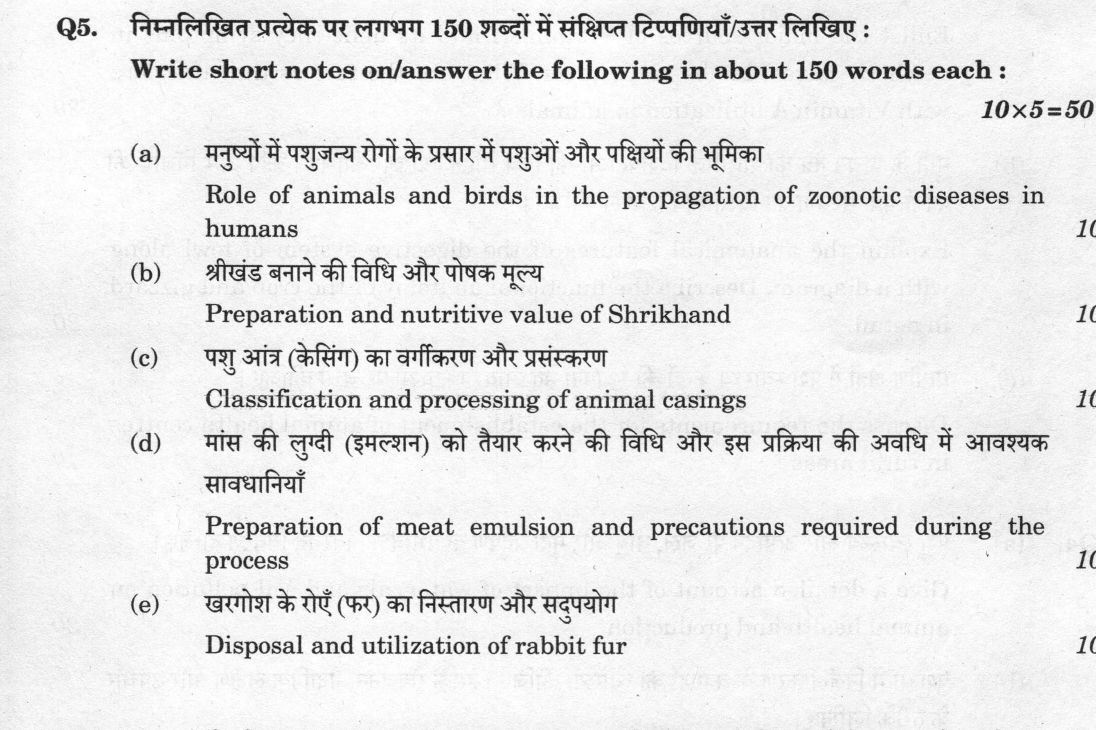
Write short notes on/answer the following in about 150 words each :
Role of animals and birds in the propagation of zoonotic diseases in humans 10 marks
Preparation and nutritive value of Shrikhand 10 marks
Classification and processing of animal casings 10 marks
Preparation of meat emulsion and precautions required during the process 10 marks
Disposal and utilization of rabbit fur 10 marks
हिंदी में प्रश्न पढ़ें
निम्नलिखित प्रत्येक पर लगभग 150 शब्दों में संक्षिप्त टिप्पणियाँ/उत्तर लिखिए :
मनुष्यों में पशुजन्य रोगों के प्रसार में पशुओं और पक्षियों की भूमिका (10 अंक)
श्रीखंड बनाने की विधि और पोषक मूल्य (10 अंक)
पशु आंत्र (केसिंग) का वर्गीकरण और प्रसंस्करण (10 अंक)
मांस की लुग्दी (इमल्शन) को तैयार करने की विधि और इस प्रक्रिया की अवधि में आवश्यक सावधानियाँ (10 अंक)
खरगोश के रोएँ (फर) का निस्तारण और सदुपयोग (10 अंक)
Model answer
Drafted with AI by UPSC Answer Check against this question's marking rubric, to the 150-word length. UPSC does not publish answers for Mains — this is one way to score well, not an official key. How we build rubrics and answers.
(a) Role of animals and birds in the propagation of zoonotic diseases in humans (10 marks)
Animals and birds act as:
- Reservoir hosts, which maintain and shed the agent: dogs (rabies), cattle and buffaloes (brucellosis, bovine tuberculosis, anthrax), rodents (plague, leptospirosis), poultry and wild birds (avian influenza, salmonellosis), bats (Nipah virus) and cats (toxoplasmosis).
- Amplifying hosts, in which the agent multiplies before reaching humans, such as pigs and wading birds in Japanese encephalitis.
- Hosts for vectors that bite humans, such as monkeys and ticks in Kyasanur Forest disease.
Routes of spread to humans:
- Direct contact: bites, scratches, and handling of infected animals, aborted material and carcasses, an occupational risk for farmers, veterinarians and butchers.
- Food: raw milk, and undercooked meat and eggs.
- Inhalation of aerosols and dust from contaminated litter (Q fever, psittacosis).
- Vectors, and water or environment contaminated by urine and faeces.
Crowding, close contact with wildlife, live-animal markets and loss of habitat raise the risk. Control needs One Health cooperation: animal vaccination, pasteurisation, meat inspection and education.
(b) Preparation and nutritive value of Shrikhand (10 marks)
Shrikhand is a traditional Indian sweet made from strained curd (chakka), sugar and flavours.
Preparation:
- Heat skim or standardised milk to about 85 °C and cool to 30 to 32 °C.
- Inoculate with 1 to 2% lactic culture and hold for 12 to 16 hours to make dahi.
- Drain the whey in a muslin bag or with a separator to get chakka.
- Knead the chakka with powdered sugar (about 1 part chakka to 0.8 part sugar) to a smooth mass.
- Add flavours and colour (cardamom, saffron, nutmeg, nuts, or mango pulp for amrakhand), then pack and store at 4 to 5 °C.
FSSAI standards give minimum fat and protein and a maximum sugar level. Shelf life is about a week under refrigeration.
Nutritive value: rich in energy (sugar and fat), milk protein of high biological value, calcium, phosphorus and B vitamins, and lactose is partly reduced by fermentation; live culture may give probiotic benefit. It is high in sugar, so should be eaten in moderation.
(c) Classification and processing of animal casings (10 marks)
Casings are the tubular envelopes that hold sausages.
Classification:
- Natural casings, from the intestines of hog, sheep, goat and cattle (small intestine, large intestine and caecum or "bung") and from stomach and bladder. They are edible and permeable. Sheep casings are narrow (about 16 to 24 mm) and hog casings wider (about 28 to 40 mm).
- Artificial casings: collagen (edible or non-edible), cellulose, fibrous, plastic and alginate, made in uniform sizes.
Processing of natural casings:
- Collect fresh intestines at slaughter; strip the contents, fat and mesentery.
- Wash, and scrape off the mucosa and outer layers (sliming), leaving the strong submucosa.
- Soak, rinse, grade by diameter, length and quality, and test for leaks with air or water.
- Preserve with dry salt or brine, tied in bundles, and store cool.
- Before use, soak in warm water and flush out the salt.
(d) Preparation of meat emulsion and precautions during the process (10 marks)
A meat emulsion is a fine mixture of lean meat, fat and water in which fat globules are coated and held by salt-soluble muscle proteins (myosin, actin), used for sausages, frankfurters and nuggets.
Method:
- Use fresh, chilled meat (0 to 4 °C), trim and grind it.
- Chop the lean meat in a bowl cutter with salt (about 2%), curing salt or nitrite, phosphate and some ice, to extract proteins.
- Add fat, then the remaining ice or cold water, spices and binders (starch, soy).
- Chop to a fine, sticky, uniform paste.
- Stuff into casings or moulds without air pockets.
- Cook until the centre reaches about 70 to 72 °C, then chill.
Precautions:
- Keep the temperature below about 12 to 15 °C during chopping with ice, since heat denatures protein and melts fat, and the emulsion breaks.
- Follow the order of ingredients and correct fat and water levels, and avoid over- or under-chopping.
- Keep equipment clean, and nitrite within the legal limit.
- Cook to a safe core temperature, cool quickly and store cold.
(e) Disposal and utilisation of rabbit fur (10 marks)
Rabbit skin and fur are valuable by-products that should not be wasted.
- Removal: after slaughter and bleeding, the skin is removed as a cylinder (case skinning) starting from the hind legs, and flesh and fat are scraped off.
- Drying: the pelt is turned fur-side in, put on a wire or wooden stretcher and dried in a cool, shaded, ventilated place, not in the sun or near heat; it may be salted.
- Tanning and dressing: soaking, pickling and tanning (chrome or alum), then dressing and dyeing.
- Uses: garments, caps, gloves, collars, trimmings, toys and rugs; short hair for felt in hats; and glue from scraps.
- Angora rabbits give wool, which is sheared or plucked three to four times a year, and spun into yarn.
- Waste skin and trimmings can go for glue, gelatin or manure, and are never left to rot.
How this answer will be evaluated
Evaluation rubric
Each sub-part is marked on its own, against the marks and word limit printed on the paper.
- (a) Explain the role of animals and birds in propagating zoonotic diseases to humans, in about 150 words (10 marks). 10 marks · 150 words
Must cover
- Host roles with named examples: reservoir (dogs-rabies, cattle-brucellosis, bats-Nipah), amplifying (pigs-Japanese encephalitis), vector-hosts (monkeys-KFD)
- Routes: direct contact and bites, food (raw milk, undercooked meat and eggs), aerosols, vectors and contaminated water
- Predisposing factors: crowding, wildlife contact, live-animal markets, habitat loss
- Control through One Health: animal vaccination, pasteurisation, meat inspection, education
Loses marks
- Listing only diseases with no host roles or routes.
- Wrong pairing, e.g. Japanese encephalitis with dogs.
Earns more
- Occupational risk groups named.
- Correct pairing of disease with its animal or bird source.
Extra mark
- Avian influenza or Nipah as emerging zoonoses
- (b) Describe the preparation and nutritive value of Shrikhand, in about 150 words (10 marks). 10 marks · 150 words
Must cover
- Lactic-cultured dahi (1-2% culture, 30-32 °C, 12-16 h) drained to chakka
- Chakka mixed with powdered sugar (about 1:0.8), flavours such as cardamom, saffron, nuts, fruit pulp; packed and kept at 4-5 °C
- Nutritive value: energy, high-quality milk protein, calcium, phosphorus, B vitamins; reduced lactose; probiotic potential
- Note on high sugar and moderate intake, and FSSAI compositional standards
Loses marks
- Making Shrikhand from paneer or khoa.
- Omitting draining of whey or the sugar step.
Earns more
- Sequence of steps given in order.
- Amrakhand as a variant.
Extra mark
- Shelf-life of about a week under refrigeration
- (c) Write on the classification and processing of animal casings, in about 150 words (10 marks). 10 marks · 150 words
Must cover
- Definition: tubular envelopes for sausages
- Classification: natural (hog, sheep, goat, cattle intestine, bung, stomach, bladder) versus artificial (collagen, cellulose, fibrous, plastic, alginate)
- Processing: collect fresh, strip contents and fat, slime (scrape mucosa), retain submucosa, wash
- Grading by diameter and length, leak testing, salting or brining, bundling, cool storage, desalting before use
Loses marks
- Calling the whole intestine wall the finished casing with no scraping step.
- Listing types with no processing.
Earns more
- Sizes of sheep and hog casings.
- Edible versus non-edible distinction.
Extra mark
- Uniformity advantage of artificial casings
- (d) Write on the preparation of meat emulsion and the precautions needed during the process, in about 150 words (10 marks). 10 marks · 150 words
Must cover
- Definition: fine mixture of lean, fat and water stabilised by salt-soluble proteins (myosin, actin)
- Steps: chilled meat, grinding, chopping with salt, nitrite, phosphate and ice, then fat, water, spices and binders, stuffing, cooking
- Temperature control: below about 12-15 °C during chopping, else emulsion breaks
- Other precautions: order of ingredients, fat and water levels, avoiding over-chopping, hygiene, nitrite limit, cook to 70-72 °C core
Loses marks
- Adding fat before extracting proteins with salt.
- No temperature figures or cooking end-point.
Earns more
- Explaining why heat breaks the emulsion.
- Products named (sausage, frankfurter, nugget).
Extra mark
- Vacuum or air-pocket removal during stuffing
- (e) Write on the disposal and utilisation of rabbit fur, in about 150 words (10 marks). 10 marks · 150 words
Must cover
- Case skinning, scraping and shade drying on stretchers
- Tanning and dressing (chrome or alum), dyeing
- Uses: garments, caps, gloves, trimmings, toys, felt; glue from scraps
- Angora wool harvest by shearing or plucking, and use of waste for gelatin or manure
Loses marks
- Sun-drying pelts or drying fur-side out.
- Discarding skin as waste.
Earns more
- Avoiding sun or heat drying.
- Frequency of Angora harvest.
Extra mark
- Salting for temporary preservation
What "Write short notes" is asking you to do
Five or six self-contained answers, marked separately, typically 10 marks and about 150 words each. Each note must carry its own definition, its two or three defining features and a line on why it matters; a common introduction or conclusion across the notes earns nothing.
Structure that answers it
Per note: one-line definition or identification → two or three features, mechanisms or named examples → one line of significance or Indian application
Where marks are lost
Writing the first two notes at essay length and rationing the rest. Each note is marked on its own, so marks surrendered on a compressed or unattempted note cannot be won back by the long ones.
Practice this exact question
Write your answer and it is marked point by point against the model answer above — what you covered, what you missed, what you got wrong.
Evaluate my answer →More from Animal Husbandry & Veterinary Science 2026 Paper II
- Q2 (a) Enlist the cranial nerves of bovines. Discuss the origin, distribution and functions…
- Q3 (a) Enlist the major sources of Vitamin A and its deficiency symptoms in newborn calves,…
- Q4 (a) Give a detailed account of the impact of water, air and soil pollution on animal heal…
- Q5 Write short notes on/answer the following in about 150 words each : (a) Role of animals a…
- Q6 (a) Describe the processing of yoghurt and cultured buttermilk along with flow diagrams.…
- Q7 (a) Describe the procedure for conducting post-mortem examination of a cow in a vetero-le…
- Q8 (a) Differentiate between a service abattoir and a commercial abattoir. Write down the ge…