Paper II — Q8
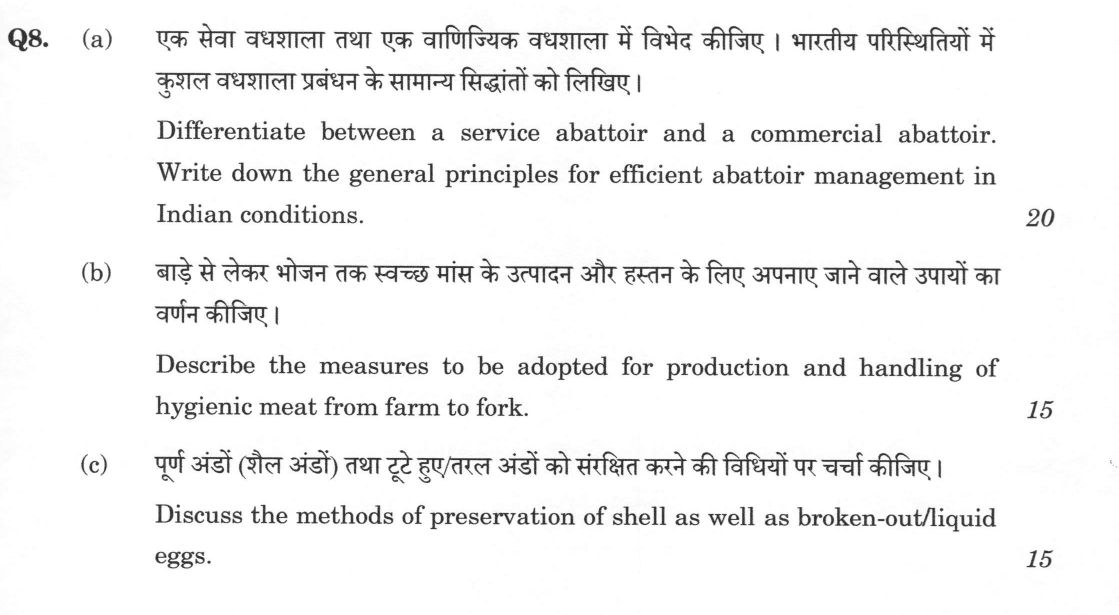
(a) Differentiate between a service abattoir and a commercial abattoir. Write down the general principles for efficient abattoir…
Differentiate between a service abattoir and a commercial abattoir. Write down the general principles for efficient abattoir management in Indian conditions. 20 marks
Describe the measures to be adopted for production and handling of hygienic meat from farm to fork. 15 marks
Discuss the methods of preservation of shell as well as broken-out/liquid eggs. 15 marks
हिंदी में प्रश्न पढ़ें
एक सेवा वधशाला तथा एक वाणिज्यिक वधशाला में विभेद कीजिए । भारतीय परिस्थितियों में कुशल वधशाला प्रबंधन के सामान्य सिद्धांतों को लिखिए। (20 अंक)
बाड़े से लेकर भोजन तक स्वच्छ मांस के उत्पादन और हस्तन के लिए अपनाए जाने वाले उपायों का वर्णन कीजिए। (15 अंक)
पूर्ण अंडों (शैल अंडों) तथा टूटे हुए/तरल अंडों को संरक्षित करने की विधियों पर चर्चा कीजिए। (15 अंक)
Model answer
Drafted with AI by UPSC Answer Check against this question's marking rubric, to the expected length. UPSC does not publish answers for Mains — this is one way to score well, not an official key. How we build rubrics and answers.
(a) Service abattoir versus commercial abattoir, and principles of efficient abattoir management in India (20 marks)
Difference:
- Ownership and purpose: a service abattoir is usually owned by a municipality or local body and only provides slaughter facilities, for a fee, to butchers and meat traders; a commercial abattoir is owned by a private or corporate enterprise that buys the animals and slaughters, processes and sells the meat and by-products.
- Ownership of animals and meat: in the service abattoir the butcher owns the animal and the meat and the abattoir earns only a service charge; in the commercial abattoir the abattoir owns both.
- Scale and technology: the service abattoir is small and often old, serving the local market; the commercial abattoir is larger, mechanised, with chillers, a by-product plant and an effluent treatment plant, and often serves distant markets and exports.
- By-products: usually poorly used in the service abattoir; fully used in the commercial one.
Principles of efficient management in Indian conditions:
- Site and layout: an approved site away from habitation, with potable water, drainage, an approach road and a downwind position; a one-way flow of animals and meat, with clean and dirty areas separated.
- Compliance: licence under FSSAI regulations, the Prevention of Cruelty to Animals (Slaughter House) Rules, 2001, and pollution-control norms.
- Humane and hygienic operation: lairage with rest and water, ante-mortem inspection by a veterinarian, stunning, proper bleeding, dressing without gut contamination, and post-mortem inspection with condemnation of unfit material.
- Cooling and cold chain: chilling of carcasses to about 0 to 4 °C soon after dressing.
- By-product and waste use: hides, blood, bones, fat and offal used through edible and inedible rendering, and effluent treated before disposal.
- Staff and management: trained, medically checked workers with personal hygiene, a HACCP and GMP system, records for traceability, adequate capacity utilisation and modernisation.
(b) Production and handling of hygienic meat from farm to fork (15 marks)
Farm:
- Keep animals healthy through housing, balanced feed, vaccination, deworming and biosecurity, and use only approved drugs with the withdrawal period observed, to avoid residues.
- Keep records of treatment and movement.
- Transport humanely in suitable vehicles at proper density, without overcrowding or injury.
Slaughter:
- Rest the animals with water and withhold feed for about 12 hours, and inspect them before slaughter, rejecting sick animals.
- Stun, bleed completely, and skin and eviscerate quickly without rupturing the gut; use potable water and sterilise knives at about 82 °C.
- Post-mortem inspection of head, viscera and carcass by a veterinarian, with stamping of fit meat and condemnation of the rest.
Post-slaughter:
- Chill carcasses promptly to 0 to 4 °C, and hold and transport chilled or frozen meat at 0 to 4 °C or at -18 °C in refrigerated vehicles, without a break in the cold chain.
- Cut and process in clean rooms, apply GMP and HACCP, separate raw and cooked products, and keep clean packaging, labelling and traceability.
Retail and consumer:
- Keep meat in clean, cold display, use separate boards, and keep hands and equipment clean.
- Cook to a core temperature of at least 70 °C and refrigerate leftovers.
Personnel at all stages need training, health checks and hygiene, and the whole chain works under FSSAI regulation.
(c) Preservation of shell eggs and of broken-out (liquid) eggs (15 marks)
Only clean, fresh, uncracked eggs are worth preserving.
Shell eggs:
- Refrigeration at 0 to 4 °C with about 85 to 90% relative humidity, the standard method, giving weeks to months of storage.
- Oiling with a thin coat of edible mineral oil, which seals the pores and reduces loss of moisture and carbon dioxide.
- Immersion in lime water (about 3% calcium hydroxide) or in water glass (sodium silicate, 1 part in about 10 parts of boiled water), which blocks the pores.
- Thermostabilisation, dipping in hot water at about 96 to 100 °C for a few seconds, or in hot oil, to form a surface seal; in-shell pasteurisation at about 57 °C for a long hold is a variant.
- Storage in a carbon dioxide-enriched atmosphere, or packing in dry ash, sand or bran, as traditional methods.
Liquid eggs:
- Break, filter and pasteurise: whole egg at about 60 to 61 °C for 3.5 to 4 minutes, yolk at about 61 °C, and white at about 55 to 56 °C with acidification, to destroy Salmonella; then chill to 4 °C.
- Freezing at about -18 °C or below; sugar or salt (about 10%) is added to yolk to prevent gelation.
- Drying by spray or pan drying, after removing glucose from the white (by yeast or glucose oxidase) to prevent browning.
How this answer will be evaluated
Evaluation rubric
Each sub-part is marked on its own, against the marks and word limit printed on the paper.
- (a) Two tasks (20 marks; no word limit printed): differentiate a service abattoir from a commercial abattoir, and write the general principles of efficient abattoir management in Indian conditions. 20 marks
Must cover
- Service abattoir: local-body ownership, facility on fee, butcher owns animal and meat, small scale, weak by-product use
- Commercial abattoir: private or corporate, buys and sells, mechanised, chillers, by-product and effluent plants, export potential
- Principles: site and layout with one-way flow, licensing and legal compliance (FSSAI, Slaughter House Rules 2001), humane handling, ante- and post-mortem inspection
- Principles: chilling, by-product use, effluent treatment, trained staff, HACCP and GMP, records and modernisation
Loses marks
- Reversing the two types.
- Giving only a list of slaughter steps as management principles.
Earns more
- Differences given feature by feature rather than as separate descriptions.
- Indian regulatory instruments named.
Extra mark
- Capacity utilisation and modernisation as economic principles
- (b) Describe the measures for production and handling of hygienic meat from farm to fork (15 marks; no word limit printed). 15 marks
Must cover
- Farm: animal health, vaccination, biosecurity, feed safety, drug withdrawal to avoid residues, humane transport
- Slaughter: rest and fasting, ante-mortem inspection, stunning, complete bleeding, dressing without gut rupture, potable water, post-mortem inspection
- Chilling to 0-4 °C and unbroken cold chain (frozen at -18 °C); hygienic processing with GMP and HACCP
- Retail and consumer hygiene, cooking to at least 70 °C core, personnel hygiene, traceability and FSSAI regulation
Loses marks
- Restricting the answer to abattoir operations only.
- Omitting on-farm drug withdrawal and residues.
Earns more
- Stages presented in order from farm to consumer.
- Numerical parameters (temperatures, fasting time) stated.
Extra mark
- Cross-contamination control between raw and cooked products
- (c) Discuss the methods of preservation of shell eggs and of broken-out (liquid) eggs (15 marks; no word limit printed). 15 marks
Must cover
- Shell eggs: refrigeration (0-4 °C, 85-90% RH), oiling, lime water or water glass, thermostabilisation
- Traditional and other methods: CO₂ storage, packing in ash, sand or bran; in-shell pasteurisation
- Liquid eggs: pasteurisation (whole about 60-61 °C for 3.5-4 min, white about 55-56 °C), chilling
- Freezing at -18 °C with sugar or salt for yolk, and drying after glucose removal from white
Loses marks
- Preserving cracked or dirty eggs.
- Confusing water glass with lime water in composition.
Earns more
- Mechanism given (sealing pores, reducing loss of CO₂ and moisture).
- Salmonella as the reason for pasteurisation.
Extra mark
- Quality of egg selected before preservation
What "Differentiate" is asking you to do
Fix the criteria on which the two differ and apply each criterion to both, so the pair can no longer be mixed up. Differentiate stems usually carry a further task attached — describe the mechanism, set out the principles, discuss the applications — and that task carries its own marks.
Structure that answers it
Criterion 1 applied to both → criterion 2 → criterion 3 → summary line or table → the attached second demand answered in full
Where marks are lost
Two standalone definitions placed side by side, leaving the reader to extract the difference. The second common loss is running out of space before the attached task, which is often worth as much as the differentiation.
Practice this exact question
Write your answer and it is marked point by point against the model answer above — what you covered, what you missed, what you got wrong.
Evaluate my answer →More from Animal Husbandry & Veterinary Science 2026 Paper II
- Q5 Write short notes on/answer the following in about 150 words each : (a) Role of animals a…
- Q6 (a) Describe the processing of yoghurt and cultured buttermilk along with flow diagrams.…
- Q7 (a) Describe the procedure for conducting post-mortem examination of a cow in a vetero-le…
- Q8 (a) Differentiate between a service abattoir and a commercial abattoir. Write down the ge…